
‘Echoes of the 1930s’: Brahma Chellaney warns fading US order, China-Russia axis may fuel bloc conflict
For Washington and its allies, these developments signal the rise of an alternative power bloc. Chellaney warned that President Trump’s disruptive foreign policy may be accelerating the shift.
- Sep 7, 2025,
- Updated Sep 7, 2025 2:11 PM IST
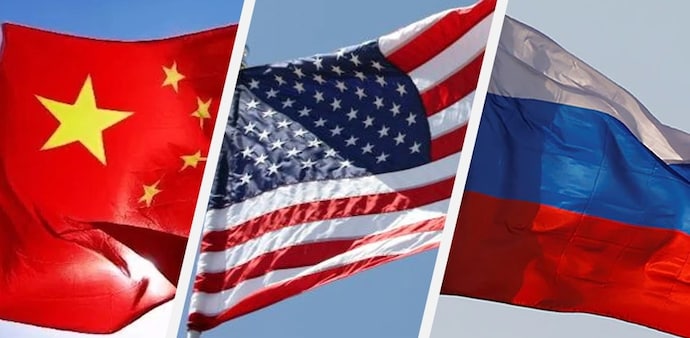
Geostrategist Brahma Chellaney has warned that the American-led post-World War II order is “fading without a clear successor,” raising the risk of the world fracturing into rival geopolitical and economic blocs.
In an editorial for The Hill, Chellaney argued that global power dynamics are shifting, reshaping both security and trade. “The slow decline of the US-led order without the emergence of a stable successor is ushering in a new era — fractured, fiercely contested and dangerously unpredictable,” he wrote.
Two recent events in China underscored this transition: the Shanghai Cooperation Organization (SCO) summit in Tianjin from Aug. 31 to Sept. 1, and Beijing’s Sept. 3 military parade marking the end of World War II. The SCO, dominated by China and Russia, has expanded from a regional forum into a platform for strategic alignment among mostly autocratic states. The parade showcased Chinese military strength before leaders such as Vladimir Putin and Kim Jong-un — what Chellaney described as an “Axis of Upheaval.”
For Washington and its allies, these developments signal the rise of an alternative power bloc. Chellaney warned that President Trump’s disruptive foreign policy may be accelerating the shift: “History could record something else — the corrosion of America’s alliances and partnerships, the erosion of its credibility and the acceleration toward a truly multipolar world.”
Fragmentation is also playing out economically. Once seen as irreversible, globalisation has stalled. Washington now leans on tariffs, sanctions and subsidies, while Beijing promotes yuan-based trade, alternative supply chains and large gold purchases to reduce Western leverage. The result, Chellaney argued, is “not a single global marketplace but a patchwork of rival trading and financial blocs.”
Technology ecosystems are diverging, energy routes are being redrawn, and competing payment systems are emerging. The ripple effects are visible in conflicts disrupting supply chains, energy markets and refugee flows. “This moment echoes the 1930s,” Chellaney wrote, warning that blocs could again harden into confrontation as they did before World War II.
In this fractured landscape, the role of “swing states” will be decisive. A report by the Center for a New American Security identified Brazil, India, Indonesia, Saudi Arabia, South Africa and Turkey as pivotal actors balancing ties with the US, China and Russia. India, the only democracy in the SCO and a member of the Quad, is especially critical in shaping whether the world splits into hostile camps or maintains some pluralism.
Yet Chellaney cautioned that escalating US-China rivalry could erase this middle ground. “If fragmentation hardens into a bipolar structure, the risk of confrontation will rise,” he wrote. Preventing such an outcome, he argued, will require renewed multilateralism, global cooperation on climate, health and technology, and restraint from major powers.
“The lesson of the 20th century,” Chellaney concluded, “is that when trade and politics fracture into competing blocs, confrontation follows. Unless today’s drift is reversed, the coming decade may bring not just the end of globalisation, but the return of bloc-driven conflict.”
Geostrategist Brahma Chellaney has warned that the American-led post-World War II order is “fading without a clear successor,” raising the risk of the world fracturing into rival geopolitical and economic blocs.
In an editorial for The Hill, Chellaney argued that global power dynamics are shifting, reshaping both security and trade. “The slow decline of the US-led order without the emergence of a stable successor is ushering in a new era — fractured, fiercely contested and dangerously unpredictable,” he wrote.
Two recent events in China underscored this transition: the Shanghai Cooperation Organization (SCO) summit in Tianjin from Aug. 31 to Sept. 1, and Beijing’s Sept. 3 military parade marking the end of World War II. The SCO, dominated by China and Russia, has expanded from a regional forum into a platform for strategic alignment among mostly autocratic states. The parade showcased Chinese military strength before leaders such as Vladimir Putin and Kim Jong-un — what Chellaney described as an “Axis of Upheaval.”
For Washington and its allies, these developments signal the rise of an alternative power bloc. Chellaney warned that President Trump’s disruptive foreign policy may be accelerating the shift: “History could record something else — the corrosion of America’s alliances and partnerships, the erosion of its credibility and the acceleration toward a truly multipolar world.”
Fragmentation is also playing out economically. Once seen as irreversible, globalisation has stalled. Washington now leans on tariffs, sanctions and subsidies, while Beijing promotes yuan-based trade, alternative supply chains and large gold purchases to reduce Western leverage. The result, Chellaney argued, is “not a single global marketplace but a patchwork of rival trading and financial blocs.”
Technology ecosystems are diverging, energy routes are being redrawn, and competing payment systems are emerging. The ripple effects are visible in conflicts disrupting supply chains, energy markets and refugee flows. “This moment echoes the 1930s,” Chellaney wrote, warning that blocs could again harden into confrontation as they did before World War II.
In this fractured landscape, the role of “swing states” will be decisive. A report by the Center for a New American Security identified Brazil, India, Indonesia, Saudi Arabia, South Africa and Turkey as pivotal actors balancing ties with the US, China and Russia. India, the only democracy in the SCO and a member of the Quad, is especially critical in shaping whether the world splits into hostile camps or maintains some pluralism.
Yet Chellaney cautioned that escalating US-China rivalry could erase this middle ground. “If fragmentation hardens into a bipolar structure, the risk of confrontation will rise,” he wrote. Preventing such an outcome, he argued, will require renewed multilateralism, global cooperation on climate, health and technology, and restraint from major powers.
“The lesson of the 20th century,” Chellaney concluded, “is that when trade and politics fracture into competing blocs, confrontation follows. Unless today’s drift is reversed, the coming decade may bring not just the end of globalisation, but the return of bloc-driven conflict.”