
Ex-Army Gen warns: 'Assembled in India, controlled abroad - even civilian drones now a threat'
Drones are now potent weapons that can be exploited by state and non-state actors alike, says former major general
- Jul 8, 2025,
- Updated Jul 8, 2025 9:05 PM IST
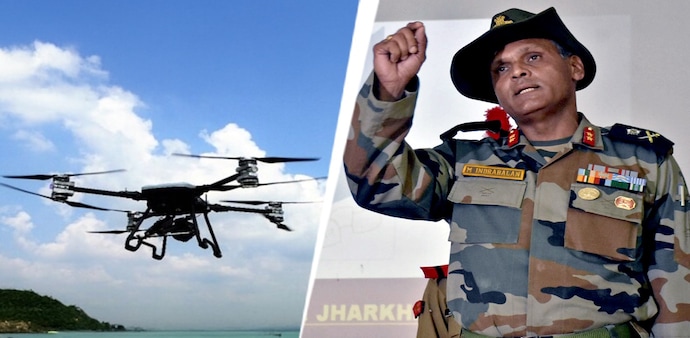
India's growing drone industry may be racing ahead on the civilian front, but it faces serious national security risks that are yet to be fully addressed, warns retired Major General M Indrabalan. In an exclusive interview with Business Today Digital, he cites lessons from the Russia-Ukraine and Iran-Israel conflicts to underline how low-cost drones have evolved into potent offensive tools.
"I don't want to sound alarmist, but it is certainly a matter of concern," says Indrabalan - a Kargil War veteran and a Military Technology Advisor to several drone companies, including IIT Madras incubated ePlane and Amber Wings.
Edited Excerpts
What is your initial assessment of the drone industry in India, and the kind of threat emerging, especially in light of developments in Iran and Russia?
Until recently drones were not seen as an internal security or operational reliability threat. The Operation Sindoor, Russia-Ukraine, and Israel-Iran wars have unfolded the seriousness of the situation. The drone industry in India is expanding rapidly. While the growth of drones for civilian applications - such as wedding photography, travel videography, agriculture, inspections, etc - is a positive development, we must not overlook the emerging risks.
The recent Ukraine-Russia conflict provides a compelling case study. Ukraine managed to infiltrate hundreds of drones into Russian territory - hidden inside container cabins. These were then launched remotely, targeting high-value assets such as strategic bombers. Drones costing a fraction of the value of their targets managed to destroy multi-million-dollar assets. Similarly, during the Iran-Israel escalation, miniature FPV (First-Person View) drones were launched-reportedly smuggled in well before hand-to neutralise key air defence installations. These low-cost drones paved the way for missile and aircraft attacks.
The lesson is clear: drones are now potent weapons that can be exploited by state and non-state actors alike. The recent arrest by the NIA of an individual accused of supplying and training Naxalites in drone operations is an alarming indicator of what lies ahead. The disruptive growth of drone technology and the emanating security risks make it imperative for us to review our policy, process procedures, and systems to match up to the emerging challenges.
Can small civilian drones, like those used in weddings or vlogging, be converted into attack drones?
Absolutely. Civilian drones, including nano drones (weighing less than 250 grams), are highly versatile. Currently, nano drones do not even require type certification under DGCA rules. Anyone can buy one off the shelf. These drones, despite their size, can pose serious surveillance or even kinetic threats.
For instance, a nano drone equipped with a camera can discreetly capture sensitive imagery near strategic locations such as military, petroleum, or nuclear installations without detection, especially when flying below 400 feet. Now imagine loading even a small amount of explosive - say, 100 grams -on such a drone. That's enough to damage a fuel depot, ammunition dump, or gas turbine. Larger drones - 2.5 kg, 10 kg, 25 kg, or even 250 kg - can carry exponentially higher payloads and be modified for more destructive purposes.
In short, yes, even basic civilian drones can be converted into weaponised platforms.
Are our defence forces adequately prepared to counter drone threats, especially if adversaries like China or Pakistan attempt tactics similar to Ukraine's?
During my service until November 2023, drones had not yet emerged as dominant offensive weapons in global warfare. Since then, things have changed dramatically. I can say with confidence that for border-specific threats, our armed forces - particularly during Operation Sindoor - demonstrated effective counter-drone capabilities. No strategic Indian targets were hit by enemy drones during that operation.
However, the question of preparedness against drone threats originating within the country remains uncertain. While border AD (Air Defence) systems are robust, I am not in a position to comment definitively on internal readiness of our security forces, especially against low-cost, smuggled drones used in asymmetric or hybrid warfare if launched from and within the hinterland against high-value military or non-military targets.
The lack of registration, tracking, and drone traffic management is seen by many as a major airspace vulnerability. How serious is the situation?
That is my real concern. India currently has a grossly inadequate tracking and registration mechanism. As per DGCA records, over 34,395 UIN UAS counts, 122 Type Certified, 646 Non-Type Certified (enlisted) and 4989 Non-Type Certified Nano and Model UAS). These numbers are in itself unusual and yet as per my understanding there's no cap on how many drones can be manufactured, imported, or deployed under each certification. If one analyses the importer and manufacturer of these drones, the overwhelming presence of Chinese drones becomes evident. This leaves room for massive exploitation.
Worse, the stated purpose of drone use - often recreational or agricultural - can be falsified. Once type certified, there's no real oversight on the drone's actual use. Anyone with money and intent can build or import large numbers of drones with minimal scrutiny and deploy them for usage other than registered for, without coming under scrutiny until an incident happens.
We urgently need a comprehensive overhaul of the type certification and UIN (Unique Identification Number) issuance processes. As of now, only drones that voluntarily apply for a UIN before a sale are registered. The ones manufactured but not sold need not apply. That is an unacceptable loophole since those drones can fall into the wrong hands and be misused. Further, while Sub Rule 15(4) of Drone Rule 21 mandates electronic identity linkage of drone body UIN to Flight Control Unit and Ground Control Station, the type certifications or UIN documents do not reflect this mandate in the right earnest.
Moreover, DGCA's DigiSky platform, which maps permitted and restricted flying zones, lacks the technological systems and integration needed to detect and track unregistered drones and drones violating flight rules. We need to put in place effective real-time monitoring systems that can identify and flag any drone - certified or not - which enters the airspace and nab the ones that violate. A major AI-driven technology intervention is a must.
You've highlighted that most drones in India are assembled. We don't manufacture critical subsystems. Could you elaborate on this vulnerability?
The most sensitive part of any drone is its electronic core - the autopilot or master flight controller (MFC), navigation module (NM), and command & Communication (C2) systems. These are essentially the "brain" of the drone. Unfortunately, India remains heavily dependent on foreign suppliers-many from countries not aligned with our security interests-for these key components. The autopilot or flight controller (FC) is the most critical of these. A drone is a slave to the FC. Any foreign agency can smartly induce a bug in the FC and exercise remote control over the drone without the owner's knowledge. It's like hacking or cyber attack. Best is the Command and Control or C2 Link. Again it is mostly foreign. The C2 link can be hacked easily by its foreign owner to divert sensitive data or spoof or disable the drone. Likewise, the NU provided the navigation, homing, and flight path. This too can be easily manipulated if these are of foreign origin.
So, in effect, our drones are subservient to foreign players. Even the propulsion system and power systems are currently imported. So, the majority of the drones supplied so far - even to the military - are primarily assembled drones with a large foreign content. Even the military has realised this and is taking expeditionary measures to address the issue. But a truly 100% indigenous drone, especially with core electronic components, is at least 3 to 5 years away, depending on how much weight the government and industry put behind it. The dependency on the import of magnets and battery cells and a few non-sensitive electronic parts is unlikely to change, but is acceptable from the sensitivity angle.
No Indian has successfully indigenised any of these three components till now. But real efforts are on.
How about Indigenisation Content (IC) Policy? Does it cover essential aspects?
True indigenisation must be viewed through a prism of four faces: 1) national security-sensitive components; 2) domestic manufacturing opportunity; 3) long-term R&D and deep-tech innovation; 4) Rare earth materials and chip manufacturing challenges.
However, current procurement policies define indigenisation loosely-often by a flat value percentage like 51% or 60% as per the norms, without specifying which components must be Indian. This leads to misaligned priorities. For instance, agriculture drones may meet the 51% threshold by value, but continue using imported autopilots or radios. This is acceptable for farm use but not for military or strategic applications. The IC must factor indigenisation policies that reflect security priorities, not just economic value.
What immediate policy actions would you recommend?
Firstly, we need a multi-ministerial indigenisation framework. The Ministry of Home Affairs should lead the charge on national security standards, while the Ministry of Defence should frame indigenisation requirements for military use. Other ministries-like Civil Aviation, Agriculture, etc.-can frame their own policies, but without compromising the others' policies.
Second, every RFP (Request for Proposal) -whether from the armed forces or civilian departments-must include component-specific indigenisation mandates, not just a percentage of the overall cost.
Finally, the procurement ecosystem must incentivise R&D-led manufacturing, not just cost-based sourcing. We cannot continue awarding contracts based solely on L1 (lowest bidder) pricing, especially when Chinese drone models like DJI or EFT 610 are available at half the cost of Indian drones, which don't enjoy the same economies of scale.
Should India restrict drone imports from China?
There are two approaches. One is to restrict imports outright. The other, and more sustainable approach, is to create policy incentives for indigenous production and R&D. Restricting imports without building capacity locally will only create supply shortages.
China's scale advantage allows them to dump drones in India at extremely low costs. For example, a DJI drone that sells here for Rs 2 lakhs might cost an Indian company Rs 4.5 lakhs to manufacture without Chinese parts. So naturally, Chinese-origin drones win tenders. This discourages even Indian majors from investing in indigenous development - they'd rather buy cheap and sell to the government.
Thus, we need strategic interventions-whether via tariffs, R&D grants, or preferential procurement - to reverse this trend.
What is the way forward for drone tracking and airspace control?
The current drone tracking infrastructure in India is inadequate. The Digital Sky Verification Engine (DIVE) and the DigiSky portal were created with good intent, but they lack real-time detection and enforcement capabilities. We need a mandatory UIN (Unique Identification Number) registration system for all drones, with automated alerts triggered the moment any unregistered drone attempts to take off. The UIN must be digitally linked with the unique serial numbers of the drone's Main Flight Controller (MFC), Command and Control (C2) module, and Navigation module - similar to how serial identifiers are tied to a motor vehicle or mobile device.
Additionally, drone tracking should be integrated across RF (radio frequency), telecom, and GNSS (Global Navigation Satellite System) networks to enable real-time geofencing and location monitoring. Within the DigiSky platform, a red-flag alert system must be built in to instantly notify authorities if a drone is found flying without the required permissions or deviating from its declared flight path or purpose.
To support compliance and response, stronger enforcement protocols are required. These should involve coordinated actions by local law enforcement agencies, paramilitary units, and airspace control authorities to intercept, investigate, and neutralise rogue or non-compliant drone operations.
Currently, if an unregistered drone flies, it's almost next to impossible to track, since we have a reactive systems that works on incident reporting. This needs a complete overhaul with a huge investment to create an all-encompassing solution like it is done for the aviation industry.
I am also aware that the concerned ministries and the military have realised the seriousness of the matter and have initiated a number of measures to address these concerns and fix the loopholes. The seminar under the Aegis of Integrated Defence Staff being conducted by CENJOWS in Delhi on 16 July is one such commendable effort towards stakeholder involvement in addressing the concerns of indigenisation.
India's growing drone industry may be racing ahead on the civilian front, but it faces serious national security risks that are yet to be fully addressed, warns retired Major General M Indrabalan. In an exclusive interview with Business Today Digital, he cites lessons from the Russia-Ukraine and Iran-Israel conflicts to underline how low-cost drones have evolved into potent offensive tools.
"I don't want to sound alarmist, but it is certainly a matter of concern," says Indrabalan - a Kargil War veteran and a Military Technology Advisor to several drone companies, including IIT Madras incubated ePlane and Amber Wings.
Edited Excerpts
What is your initial assessment of the drone industry in India, and the kind of threat emerging, especially in light of developments in Iran and Russia?
Until recently drones were not seen as an internal security or operational reliability threat. The Operation Sindoor, Russia-Ukraine, and Israel-Iran wars have unfolded the seriousness of the situation. The drone industry in India is expanding rapidly. While the growth of drones for civilian applications - such as wedding photography, travel videography, agriculture, inspections, etc - is a positive development, we must not overlook the emerging risks.
The recent Ukraine-Russia conflict provides a compelling case study. Ukraine managed to infiltrate hundreds of drones into Russian territory - hidden inside container cabins. These were then launched remotely, targeting high-value assets such as strategic bombers. Drones costing a fraction of the value of their targets managed to destroy multi-million-dollar assets. Similarly, during the Iran-Israel escalation, miniature FPV (First-Person View) drones were launched-reportedly smuggled in well before hand-to neutralise key air defence installations. These low-cost drones paved the way for missile and aircraft attacks.
The lesson is clear: drones are now potent weapons that can be exploited by state and non-state actors alike. The recent arrest by the NIA of an individual accused of supplying and training Naxalites in drone operations is an alarming indicator of what lies ahead. The disruptive growth of drone technology and the emanating security risks make it imperative for us to review our policy, process procedures, and systems to match up to the emerging challenges.
Can small civilian drones, like those used in weddings or vlogging, be converted into attack drones?
Absolutely. Civilian drones, including nano drones (weighing less than 250 grams), are highly versatile. Currently, nano drones do not even require type certification under DGCA rules. Anyone can buy one off the shelf. These drones, despite their size, can pose serious surveillance or even kinetic threats.
For instance, a nano drone equipped with a camera can discreetly capture sensitive imagery near strategic locations such as military, petroleum, or nuclear installations without detection, especially when flying below 400 feet. Now imagine loading even a small amount of explosive - say, 100 grams -on such a drone. That's enough to damage a fuel depot, ammunition dump, or gas turbine. Larger drones - 2.5 kg, 10 kg, 25 kg, or even 250 kg - can carry exponentially higher payloads and be modified for more destructive purposes.
In short, yes, even basic civilian drones can be converted into weaponised platforms.
Are our defence forces adequately prepared to counter drone threats, especially if adversaries like China or Pakistan attempt tactics similar to Ukraine's?
During my service until November 2023, drones had not yet emerged as dominant offensive weapons in global warfare. Since then, things have changed dramatically. I can say with confidence that for border-specific threats, our armed forces - particularly during Operation Sindoor - demonstrated effective counter-drone capabilities. No strategic Indian targets were hit by enemy drones during that operation.
However, the question of preparedness against drone threats originating within the country remains uncertain. While border AD (Air Defence) systems are robust, I am not in a position to comment definitively on internal readiness of our security forces, especially against low-cost, smuggled drones used in asymmetric or hybrid warfare if launched from and within the hinterland against high-value military or non-military targets.
The lack of registration, tracking, and drone traffic management is seen by many as a major airspace vulnerability. How serious is the situation?
That is my real concern. India currently has a grossly inadequate tracking and registration mechanism. As per DGCA records, over 34,395 UIN UAS counts, 122 Type Certified, 646 Non-Type Certified (enlisted) and 4989 Non-Type Certified Nano and Model UAS). These numbers are in itself unusual and yet as per my understanding there's no cap on how many drones can be manufactured, imported, or deployed under each certification. If one analyses the importer and manufacturer of these drones, the overwhelming presence of Chinese drones becomes evident. This leaves room for massive exploitation.
Worse, the stated purpose of drone use - often recreational or agricultural - can be falsified. Once type certified, there's no real oversight on the drone's actual use. Anyone with money and intent can build or import large numbers of drones with minimal scrutiny and deploy them for usage other than registered for, without coming under scrutiny until an incident happens.
We urgently need a comprehensive overhaul of the type certification and UIN (Unique Identification Number) issuance processes. As of now, only drones that voluntarily apply for a UIN before a sale are registered. The ones manufactured but not sold need not apply. That is an unacceptable loophole since those drones can fall into the wrong hands and be misused. Further, while Sub Rule 15(4) of Drone Rule 21 mandates electronic identity linkage of drone body UIN to Flight Control Unit and Ground Control Station, the type certifications or UIN documents do not reflect this mandate in the right earnest.
Moreover, DGCA's DigiSky platform, which maps permitted and restricted flying zones, lacks the technological systems and integration needed to detect and track unregistered drones and drones violating flight rules. We need to put in place effective real-time monitoring systems that can identify and flag any drone - certified or not - which enters the airspace and nab the ones that violate. A major AI-driven technology intervention is a must.
You've highlighted that most drones in India are assembled. We don't manufacture critical subsystems. Could you elaborate on this vulnerability?
The most sensitive part of any drone is its electronic core - the autopilot or master flight controller (MFC), navigation module (NM), and command & Communication (C2) systems. These are essentially the "brain" of the drone. Unfortunately, India remains heavily dependent on foreign suppliers-many from countries not aligned with our security interests-for these key components. The autopilot or flight controller (FC) is the most critical of these. A drone is a slave to the FC. Any foreign agency can smartly induce a bug in the FC and exercise remote control over the drone without the owner's knowledge. It's like hacking or cyber attack. Best is the Command and Control or C2 Link. Again it is mostly foreign. The C2 link can be hacked easily by its foreign owner to divert sensitive data or spoof or disable the drone. Likewise, the NU provided the navigation, homing, and flight path. This too can be easily manipulated if these are of foreign origin.
So, in effect, our drones are subservient to foreign players. Even the propulsion system and power systems are currently imported. So, the majority of the drones supplied so far - even to the military - are primarily assembled drones with a large foreign content. Even the military has realised this and is taking expeditionary measures to address the issue. But a truly 100% indigenous drone, especially with core electronic components, is at least 3 to 5 years away, depending on how much weight the government and industry put behind it. The dependency on the import of magnets and battery cells and a few non-sensitive electronic parts is unlikely to change, but is acceptable from the sensitivity angle.
No Indian has successfully indigenised any of these three components till now. But real efforts are on.
How about Indigenisation Content (IC) Policy? Does it cover essential aspects?
True indigenisation must be viewed through a prism of four faces: 1) national security-sensitive components; 2) domestic manufacturing opportunity; 3) long-term R&D and deep-tech innovation; 4) Rare earth materials and chip manufacturing challenges.
However, current procurement policies define indigenisation loosely-often by a flat value percentage like 51% or 60% as per the norms, without specifying which components must be Indian. This leads to misaligned priorities. For instance, agriculture drones may meet the 51% threshold by value, but continue using imported autopilots or radios. This is acceptable for farm use but not for military or strategic applications. The IC must factor indigenisation policies that reflect security priorities, not just economic value.
What immediate policy actions would you recommend?
Firstly, we need a multi-ministerial indigenisation framework. The Ministry of Home Affairs should lead the charge on national security standards, while the Ministry of Defence should frame indigenisation requirements for military use. Other ministries-like Civil Aviation, Agriculture, etc.-can frame their own policies, but without compromising the others' policies.
Second, every RFP (Request for Proposal) -whether from the armed forces or civilian departments-must include component-specific indigenisation mandates, not just a percentage of the overall cost.
Finally, the procurement ecosystem must incentivise R&D-led manufacturing, not just cost-based sourcing. We cannot continue awarding contracts based solely on L1 (lowest bidder) pricing, especially when Chinese drone models like DJI or EFT 610 are available at half the cost of Indian drones, which don't enjoy the same economies of scale.
Should India restrict drone imports from China?
There are two approaches. One is to restrict imports outright. The other, and more sustainable approach, is to create policy incentives for indigenous production and R&D. Restricting imports without building capacity locally will only create supply shortages.
China's scale advantage allows them to dump drones in India at extremely low costs. For example, a DJI drone that sells here for Rs 2 lakhs might cost an Indian company Rs 4.5 lakhs to manufacture without Chinese parts. So naturally, Chinese-origin drones win tenders. This discourages even Indian majors from investing in indigenous development - they'd rather buy cheap and sell to the government.
Thus, we need strategic interventions-whether via tariffs, R&D grants, or preferential procurement - to reverse this trend.
What is the way forward for drone tracking and airspace control?
The current drone tracking infrastructure in India is inadequate. The Digital Sky Verification Engine (DIVE) and the DigiSky portal were created with good intent, but they lack real-time detection and enforcement capabilities. We need a mandatory UIN (Unique Identification Number) registration system for all drones, with automated alerts triggered the moment any unregistered drone attempts to take off. The UIN must be digitally linked with the unique serial numbers of the drone's Main Flight Controller (MFC), Command and Control (C2) module, and Navigation module - similar to how serial identifiers are tied to a motor vehicle or mobile device.
Additionally, drone tracking should be integrated across RF (radio frequency), telecom, and GNSS (Global Navigation Satellite System) networks to enable real-time geofencing and location monitoring. Within the DigiSky platform, a red-flag alert system must be built in to instantly notify authorities if a drone is found flying without the required permissions or deviating from its declared flight path or purpose.
To support compliance and response, stronger enforcement protocols are required. These should involve coordinated actions by local law enforcement agencies, paramilitary units, and airspace control authorities to intercept, investigate, and neutralise rogue or non-compliant drone operations.
Currently, if an unregistered drone flies, it's almost next to impossible to track, since we have a reactive systems that works on incident reporting. This needs a complete overhaul with a huge investment to create an all-encompassing solution like it is done for the aviation industry.
I am also aware that the concerned ministries and the military have realised the seriousness of the matter and have initiated a number of measures to address these concerns and fix the loopholes. The seminar under the Aegis of Integrated Defence Staff being conducted by CENJOWS in Delhi on 16 July is one such commendable effort towards stakeholder involvement in addressing the concerns of indigenisation.