
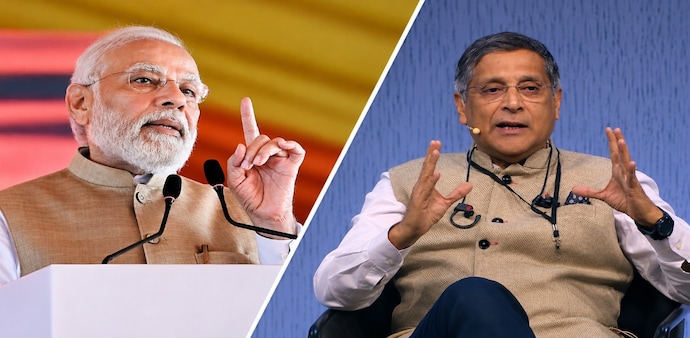
Ex-CEA Arvind Subramanian praises PM Modi's three big achievements, but says India's rise is 'a bit overdone'
Subramanian, who served as Chief Economic Adviser during the first four years of the Modi government, acknowledged the administration's achievements in welfare delivery, infrastructure, and digital technology
- Nov 10, 2026,
- Updated Nov 10, 2026 5:03 PM IST
Former Chief Economic Adviser Arvind Subramanian has questioned the widely held narrative of India as a rising global economic power. He argued that strong headline growth figures mask weaknesses in manufacturing, investor confidence, and the rupee.
"The conventional wisdom, not just within India, all countries have grandiose ambitions for themselves. That's conventional wisdom, but we have to look a bit harder at that question. And my assessment is that it's a bit overdone," he said while speaking at the State of Asia 2026 event.
Don't Miss: Trump loses, rupee gains: How US midterm elections triggered a turnaround in India's currency
The economist said this when asked whether India had succeeded in taking up the China-plus opportunity.
Subramanian, who served as Chief Economic Adviser during the first four years of the Modi government, acknowledged the administration's achievements in welfare delivery, infrastructure and digital technology.
"To be fair to the government, they have two or three really big achievements. One, the welfare system. Mr Modi has overhauled it in ways that now...for example, free grain, bank accounts, toilets, running water etc. are being provided to everyone and increasingly cash transfers," he said. "India is a burgeoning Europe, as it were, with social insurance. Mr Modi has made great progress on that."
He also credited the government with improving physical infrastructure and leveraging digital technology to strengthen India's global standing.
'Serious under-accomplishments' beneath growth numbers
Subramanian said India's strong economic growth figures presented an incomplete picture of the economy.
"The latest World Economic Outlook came out from the IMF, and the headline is 'India powers global growth' because India's headline growth is 7.5% and the next best is three, four, whatever, depending on which country you're looking at. But if you look beneath the headline numbers in this, there are some serious under-accomplishments," he said.
The economist pointed to the rupee's sustained weakness despite India's relatively strong growth. "It's a bit odd when all of you look at these headline numbers. In the last three years, the Indian currency has been under sustained pressure more than almost any emerging market country even before the Iran war began," he said.
"India is of course unusually energy dependent, and the central bank has spent not five, not 10, not 100 but hundreds of billions of dollars defending the currency. And there's a tangible sense of why investors are fleeing India."
The former CEA further said the contrast between India's reported growth and conditions in financial markets deserved greater attention. "What I want to say therefore is that at that level of the headline and the underlying reality there is a dissonance which I think all of us need to be careful about," he said.
Must Read: Poverty down to 3.9%, so why free ration for 80 crore? PM's economic advisor explains
'China Plus One' opportunity remains limited
Turning to the China Plus One strategy, Subramanian said India's biggest success had been attracting Apple's manufacturing operations through Taiwanese contract manufacturer Foxconn.
However, he argued that India had not captured a sufficiently large share of global labour-intensive manufacturing despite its vast workforce.
"Yes, one major success is Apple relocating increasingly into, I should say, Foxconn, in deference to our Taiwanese colleague here, Foxconn has come to India. Apple is increasingly going to locate in India," he said.
"But apart from that, if you look at India's share of low-skill manufacturing exports in the world, it is at about 2.5 to 3% today. India has about 25% of the global labour force amongst developing countries but two, 2.5%."
Subramanian said these figures, combined with pressure on the rupee and his concerns about investor confidence, showed that India's economic achievements should not be viewed in isolation.
"So the whole China Plus One opportunity, the fact that investors don't have confidence in India, they're fleeing, the rupee's under pressure means that it doesn't mean there haven't been accomplishments. It means that that's not the entire story."