
Ex-foreign secretary backs New Delhi's approach on Trump: 'Standing firm now saves greater pain later'
'When you are dealing with somebody who's really a bully, the more you give in, the more will be demanded of you,' says former foreign secretary Shyam Saran
- Oct 28, 2025,
- Updated Oct 28, 2025 5:54 PM IST
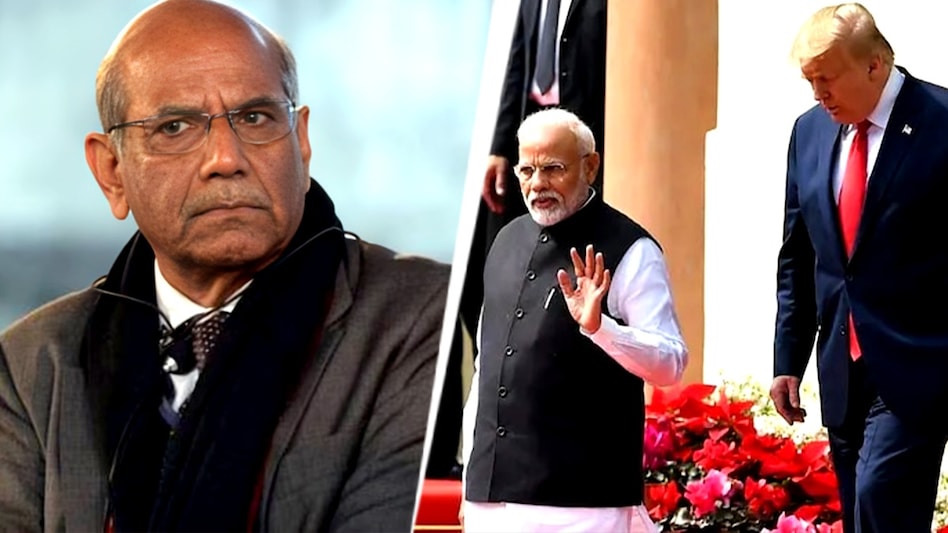
Former Foreign Secretary Shyam Saran has said the India–US relations have entered their lowest phase in 25 years, attributing the strain to Washington's shifting stance toward Pakistan, tightening visa norms, and a "mercurial" U.S. leadership under President Donald Trump. Saran described the current dynamic as a "more challenging situation than we have been in for quite some time."
He pointed out that Trump's renewed warmth toward Pakistan's leadership reflects both personal and strategic motivations. "When the Indians denied him a role in India–Pakistan conflict resolution, Pakistan very happily gave him all the credit," Saran said in an interview with The Wire. "Not only gave him all the credit but gave him what he really wanted, which is a nomination for the Nobel Prize, which India kept completely silent about. So that alone explains quite a great deal in terms of the new kind of bonhomie that you see, particularly with the field marshal in Pakistan."
Saran added that this change could not be dismissed as optics. "There is a shift in the U.S. position with regard to Pakistan, and the fact that Pakistan was not only invited to the Sharm-el-Sheikh conference, the fact that Shehbaz Sharif was asked to speak - all that shows that there is a renewed interest in Pakistan," he said. He suggested that Washington could be seeking access to Bagram airfield in Afghanistan or using Islamabad to keep India "somewhat off balance" while extracting concessions.
On being asked if this is the lowest point in bilateral relations since President Bill Clinton's visit in 2000, Saran replied, "The 25-year upward trajectory of India–US relations has certainly plateaued, if not started declining. How can anybody deny that?"
He noted that the strain extends beyond diplomacy, with Indian-Americans facing greater insecurity in the United States. "I have friends in the U.S. who are feeling very, very insecure. They are feeling fearful. So from a model minority community it has now become a target," he said, linking the change to MAGA-era racism and "greater scrutiny of Indian visa seekers."
Saran pointed to a sharp fall in Indian student interest in U.S. universities. "There has been a 25% to 30% drop or perhaps even more of Indian students wanting to go to American universities. In addition to the political difficulties that we are facing with the U.S. administration, there is at this level also a deeper change taking place," he said.
On India's response to Trump's unpredictable diplomacy, Saran defended New Delhi's approach as pragmatic restraint. "We have to be mindful of the fact that it is not only us who have been finding it very difficult to deal with this unpredictability, this uncertainty, this mercurial nature of this leader," he said. "When you are dealing with somebody who's really a bully, the more you give in, the more will be demanded of you."
Saran added that standing firm was the right long-term choice. "There may be some pain that you would have to suffer in standing up to this, but that prevents you from suffering much greater pain down the road. In not being overtly hostile to the United States or being critical of Trump, by just holding to our red lines - that has perhaps been the right approach."
Responding to comparisons with the UK and Pakistan, who have both courted Trump for tariff relief, Saran argued that India's refusal to pander is a matter of principle. "Of course there is a loss to be suffered, but it is a dynamic situation. The loss you suffer by standing up for your interest today avoids you paying a much greater price in the future," he said.
Recalling India's past independence in foreign policy, Saran added, "We were much weaker in the 60s or 70s - much less capable in economic or military terms - and yet we stood up for our interests. Take, for example, the Non-Proliferation Treaty. We refused to sign it despite huge pressure, and in retrospect, that decision proved to be right. I see no reason why we should abandon that position today."
Former Foreign Secretary Shyam Saran has said the India–US relations have entered their lowest phase in 25 years, attributing the strain to Washington's shifting stance toward Pakistan, tightening visa norms, and a "mercurial" U.S. leadership under President Donald Trump. Saran described the current dynamic as a "more challenging situation than we have been in for quite some time."
He pointed out that Trump's renewed warmth toward Pakistan's leadership reflects both personal and strategic motivations. "When the Indians denied him a role in India–Pakistan conflict resolution, Pakistan very happily gave him all the credit," Saran said in an interview with The Wire. "Not only gave him all the credit but gave him what he really wanted, which is a nomination for the Nobel Prize, which India kept completely silent about. So that alone explains quite a great deal in terms of the new kind of bonhomie that you see, particularly with the field marshal in Pakistan."
Saran added that this change could not be dismissed as optics. "There is a shift in the U.S. position with regard to Pakistan, and the fact that Pakistan was not only invited to the Sharm-el-Sheikh conference, the fact that Shehbaz Sharif was asked to speak - all that shows that there is a renewed interest in Pakistan," he said. He suggested that Washington could be seeking access to Bagram airfield in Afghanistan or using Islamabad to keep India "somewhat off balance" while extracting concessions.
On being asked if this is the lowest point in bilateral relations since President Bill Clinton's visit in 2000, Saran replied, "The 25-year upward trajectory of India–US relations has certainly plateaued, if not started declining. How can anybody deny that?"
He noted that the strain extends beyond diplomacy, with Indian-Americans facing greater insecurity in the United States. "I have friends in the U.S. who are feeling very, very insecure. They are feeling fearful. So from a model minority community it has now become a target," he said, linking the change to MAGA-era racism and "greater scrutiny of Indian visa seekers."
Saran pointed to a sharp fall in Indian student interest in U.S. universities. "There has been a 25% to 30% drop or perhaps even more of Indian students wanting to go to American universities. In addition to the political difficulties that we are facing with the U.S. administration, there is at this level also a deeper change taking place," he said.
On India's response to Trump's unpredictable diplomacy, Saran defended New Delhi's approach as pragmatic restraint. "We have to be mindful of the fact that it is not only us who have been finding it very difficult to deal with this unpredictability, this uncertainty, this mercurial nature of this leader," he said. "When you are dealing with somebody who's really a bully, the more you give in, the more will be demanded of you."
Saran added that standing firm was the right long-term choice. "There may be some pain that you would have to suffer in standing up to this, but that prevents you from suffering much greater pain down the road. In not being overtly hostile to the United States or being critical of Trump, by just holding to our red lines - that has perhaps been the right approach."
Responding to comparisons with the UK and Pakistan, who have both courted Trump for tariff relief, Saran argued that India's refusal to pander is a matter of principle. "Of course there is a loss to be suffered, but it is a dynamic situation. The loss you suffer by standing up for your interest today avoids you paying a much greater price in the future," he said.
Recalling India's past independence in foreign policy, Saran added, "We were much weaker in the 60s or 70s - much less capable in economic or military terms - and yet we stood up for our interests. Take, for example, the Non-Proliferation Treaty. We refused to sign it despite huge pressure, and in retrospect, that decision proved to be right. I see no reason why we should abandon that position today."