
'Turkish drones are not the most sophisticated': Ex-US NSA says Erdogan's support to Pakistan needs close attention
Erdogan has neo-autonomous aspirations, and the kind of support they are offering to Pakistan is something that bears very close attention, says Bolton
- May 21, 2025,
- Updated May 21, 2025 10:11 PM IST
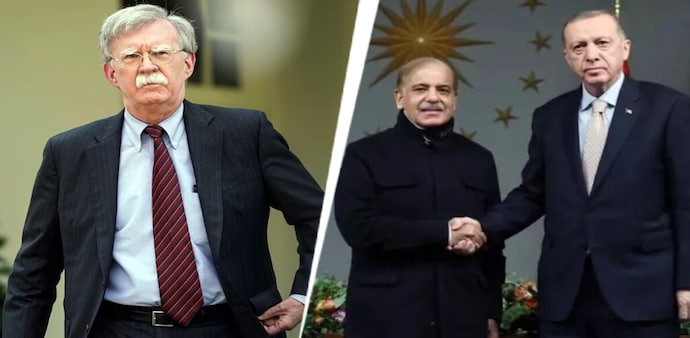
Former US National Security Advisor John Bolton has raised concerns over Turkey's growing military support to Pakistan, saying Ankara's drones are "not the most sophisticated" but their deployment alongside Turkish advisors in recent hostilities with India demands close attention.
"The Erdogan administration has very expansive ambitions around the world. Erdogan has neo-autonomous aspirations, and the kind of support they are offering to Pakistan is something that bears very close attention going forward," Bolton said while speaking to news agency ANI.
Bolton's remarks come days after Indian Army officials confirmed that Pakistan used Turkish drones extensively in its response to India's Operation Sindoor. However, India's defence systems neutralised all the aerial threats from Pakistan.
According to Lieutenant General D’Cunha, Director General of Army Air Defence, Pakistan deployed between 800 to 1000 drones over four days. "All the Unmanned Combat Aerial Vehicles [UCAV] which carried a payload...we ensured that they did not cause any damage,” he told ANI, crediting joint operations by the Indian armed forces for neutralising the threat.
Indian defence sources earlier told India Today that Turkish drone operators and military advisors assisted Pakistan in coordinating the attacks, using platforms like the Bayraktar TB2 and YIHA drones. Two Turkish operatives were reportedly killed during the conflict. "Forensic investigation of the wreckage of the drones is being done. Initial reports suggest that they are Turkish Asisguard Songar drones," Colonel Sofiya Qureshi said during a press briefing.
Experts believe Turkey's ability to mass-produce drones has been enabled in part by Indian exports of raw materials and components such as aluminium, aircraft parts, auto components, and electronics — which have surged post-pandemic. This has added a new layer to the growing strategic alignment between Ankara and Islamabad, raising concerns in Indian security circles.
Bolton also defended India's military response after the Pahalgam terror attack, calling it a legitimate act of self-defence. "India was entitled to act in self-defence against locations inside Pakistan where the terrorist attack was planned and carried out from… India's action was entirely justifiable."
He noted the escalation was more serious than previous flare-ups, such as the 2019 Balakot airstrikes, and flagged the involvement of Chinese military platforms on Pakistan's side. "It signifies the growing Chinese influence inside Pakistan, which increases the threat to India, certainly," he said.
Former US National Security Advisor John Bolton has raised concerns over Turkey's growing military support to Pakistan, saying Ankara's drones are "not the most sophisticated" but their deployment alongside Turkish advisors in recent hostilities with India demands close attention.
"The Erdogan administration has very expansive ambitions around the world. Erdogan has neo-autonomous aspirations, and the kind of support they are offering to Pakistan is something that bears very close attention going forward," Bolton said while speaking to news agency ANI.
Bolton's remarks come days after Indian Army officials confirmed that Pakistan used Turkish drones extensively in its response to India's Operation Sindoor. However, India's defence systems neutralised all the aerial threats from Pakistan.
According to Lieutenant General D’Cunha, Director General of Army Air Defence, Pakistan deployed between 800 to 1000 drones over four days. "All the Unmanned Combat Aerial Vehicles [UCAV] which carried a payload...we ensured that they did not cause any damage,” he told ANI, crediting joint operations by the Indian armed forces for neutralising the threat.
Indian defence sources earlier told India Today that Turkish drone operators and military advisors assisted Pakistan in coordinating the attacks, using platforms like the Bayraktar TB2 and YIHA drones. Two Turkish operatives were reportedly killed during the conflict. "Forensic investigation of the wreckage of the drones is being done. Initial reports suggest that they are Turkish Asisguard Songar drones," Colonel Sofiya Qureshi said during a press briefing.
Experts believe Turkey's ability to mass-produce drones has been enabled in part by Indian exports of raw materials and components such as aluminium, aircraft parts, auto components, and electronics — which have surged post-pandemic. This has added a new layer to the growing strategic alignment between Ankara and Islamabad, raising concerns in Indian security circles.
Bolton also defended India's military response after the Pahalgam terror attack, calling it a legitimate act of self-defence. "India was entitled to act in self-defence against locations inside Pakistan where the terrorist attack was planned and carried out from… India's action was entirely justifiable."
He noted the escalation was more serious than previous flare-ups, such as the 2019 Balakot airstrikes, and flagged the involvement of Chinese military platforms on Pakistan's side. "It signifies the growing Chinese influence inside Pakistan, which increases the threat to India, certainly," he said.