
'False': DK Shivakumar dismisses reports on congestion tax in Bengaluru, says infra projects to ease traffic situation
Reports had claimed that urban planners and transport experts suggested a congestion fee on single-occupancy vehicles, especially along busy stretches such as the Outer Ring Road, to reduce peak-hour traffic.
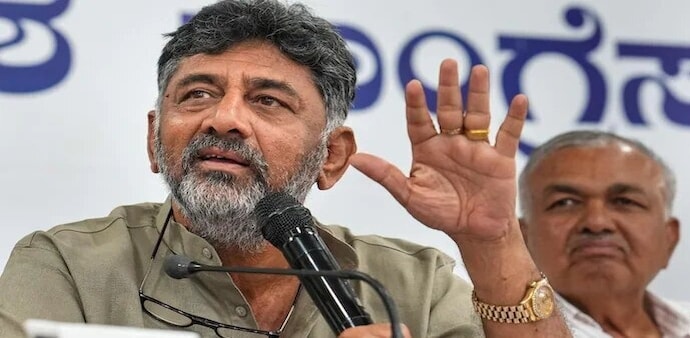
- Oct 1, 2025,
- Updated Oct 1, 2025 2:28 PM IST
Karnataka Deputy Chief Minister DK Shivakumar on Tuesday dismissed reports that the state government is planning to introduce a “congestion tax” in Bengaluru. Reports had claimed that urban planners and transport experts suggested a congestion fee on single-occupancy vehicles, especially along busy stretches such as the Outer Ring Road, to reduce peak-hour traffic.
Speaking to reporters, Shivakumar said there was no proposal before the government.
“All those things are false; there is no such tax or anything. Some industrialists, for the benefit of Bengaluru's citizens, have said that they will give some suggestions, but it has not come to my level,” he was quoted as saying by news agency PTI. He added that citizens' inputs are always welcome but the government is not planning to impose congestion tax.
He further stressed that traffic cannot be managed and curbed by restricting vehicular movement. “We are working on solutions like the peripheral ring road, a 100 km business corridor around the city, express flyovers, tunnels, and even double-decker roads. This will solve the problem,” he added.
Moreover, a study commissioned last year by the Institute for Social and Economic Change (ISEC) had recommended charging between ₹100 and ₹500 on private vehicles entering Bengaluru’s central business district during rush hours. Roads such as MG Road, Brigade Road and Dr Ambedkar Veedhi were identified as possible zones.
The study proposed using satellite or GPS-based Fastag to collect the toll, noting that the idea was not meant to generate revenue but to reduce heavy traffic and discourage single-use private cars. It also suggested that the measure could be tried out on one road first to see if it worked before expanding it elsewhere in the city.
Karnataka Deputy Chief Minister DK Shivakumar on Tuesday dismissed reports that the state government is planning to introduce a “congestion tax” in Bengaluru. Reports had claimed that urban planners and transport experts suggested a congestion fee on single-occupancy vehicles, especially along busy stretches such as the Outer Ring Road, to reduce peak-hour traffic.
Speaking to reporters, Shivakumar said there was no proposal before the government.
“All those things are false; there is no such tax or anything. Some industrialists, for the benefit of Bengaluru's citizens, have said that they will give some suggestions, but it has not come to my level,” he was quoted as saying by news agency PTI. He added that citizens' inputs are always welcome but the government is not planning to impose congestion tax.
He further stressed that traffic cannot be managed and curbed by restricting vehicular movement. “We are working on solutions like the peripheral ring road, a 100 km business corridor around the city, express flyovers, tunnels, and even double-decker roads. This will solve the problem,” he added.
Moreover, a study commissioned last year by the Institute for Social and Economic Change (ISEC) had recommended charging between ₹100 and ₹500 on private vehicles entering Bengaluru’s central business district during rush hours. Roads such as MG Road, Brigade Road and Dr Ambedkar Veedhi were identified as possible zones.
The study proposed using satellite or GPS-based Fastag to collect the toll, noting that the idea was not meant to generate revenue but to reduce heavy traffic and discourage single-use private cars. It also suggested that the measure could be tried out on one road first to see if it worked before expanding it elsewhere in the city.