
From B.R. Ambedkar to Hansa Mehta: Meet the people who helped shape India’s Constitution
Ambedkar, chairman of the Drafting Committee, played a defining role in shaping the final draft, navigating disagreements and presenting and defending its provisions before the Constituent Assembly.
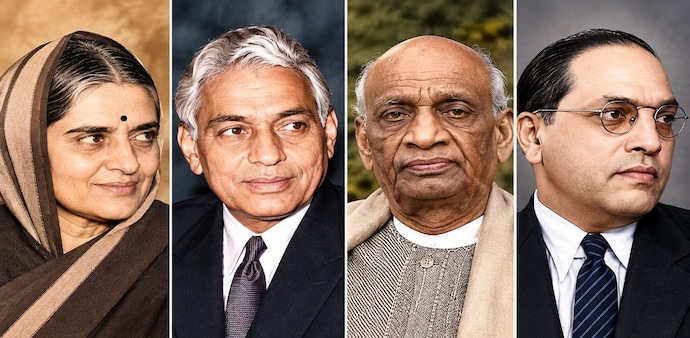
- Nov 26, 2026,
- Updated Nov 26, 2026 1:46 PM IST
Today, November 26, India celebrates Constitution Day, a day that brings back memories of the document that gave independent India its democratic foundation. It is a day to remember the values of justice, liberty, equality and fraternity, and the people who spent years debating what a free India should look like.
The Constitution was adopted by the Constituent Assembly on November 26, 1949, after nearly three years of deliberations. It came into force on January 26, 1950. Constitution Day has been officially observed on November 26 since 2015.
For many Indians, the story of that Constitution begins with one towering figure: Dr B.R. Ambedkar.
And rightly so.
Ambedkar, chairman of the Drafting Committee, played a defining role in shaping the final draft, navigating disagreements and presenting and defending its provisions before the Constituent Assembly.
But the story of India's Constitution is also a story of many people working together.
Some were famous political leaders. Some were constitutional experts. Some worked quietly behind the scenes. There were women members who argued for equality and rights, draftsmen who worked late into the night and Assembly members who debated hundreds of provisions before the country finally had its founding document.
Interestingly, Ambedkar himself acknowledged this in his final speech before the Constitution was adopted.
Ambedkar's own acknowledgement
On November 25, 1949, a day before the Constitution was formally adopted, Ambedkar spoke about the work that had gone into it.
He made it clear that the credit associated with him did not belong to him alone.
He credited B.N. Rau, the Constitutional Adviser who had prepared a rough draft for the Drafting Committee. He also acknowledged the members of the Drafting Committee, who had worked for 141 days, and gave particular credit to S.N. Mukherjee, the Chief Draftsman, for turning complicated proposals into clear legal language.
He also remembered the staff working under Mukherjee, saying they had worked extremely hard, sometimes beyond midnight.
It is a small detail in the grand story of India's Constitution, but perhaps one of the most human ones.
Don't Miss: Sheikh Hasina's planned return to Bangladesh separate from extradition request, says India
Behind the historic document were people working late, arguing over words and trying to get every provision right.
B.N. Rau, the constitutional adviser
Before the Drafting Committee began putting together the final document, B.N. Rau had already done important groundwork.
As Constitutional Adviser to the Constituent Assembly, Rau prepared a rough draft of the Constitution for the Drafting Committee to consider.
That draft did not become the Constitution as it stood. It was part of a much longer process of discussion, revision and debate. But Rau's work provided an important foundation for the committee's subsequent work.
Ambedkar himself acknowledged the contribution of Rau in his November 25 speech.
Nehru and Patel had their own important roles
The making of the Constitution was also closely tied to the work of Jawaharlal Nehru and Sardar Vallabhbhai Patel.
Nehru chaired important committees dealing with the Union Constitution and Union powers. His Objectives Resolution, adopted by the Constituent Assembly in 1947, also laid down principles that would influence the constitutional vision of independent India.
Patel chaired the Advisory Committee on Fundamental Rights, Minorities and Tribal and Excluded Areas, which dealt with questions of rights and safeguards for different communities.
Their work was part of the larger committee system through which the Assembly examined different aspects of the future Constitution.
The people behind the words
One of the lesser-known names in this story is S.N. Mukherjee, the Constitution's Chief Draftsman.
The job required turning complex political decisions and constitutional ideas into precise legal language.
Ambedkar praised Mukherjee's ability to put intricate proposals into simple and clear legal form. He also credited Mukherjee's staff, whose long hours helped bring the document to completion.
The Assembly's records also contain praise for the drafting staff, with members noting how hard they had worked during the final months of the Constitution-making process.
The women who helped shape the new India
There is another part of the story that deserves attention on Constitution Day.
There were 15 women members in the Constituent Assembly.
They included Hansa Mehta, Rajkumari Amrit Kaur, Dakshayani Velayudhan, Sucheta Kripalani, Durgabai Deshmukh and others.
Hansa Mehta, for instance, argued strongly for women's rights and equality during the constitution-making process. She was among the women members who brought questions of gender equality into the Assembly's discussions.
Their presence is an important reminder that the Constitution was not only about creating institutions of government. It was also about deciding what equality, citizenship and rights would mean for people in a newly independent country.
It was never just one person's document
The Constituent Assembly first met on December 9, 1946. Over the next two years and 11 months, its members debated the country's future, worked through committee reports, proposed amendments and voted on provisions.
The Assembly sat for 166 days in total.
That is what makes the Constitution's story so remarkable.
Ambedkar was at the centre of the final drafting process, and his contribution remains one of the defining chapters in India's constitutional history.
But around him was a much larger group of people.
There was Rau preparing the early draft. Nehru and Patel leading important committees. The members of the Drafting Committee wrestling with difficult questions. Women members arguing for equality and rights. Mukherjee and his staff working through the language. And hundreds of Assembly members debating, disagreeing, proposing changes and ultimately voting on the document.
On Constitution Day, that collective effort is worth remembering.
Because the Constitution was more than a document written in the years after Independence.
It was India's attempt to put its hopes for a new nation into words.
And 77 years after its adoption, those words continue to shape the everyday lives of Indians.
That may be the most fitting reason to celebrate November 26: to remember not just the people whose names became famous, but also the many hands, voices and hours of work that helped build the Constitution we inherit today.