
From handi phod to fish campaigns: West Bengal poll battle turns theatrical in this district
In Birbhum district, political messaging has blended with local traditions and everyday life, creating moments that are as much about optics as they are about electoral narratives
- Mar 23, 2026,
- Updated Mar 23, 2026 12:37 PM IST
As West Bengal heads into a crucial Assembly election, campaign strategies on the ground are taking an unconventional turn, with candidates turning to symbolic, highly visual outreach to connect with voters.
In Birbhum district, political messaging has blended with local traditions and everyday life, creating moments that are as much about optics as they are about electoral narratives.
Symbolism and sharp exchanges
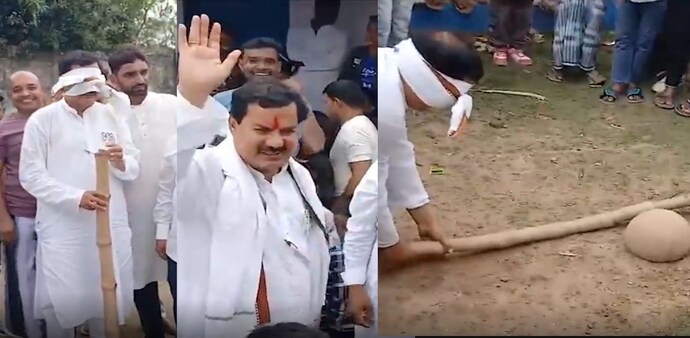
Trinamool Congress candidate from the district, Naresh Chandra Bauri, drew attention during an Eid gathering where he participated in a traditional "handi phod" activity. Blindfolded and attempting to break a suspended pot, Bauri missed the target but used the moment to draw a political parallel, suggesting that the Bharatiya Janata Party would face a similar defeat in the upcoming polls.
The remark drew a swift response from BJP candidate and sitting MLA Anup Kumar Saha, who rejected the comparison and questioned the symbolism. He argued that defeating the BJP would not be possible without a clear vision, accusing his opponent of relying on theatrics rather than substance. Saha added that voters were aware and unlikely to be influenced by such gestures.
Viral outreach and everyday connect
Saha himself became the centre of attention soon after, when a video showing him shaving a villager's beard circulated widely online. The clip, which portrayed him engaging in a familiar, everyday activity, was seen as an attempt to build relatability with voters at the grassroots level.
A similar approach was visible in Bidhannagar, where BJP candidate Dr Shardwata Mukherjee opted for a culturally resonant campaign gesture. While interacting with voters at IA Market in Salt Lake, he was seen holding a 'katla' fish, using it as a symbol to counter claims that a BJP government would restrict consumption of meat, fish and rice.
Mukherjee emphasised the cultural importance of fish in Bengali life, calling it integral to traditions and social customs. He also criticised the current administration, arguing that rising costs had made it difficult for many households to afford basic food items. According to him, improved governance would make such essentials more accessible.
High-stakes contest and party reset
These campaign moments come amid a broader political reset by Chief Minister Mamata Banerjee's Trinamool Congress. The party has undertaken a significant reshuffle, dropping 74 sitting MLAs and fielding a mix of new and experienced candidates to counter anti-incumbency and retain power.
Party leaders have stressed a focus on candidates with strong local presence and organisational depth, signalling a shift away from high-profile faces towards ground-level credibility.
The elections to the 294-member West Bengal Assembly are scheduled for April 23 and 29, setting the stage for an intense contest between the Trinamool Congress and the Bharatiya Janata Party.
As West Bengal heads into a crucial Assembly election, campaign strategies on the ground are taking an unconventional turn, with candidates turning to symbolic, highly visual outreach to connect with voters.
In Birbhum district, political messaging has blended with local traditions and everyday life, creating moments that are as much about optics as they are about electoral narratives.
Symbolism and sharp exchanges
Trinamool Congress candidate from the district, Naresh Chandra Bauri, drew attention during an Eid gathering where he participated in a traditional "handi phod" activity. Blindfolded and attempting to break a suspended pot, Bauri missed the target but used the moment to draw a political parallel, suggesting that the Bharatiya Janata Party would face a similar defeat in the upcoming polls.
The remark drew a swift response from BJP candidate and sitting MLA Anup Kumar Saha, who rejected the comparison and questioned the symbolism. He argued that defeating the BJP would not be possible without a clear vision, accusing his opponent of relying on theatrics rather than substance. Saha added that voters were aware and unlikely to be influenced by such gestures.
Viral outreach and everyday connect
Saha himself became the centre of attention soon after, when a video showing him shaving a villager's beard circulated widely online. The clip, which portrayed him engaging in a familiar, everyday activity, was seen as an attempt to build relatability with voters at the grassroots level.
A similar approach was visible in Bidhannagar, where BJP candidate Dr Shardwata Mukherjee opted for a culturally resonant campaign gesture. While interacting with voters at IA Market in Salt Lake, he was seen holding a 'katla' fish, using it as a symbol to counter claims that a BJP government would restrict consumption of meat, fish and rice.
Mukherjee emphasised the cultural importance of fish in Bengali life, calling it integral to traditions and social customs. He also criticised the current administration, arguing that rising costs had made it difficult for many households to afford basic food items. According to him, improved governance would make such essentials more accessible.
High-stakes contest and party reset
These campaign moments come amid a broader political reset by Chief Minister Mamata Banerjee's Trinamool Congress. The party has undertaken a significant reshuffle, dropping 74 sitting MLAs and fielding a mix of new and experienced candidates to counter anti-incumbency and retain power.
Party leaders have stressed a focus on candidates with strong local presence and organisational depth, signalling a shift away from high-profile faces towards ground-level credibility.
The elections to the 294-member West Bengal Assembly are scheduled for April 23 and 29, setting the stage for an intense contest between the Trinamool Congress and the Bharatiya Janata Party.