
Game-changer for ISRO: This 100% tech transfer deal from Russia could make India a heavy-lift space power
A semi-cryogenic boost could enable heavier payloads to Geosynchronous Transfer Orbit (GTO) and give ISRO the flexibility needed for complex mission design and reusability experiments.
- Dec 5, 2025,
- Updated Dec 5, 2025 5:05 PM IST
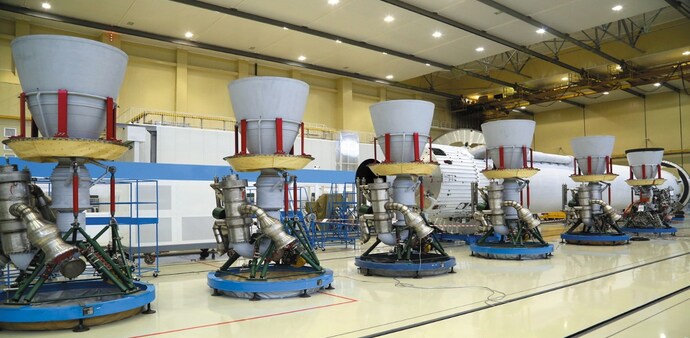
As Russian President Vladimir Putin arrived in India this week, a breakthrough agreement quietly marked one of the most consequential developments for India’s future in space exploration: Moscow has agreed to a 100% transfer of technology for its advanced RD-191M semi-cryogenic rocket engines to the Indian Space Research Organisation (ISRO).
The deal injects momentum into India’s long-standing quest for next-generation propulsion systems, positioning the country to leapfrog into the league of heavy-lift and reusable rocket technologies.
Shift beyond cryogenics
For decades, India’s rockets have relied on cryogenic engines, which operate using ultra-cold liquid hydrogen and liquid oxygen. While powerful, cryogenic systems are technologically demanding and pose major engineering challenges.
In recent years, Indian space scientists have been quietly working on semi-cryogenic engines, which use a simpler and more robust combination: Liquid Oxygen (LOX) and refined kerosene (RP-1). These engines offer higher efficiency and improved performance without the complexities of hydrogen handling.
Why the RD-191M matters
Developed by Russia’s NPO Energomash, the RD-191 series powers the country’s newest Angara rockets, and is globally regarded as one of the most reliable high-thrust semi-cryogenic engines.
The technology transfer brings multiple strategic advantages for India:
- Massive jump in thrust: ISRO’s Vikas engine generates 60-80 tonnes of thrust. The RD-191 delivers 200-220 tonnes, making it two-and-a-half times more powerful.
- Throttleable capability: Unlike India’s current engines, the RD-191 can increase or decrease thrust mid-flight, enabling precision manoeuvres, safer launches, and eventual reuse of rocket stages — an area where India has ambitions but limited experience.
- Global pedigree: Variants such as the RD-181 power the U.S. Antares rocket, while the RD-151 has been used by South Korea, underscoring its reliability and adaptability.
Boost for heavy-lift and deep space missions
India’s heaviest launcher today, the LVM3, uses a mix of solid and cryogenic stages. Upgrading its second stage with an RD-191-derived module would dramatically increase its lift potential.
This enhancement is not just desirable — it is essential. India is preparing for:
- next-generation high-throughput communication satellites,
- future Chandrayaan missions,
- interplanetary expeditions, and
- the Gaganyaan human spaceflight programme.
A semi-cryogenic boost could enable heavier payloads to Geosynchronous Transfer Orbit (GTO) and give ISRO the flexibility needed for complex mission design and reusability experiments.
The transfer marks a significant shift in India-Russia space cooperation — moving beyond launch services to deep technology sharing. For ISRO, it is an opportunity to replace the L110 second stage of the LVM3, and over time, evolve an all-new generation of high-thrust, reusable heavy-lift vehicles.
As Russian President Vladimir Putin arrived in India this week, a breakthrough agreement quietly marked one of the most consequential developments for India’s future in space exploration: Moscow has agreed to a 100% transfer of technology for its advanced RD-191M semi-cryogenic rocket engines to the Indian Space Research Organisation (ISRO).
The deal injects momentum into India’s long-standing quest for next-generation propulsion systems, positioning the country to leapfrog into the league of heavy-lift and reusable rocket technologies.
Shift beyond cryogenics
For decades, India’s rockets have relied on cryogenic engines, which operate using ultra-cold liquid hydrogen and liquid oxygen. While powerful, cryogenic systems are technologically demanding and pose major engineering challenges.
In recent years, Indian space scientists have been quietly working on semi-cryogenic engines, which use a simpler and more robust combination: Liquid Oxygen (LOX) and refined kerosene (RP-1). These engines offer higher efficiency and improved performance without the complexities of hydrogen handling.
Why the RD-191M matters
Developed by Russia’s NPO Energomash, the RD-191 series powers the country’s newest Angara rockets, and is globally regarded as one of the most reliable high-thrust semi-cryogenic engines.
The technology transfer brings multiple strategic advantages for India:
- Massive jump in thrust: ISRO’s Vikas engine generates 60-80 tonnes of thrust. The RD-191 delivers 200-220 tonnes, making it two-and-a-half times more powerful.
- Throttleable capability: Unlike India’s current engines, the RD-191 can increase or decrease thrust mid-flight, enabling precision manoeuvres, safer launches, and eventual reuse of rocket stages — an area where India has ambitions but limited experience.
- Global pedigree: Variants such as the RD-181 power the U.S. Antares rocket, while the RD-151 has been used by South Korea, underscoring its reliability and adaptability.
Boost for heavy-lift and deep space missions
India’s heaviest launcher today, the LVM3, uses a mix of solid and cryogenic stages. Upgrading its second stage with an RD-191-derived module would dramatically increase its lift potential.
This enhancement is not just desirable — it is essential. India is preparing for:
- next-generation high-throughput communication satellites,
- future Chandrayaan missions,
- interplanetary expeditions, and
- the Gaganyaan human spaceflight programme.
A semi-cryogenic boost could enable heavier payloads to Geosynchronous Transfer Orbit (GTO) and give ISRO the flexibility needed for complex mission design and reusability experiments.
The transfer marks a significant shift in India-Russia space cooperation — moving beyond launch services to deep technology sharing. For ISRO, it is an opportunity to replace the L110 second stage of the LVM3, and over time, evolve an all-new generation of high-thrust, reusable heavy-lift vehicles.