
‘Good part is...’: CDS Chauhan hints at jet loss in Operation Sindoor, dismisses Pak claim of downing 6 planes
Chauhan said India responded swiftly after identifying the error. “The good part is that we are able to understand the tactical mistake which we made, remedy it, rectify it, and then implement it again after two days and flew all our jets again, targeting at long range.”
- May 31, 2025,
- Updated May 31, 2025 3:09 PM IST
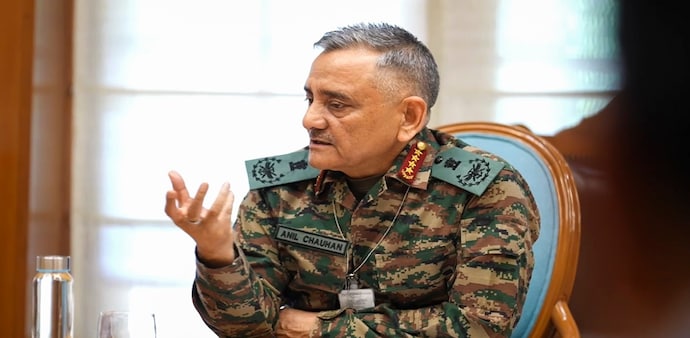
India’s Chief of Defence Staff General Anil Chauhan has pushed back against Pakistan's inflated claims of downing six fighter jets and refocused the conversation on critical military lessons.
Speaking to Bloomberg TV on the sidelines of the Shangri-La Dialogue in Singapore, Chauhan dismissed Pakistan’s assertion of downing six Indian jets as “absolutely incorrect” and emphasised that the real priority was understanding what went wrong — not just how many jets went down. The conflict, he clarified, never edged towards a nuclear confrontation.
“What is important is that, not the jet being down, but why they were being down,” Chauhan said on the sidelines of the regional security summit.
“Why they were down, what mistakes were made — that are important,” he continued. “Numbers are not important.”
Chauhan said India responded swiftly after identifying the error. “The good part is that we are able to understand the tactical mistake which we made, remedy it, rectify it, and then implement it again after two days and flew all our jets again, targeting at long range.”
At the forum, Chauhan provided deeper insight into Operation Sindoor — calling it a “non-contact” and “multi-domain” mission. He said the operation leaned heavily on cyber tools, intelligence, and disinformation management, all while coordinating complex actions across land, air, sea, and cyberspace.
He explained this strategy reflects a broader shift in warfare. “Modern warfare is undergoing a complex convergence of tactical, operational and strategic layers; old and new domains (land, air, sea, cyber and space); and even of time and space,” Chauhan said, as quoted by ANI.
In discussions with global think tanks, he underlined India’s commitment to modernising its military doctrine, stressing the role of joint operations, technology, and narrative control — elements he said were evident in Operation Sindoor.
India’s Chief of Defence Staff General Anil Chauhan has pushed back against Pakistan's inflated claims of downing six fighter jets and refocused the conversation on critical military lessons.
Speaking to Bloomberg TV on the sidelines of the Shangri-La Dialogue in Singapore, Chauhan dismissed Pakistan’s assertion of downing six Indian jets as “absolutely incorrect” and emphasised that the real priority was understanding what went wrong — not just how many jets went down. The conflict, he clarified, never edged towards a nuclear confrontation.
“What is important is that, not the jet being down, but why they were being down,” Chauhan said on the sidelines of the regional security summit.
“Why they were down, what mistakes were made — that are important,” he continued. “Numbers are not important.”
Chauhan said India responded swiftly after identifying the error. “The good part is that we are able to understand the tactical mistake which we made, remedy it, rectify it, and then implement it again after two days and flew all our jets again, targeting at long range.”
At the forum, Chauhan provided deeper insight into Operation Sindoor — calling it a “non-contact” and “multi-domain” mission. He said the operation leaned heavily on cyber tools, intelligence, and disinformation management, all while coordinating complex actions across land, air, sea, and cyberspace.
He explained this strategy reflects a broader shift in warfare. “Modern warfare is undergoing a complex convergence of tactical, operational and strategic layers; old and new domains (land, air, sea, cyber and space); and even of time and space,” Chauhan said, as quoted by ANI.
In discussions with global think tanks, he underlined India’s commitment to modernising its military doctrine, stressing the role of joint operations, technology, and narrative control — elements he said were evident in Operation Sindoor.