
Headed for India in the 1500s, uncovered by diamond miners in 2008: The remarkable story of the Bom Jesus
The Bom Jesus was a Portuguese carrack, a large sailing ship built for long-distance voyages.
- Aug 4, 2026,
- Updated Aug 4, 2026 7:30 AM IST
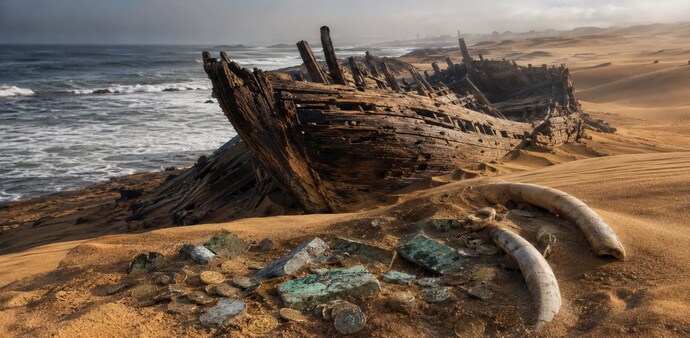
A ship that disappeared nearly 500 years ago while sailing from Portugal to India has resurfaced in one of the world's most unlikely places — beneath the sands of Namibia's Skeleton Coast. Buried for centuries and uncovered during diamond mining, the wreck of the Bom Jesus has revealed a treasure trove of gold, copper, ivory and thousands of coins, giving historians a rare look at Portugal's early global trade routes, according to a report by The Economic Times.
Discovered during diamond mining
The discovery was made in 2008 near Oranjemund, along Namibia's remote Atlantic coastline, where the Namib Desert meets the sea. During routine diamond mining operations, workers uncovered the remains of an old wooden ship after changing the shoreline and pumping out seawater.
Don't Miss: Netaji's grandnephew Chandra Kumar Bose quits TMC
What first appeared to be an unusual archaeological find soon became one of Africa's most significant shipwreck discoveries. Initially known as the Oranjemund wreck, experts later identified it as the Portuguese carrack Bom Jesus.
The ship was found in remarkable condition, thanks to the harsh desert environment. Archaeologists believe the dry climate, shifting sands and cold Atlantic currents helped preserve large sections of the vessel and much of its cargo. They described the site as a rare time capsule, with even delicate materials surviving in exceptional condition.
A voyage to India that never ended
The Bom Jesus was a Portuguese carrack, a large sailing ship built for long-distance voyages. During the 16th century, such vessels transported goods, supplies and valuable cargo between Europe, Africa and Asia as Portugal expanded its global trading empire.
According to historical records, the ship left Lisbon on March 7, 1533, on a voyage to India. These expeditions were highly ambitious but also dangerous, exposing sailors to violent storms, navigational challenges, disease and the constant risk of shipwreck.
The Bom Jesus never reached its destination. Historians believe the vessel encountered severe weather off the coast of present-day Namibia. Rough Atlantic seas likely forced it onto a sandbank, where it eventually broke apart and disappeared beneath the sands.
For centuries, the wreck remained hidden with no sign of its existence.
Treasure frozen in time
When archaeologists excavated the site, they uncovered an extraordinary collection of Renaissance-era artifacts. Among the discoveries were more than 2,000 gold and silver coins.
A study titled The Shipwreck of Bom Jesus, AD 1533: Fugger Copper in Namibia found that the ship was carrying around 1,845 copper ingots weighing nearly 17 tons. Copper was a highly valuable trading commodity at the time and formed a major part of the ship's commercial cargo.
Researchers also recovered 105 elephant tusks. Later analysis revealed that the ivory originated in West Africa, highlighting the vast trade networks linking Africa, Europe and Asia during the 16th century. The findings were published in the Current Biology study Sourcing Elephant Ivory from a Sixteenth-Century Portuguese Shipwreck.
The exceptional preservation of the cargo surprised archaeologists. Objects that would normally have deteriorated after centuries underwater remained largely intact, allowing researchers to study not only the ship itself but also the commercial and economic links that shaped its voyage.
The crew's fate remains a mystery
Despite the remarkable discovery, one mystery remains unsolved. While the cargo has been recovered, no trace of the people who sailed on the Bom Jesus has ever been found.
A ship of its size could have carried around 200 crew members, yet archaeologists found no human remains at or near the site.
Historians believe the sailors may have drowned when the vessel broke apart, while others suggest some could have reached the shore only to face the unforgiving Namib Desert, where fresh water and food are extremely scarce.
Whether the crew perished at sea or struggled to survive on land remains unknown, leaving one of history's most extraordinary shipwreck discoveries with a mystery that endures nearly five centuries later.
A ship that disappeared nearly 500 years ago while sailing from Portugal to India has resurfaced in one of the world's most unlikely places — beneath the sands of Namibia's Skeleton Coast. Buried for centuries and uncovered during diamond mining, the wreck of the Bom Jesus has revealed a treasure trove of gold, copper, ivory and thousands of coins, giving historians a rare look at Portugal's early global trade routes, according to a report by The Economic Times.
Discovered during diamond mining
The discovery was made in 2008 near Oranjemund, along Namibia's remote Atlantic coastline, where the Namib Desert meets the sea. During routine diamond mining operations, workers uncovered the remains of an old wooden ship after changing the shoreline and pumping out seawater.
Don't Miss: Netaji's grandnephew Chandra Kumar Bose quits TMC
What first appeared to be an unusual archaeological find soon became one of Africa's most significant shipwreck discoveries. Initially known as the Oranjemund wreck, experts later identified it as the Portuguese carrack Bom Jesus.
The ship was found in remarkable condition, thanks to the harsh desert environment. Archaeologists believe the dry climate, shifting sands and cold Atlantic currents helped preserve large sections of the vessel and much of its cargo. They described the site as a rare time capsule, with even delicate materials surviving in exceptional condition.
A voyage to India that never ended
The Bom Jesus was a Portuguese carrack, a large sailing ship built for long-distance voyages. During the 16th century, such vessels transported goods, supplies and valuable cargo between Europe, Africa and Asia as Portugal expanded its global trading empire.
According to historical records, the ship left Lisbon on March 7, 1533, on a voyage to India. These expeditions were highly ambitious but also dangerous, exposing sailors to violent storms, navigational challenges, disease and the constant risk of shipwreck.
The Bom Jesus never reached its destination. Historians believe the vessel encountered severe weather off the coast of present-day Namibia. Rough Atlantic seas likely forced it onto a sandbank, where it eventually broke apart and disappeared beneath the sands.
For centuries, the wreck remained hidden with no sign of its existence.
Treasure frozen in time
When archaeologists excavated the site, they uncovered an extraordinary collection of Renaissance-era artifacts. Among the discoveries were more than 2,000 gold and silver coins.
A study titled The Shipwreck of Bom Jesus, AD 1533: Fugger Copper in Namibia found that the ship was carrying around 1,845 copper ingots weighing nearly 17 tons. Copper was a highly valuable trading commodity at the time and formed a major part of the ship's commercial cargo.
Researchers also recovered 105 elephant tusks. Later analysis revealed that the ivory originated in West Africa, highlighting the vast trade networks linking Africa, Europe and Asia during the 16th century. The findings were published in the Current Biology study Sourcing Elephant Ivory from a Sixteenth-Century Portuguese Shipwreck.
The exceptional preservation of the cargo surprised archaeologists. Objects that would normally have deteriorated after centuries underwater remained largely intact, allowing researchers to study not only the ship itself but also the commercial and economic links that shaped its voyage.
The crew's fate remains a mystery
Despite the remarkable discovery, one mystery remains unsolved. While the cargo has been recovered, no trace of the people who sailed on the Bom Jesus has ever been found.
A ship of its size could have carried around 200 crew members, yet archaeologists found no human remains at or near the site.
Historians believe the sailors may have drowned when the vessel broke apart, while others suggest some could have reached the shore only to face the unforgiving Namib Desert, where fresh water and food are extremely scarce.
Whether the crew perished at sea or struggled to survive on land remains unknown, leaving one of history's most extraordinary shipwreck discoveries with a mystery that endures nearly five centuries later.