
Co-founder and CEO of Razorpay on why it's never okay to be second
Harshil Mathur, Co-founder and CEO of Razorpay, shares why being first matters, customer value outlasts valuation, and wealth is meaningful only when it creates impact beyond oneself.
- Aug 3, 2026,
- Updated Aug 3, 2026 4:31 PM IST
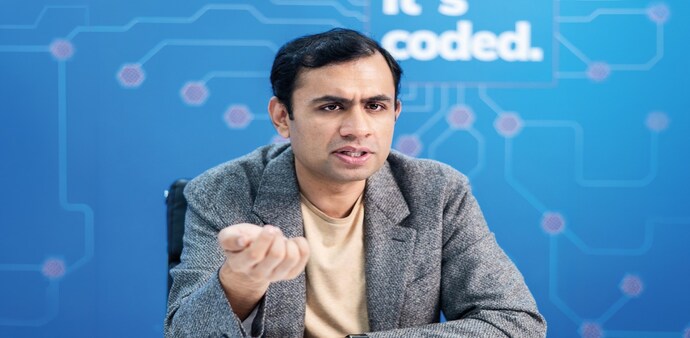
The fourth floor of Razorpay's Bengaluru headquarters does not look like the office of one of India's largest fintech companies. Employees move briskly between meeting rooms, conversations spill into open workspaces, and the energy is unmistakably start-up—fast, informal, and quietly intense. Amid the bustle sits Harshil Mathur, dressed in a light brown blazer, relaxed and measured, belying the pace at which his company has grown.
Twelve years ago, that journey looked anything but certain. Fresh out of IIT Roorkee, Mathur and his friend Shashank Kumar started Razorpay in Jaipur before relocating to Bengaluru to be closer to the start-ups they believed others had overlooked.
Investors dismissed payments as a crowded market dominated by a few established players. Yet, the founders saw an opportunity—build for India's smallest start-ups and grow alongside them. That conviction has since transformed Razorpay from a payment gateway into one of India's largest fintech companies, processing over a billion transactions every quarter, handling annualised payments of more than $180 billion and steadily inching towards a public listing.
In a conversation with Business Today, Mathur reflects on building through rejection, scaling with customers, why value matters more than valuation, and what it takes to lead a company through constant reinvention. Edited excerpts:
Q: Looking back, what was the original thesis behind Razorpay, especially when investors believed the payments opportunity had already played out?
A: We started building in this space because we believed it was a problem worth solving. As we progressed, we realised we needed capital because payments is a business where you have to invest first and build over time. So, we started meeting investors, assuming they would understand what we were trying to build. Instead, we faced a lot of rejections. The common view was that payments was already a commoditised market with 20-30 established players. Investors would ask us, “How are you going to create space for yourself?”
At the time, there were five or six dominant players. The top three alone controlled 85-90% of the market, so there was a perception that everything that could be built in payments had already been built. Our view was different. While there were many players, almost all of them were focused on large enterprises. In 2014, India's start-up ecosystem was just beginning to take off, and we felt nobody was building for very small start-ups. Everyone was solving for established businesses, but not for one- or two-person start-ups operating out of a room.
Our thesis was simple—if we solved for these start-ups early, many of them would eventually become large companies, and we could grow alongside them. That became our core focus, and over the last decade, it has proved to be the right strategy. Some of India’s largest technology companies started with Razorpay. Groww processed its first transaction on Razorpay. So did Meesho and Zepto. Today, they are multi-billion-dollar companies—listed or preparing to go public—and we have continued to build products and features that support their growth as they scale.
The core principle behind Razorpay has not changed. Our goal has always been to enable founders to focus on building their businesses while we take care of their financial operations. We started with payments, but over time, expanded into multiple adjacent areas. What began as a payment gateway has grown to include payment pages, payment links, Magic Checkout, RazorpayX, corporate cards, point-of-sale devices, marketing and engagement solutions, and several other offerings. So, while the vision has expanded significantly, the underlying philosophy remains the same.
Q. Payments itself is a large opportunity. What made you believe Razorpay needed to expand beyond payments and become a broader financial platform?
A. The decision was largely driven by our customers. Our first expansion beyond payments was into payouts. Around 2016-17, customers would tell us, “You have solved collections for us. We can accept digital payments. But everything that happens after that is still manual.” They still had to pay vendors, gig workers and partners through cash, cheques or traditional bank transfers. The process was fragmented, time-consuming and prone to errors. They wanted us to solve that problem as well.
That led us to build payouts. From there, payroll became a natural extension because every business has to pay salaries. As a founder, I experienced that pain myself. In the early days, I used to process salaries manually through our bank account. Every month, I had to calculate salary payouts, deduct taxes, pay TDS, professional tax and other statutory dues. It took a lot of time, and that is the reality for many early-stage start-ups where the founder is also the finance team. We felt we could automate that entire workflow and let founders focus on building their businesses.
The same thinking led us to gift cards. We realised more digital businesses wanted to offer gift cards as gifting became popular. Since we already operate at the intersection of technology and money movement, building a gift card platform was a natural extension. Today, we power gift cards for companies such as Blinkit and Zomato. While many businesses adopt it alongside our payments platform, some use the gift card platform independently.
That is how our expansion has always happened. Every time we identify an unsolved problem for businesses, and believe we are well placed to solve it because we sit at the intersection of technology and finance, we build for it. Every product we have launched has been designed for businesses. We have consciously stayed away from building directly for consumers because our role is to help businesses serve their customers better.
Q. You have said you are prouder of the fact that Razorpay powers nearly 80% of India's unicorns than of Razorpay itself becoming a unicorn. When the company entered the unicorn club in 2020, how did you view that milestone? Did it change anything internally or simply raise expectations from the outside?
A. Becoming a unicorn definitely brought a lot more attention. There was suddenly much greater interest from the media, and the broader start-up ecosystem started looking at us differently. But internally, not much changed. We already had a lot on our plate. We celebrated for a day and then got back to work. It happened in the middle of the pandemic, so even the celebration was virtual.
What did change were expectations from the outside. People started looking at Razorpay differently, and that naturally brought greater responsibility.
Q. In today’s start-up ecosystem, valuation often dominates the conversation. As a founder, how do you distinguish between valuation and genuine value creation?
A. At the end of the day, the only thing that truly matters is the value you create for your customers. If you are creating more value for yourself than for your customers, you are living on borrowed valuation. Those valuations eventually correct themselves. The only sustainable way to build a business is to create more value for your customers than you capture for yourself.
That is why I am more excited about the fact that Razorpay powers nearly 80% of India’s unicorns than about Razorpay itself becoming a unicorn. To me, that is a far more meaningful measure of the impact we have created.
One question I ask myself when I meet customers is: If Razorpay did not exist tomorrow, would they care? If the answer is yes, then we are creating real value. If we are simply one of many interchangeable providers, then whatever valuation you have does not mean much because customers can always switch to someone else.
The other way we measure value creation is through innovation. We have built a culture where it is okay to fail, but it is not okay to be second or third (in the market). If you are constantly launching new products, some of them will fail, and that is fine. What is not fine is not trying at all.
A good example is UPI. In 2016, we became the first payment gateway in India to launch UPI. At the time, many people did not believe it would scale because several large banks and consumer apps were not even on the platform. But we believed it represented the future of digital payments. When UPI eventually took off, many large customers moved to Razorpay because we were already ready. Being early on those bets has helped us create long-term value for our customers, and that is ultimately what matters more than valuation.
Q. Your name now features on wealth rankings, but you have often spoken more about impact than valuation. On a personal level, how do you define success and what does wealth mean to you today?
A. Success means different things at different stages of life. Today, I measure it by the impact on people and on the ecosystem. Whether it is the number of start-ups we have helped build, the customers who genuinely feel they will miss us if Razorpay did not exist, or the employees who have grown with the company—that is what success looks like to me.
It is not just about giving people jobs. They could have found jobs elsewhere. The real question is whether they were able to do meaningful work, learn something new and grow because they were at Razorpay. That is what gives me the greatest sense of satisfaction.
Even employees who have moved on often tell us that Razorpay was the most meaningful phase of their careers because they got to do some of their best work here. Those are the moments that make you proud.
As for wealth, of course it is important. I won’t pretend it is not. But I see it as a means to an end rather than the end itself. It gives you the ability to take care of your family, support causes you care about and create opportunities that may not have been possible otherwise.
For example, my father is deeply passionate about philanthropy. He comes from a small village, and he enjoys giving back to his community.
Personally, though, I don’t spend much time thinking about wealth. Building a company takes up almost all your time. By the time Sunday comes around, I would rather spend it quietly with my family and friends than think about material things.
Q. India’s digital payments ecosystem has evolved dramatically over the past decade, driven by UPI and a strong public digital infrastructure. How important have these digital public rails been in Razorpay growth and shaping India’s fintech ecosystem?
A. I think India’s public digital infrastructure is among the best in the world. What is unique is that we have created public rails on top of which private companies can build the last-mile experience. That means everyone benefits as the ecosystem grows, instead of operating in closed-loop systems.
A large part of the success of India’s fintech ecosystem—including Razorpay—has been possible because of these digital public rails and the way they have been designed. It has been a collective effort. Policymakers, the government, regulators, public institutions and private companies like us, as well as consumer-facing fintech players, have all played an important role in building the ecosystem we have today.
@palakagarwal
The fourth floor of Razorpay's Bengaluru headquarters does not look like the office of one of India's largest fintech companies. Employees move briskly between meeting rooms, conversations spill into open workspaces, and the energy is unmistakably start-up—fast, informal, and quietly intense. Amid the bustle sits Harshil Mathur, dressed in a light brown blazer, relaxed and measured, belying the pace at which his company has grown.
Twelve years ago, that journey looked anything but certain. Fresh out of IIT Roorkee, Mathur and his friend Shashank Kumar started Razorpay in Jaipur before relocating to Bengaluru to be closer to the start-ups they believed others had overlooked.
Investors dismissed payments as a crowded market dominated by a few established players. Yet, the founders saw an opportunity—build for India's smallest start-ups and grow alongside them. That conviction has since transformed Razorpay from a payment gateway into one of India's largest fintech companies, processing over a billion transactions every quarter, handling annualised payments of more than $180 billion and steadily inching towards a public listing.
In a conversation with Business Today, Mathur reflects on building through rejection, scaling with customers, why value matters more than valuation, and what it takes to lead a company through constant reinvention. Edited excerpts:
Q: Looking back, what was the original thesis behind Razorpay, especially when investors believed the payments opportunity had already played out?
A: We started building in this space because we believed it was a problem worth solving. As we progressed, we realised we needed capital because payments is a business where you have to invest first and build over time. So, we started meeting investors, assuming they would understand what we were trying to build. Instead, we faced a lot of rejections. The common view was that payments was already a commoditised market with 20-30 established players. Investors would ask us, “How are you going to create space for yourself?”
At the time, there were five or six dominant players. The top three alone controlled 85-90% of the market, so there was a perception that everything that could be built in payments had already been built. Our view was different. While there were many players, almost all of them were focused on large enterprises. In 2014, India's start-up ecosystem was just beginning to take off, and we felt nobody was building for very small start-ups. Everyone was solving for established businesses, but not for one- or two-person start-ups operating out of a room.
Our thesis was simple—if we solved for these start-ups early, many of them would eventually become large companies, and we could grow alongside them. That became our core focus, and over the last decade, it has proved to be the right strategy. Some of India’s largest technology companies started with Razorpay. Groww processed its first transaction on Razorpay. So did Meesho and Zepto. Today, they are multi-billion-dollar companies—listed or preparing to go public—and we have continued to build products and features that support their growth as they scale.
The core principle behind Razorpay has not changed. Our goal has always been to enable founders to focus on building their businesses while we take care of their financial operations. We started with payments, but over time, expanded into multiple adjacent areas. What began as a payment gateway has grown to include payment pages, payment links, Magic Checkout, RazorpayX, corporate cards, point-of-sale devices, marketing and engagement solutions, and several other offerings. So, while the vision has expanded significantly, the underlying philosophy remains the same.
Q. Payments itself is a large opportunity. What made you believe Razorpay needed to expand beyond payments and become a broader financial platform?
A. The decision was largely driven by our customers. Our first expansion beyond payments was into payouts. Around 2016-17, customers would tell us, “You have solved collections for us. We can accept digital payments. But everything that happens after that is still manual.” They still had to pay vendors, gig workers and partners through cash, cheques or traditional bank transfers. The process was fragmented, time-consuming and prone to errors. They wanted us to solve that problem as well.
That led us to build payouts. From there, payroll became a natural extension because every business has to pay salaries. As a founder, I experienced that pain myself. In the early days, I used to process salaries manually through our bank account. Every month, I had to calculate salary payouts, deduct taxes, pay TDS, professional tax and other statutory dues. It took a lot of time, and that is the reality for many early-stage start-ups where the founder is also the finance team. We felt we could automate that entire workflow and let founders focus on building their businesses.
The same thinking led us to gift cards. We realised more digital businesses wanted to offer gift cards as gifting became popular. Since we already operate at the intersection of technology and money movement, building a gift card platform was a natural extension. Today, we power gift cards for companies such as Blinkit and Zomato. While many businesses adopt it alongside our payments platform, some use the gift card platform independently.
That is how our expansion has always happened. Every time we identify an unsolved problem for businesses, and believe we are well placed to solve it because we sit at the intersection of technology and finance, we build for it. Every product we have launched has been designed for businesses. We have consciously stayed away from building directly for consumers because our role is to help businesses serve their customers better.
Q. You have said you are prouder of the fact that Razorpay powers nearly 80% of India's unicorns than of Razorpay itself becoming a unicorn. When the company entered the unicorn club in 2020, how did you view that milestone? Did it change anything internally or simply raise expectations from the outside?
A. Becoming a unicorn definitely brought a lot more attention. There was suddenly much greater interest from the media, and the broader start-up ecosystem started looking at us differently. But internally, not much changed. We already had a lot on our plate. We celebrated for a day and then got back to work. It happened in the middle of the pandemic, so even the celebration was virtual.
What did change were expectations from the outside. People started looking at Razorpay differently, and that naturally brought greater responsibility.
Q. In today’s start-up ecosystem, valuation often dominates the conversation. As a founder, how do you distinguish between valuation and genuine value creation?
A. At the end of the day, the only thing that truly matters is the value you create for your customers. If you are creating more value for yourself than for your customers, you are living on borrowed valuation. Those valuations eventually correct themselves. The only sustainable way to build a business is to create more value for your customers than you capture for yourself.
That is why I am more excited about the fact that Razorpay powers nearly 80% of India’s unicorns than about Razorpay itself becoming a unicorn. To me, that is a far more meaningful measure of the impact we have created.
One question I ask myself when I meet customers is: If Razorpay did not exist tomorrow, would they care? If the answer is yes, then we are creating real value. If we are simply one of many interchangeable providers, then whatever valuation you have does not mean much because customers can always switch to someone else.
The other way we measure value creation is through innovation. We have built a culture where it is okay to fail, but it is not okay to be second or third (in the market). If you are constantly launching new products, some of them will fail, and that is fine. What is not fine is not trying at all.
A good example is UPI. In 2016, we became the first payment gateway in India to launch UPI. At the time, many people did not believe it would scale because several large banks and consumer apps were not even on the platform. But we believed it represented the future of digital payments. When UPI eventually took off, many large customers moved to Razorpay because we were already ready. Being early on those bets has helped us create long-term value for our customers, and that is ultimately what matters more than valuation.
Q. Your name now features on wealth rankings, but you have often spoken more about impact than valuation. On a personal level, how do you define success and what does wealth mean to you today?
A. Success means different things at different stages of life. Today, I measure it by the impact on people and on the ecosystem. Whether it is the number of start-ups we have helped build, the customers who genuinely feel they will miss us if Razorpay did not exist, or the employees who have grown with the company—that is what success looks like to me.
It is not just about giving people jobs. They could have found jobs elsewhere. The real question is whether they were able to do meaningful work, learn something new and grow because they were at Razorpay. That is what gives me the greatest sense of satisfaction.
Even employees who have moved on often tell us that Razorpay was the most meaningful phase of their careers because they got to do some of their best work here. Those are the moments that make you proud.
As for wealth, of course it is important. I won’t pretend it is not. But I see it as a means to an end rather than the end itself. It gives you the ability to take care of your family, support causes you care about and create opportunities that may not have been possible otherwise.
For example, my father is deeply passionate about philanthropy. He comes from a small village, and he enjoys giving back to his community.
Personally, though, I don’t spend much time thinking about wealth. Building a company takes up almost all your time. By the time Sunday comes around, I would rather spend it quietly with my family and friends than think about material things.
Q. India’s digital payments ecosystem has evolved dramatically over the past decade, driven by UPI and a strong public digital infrastructure. How important have these digital public rails been in Razorpay growth and shaping India’s fintech ecosystem?
A. I think India’s public digital infrastructure is among the best in the world. What is unique is that we have created public rails on top of which private companies can build the last-mile experience. That means everyone benefits as the ecosystem grows, instead of operating in closed-loop systems.
A large part of the success of India’s fintech ecosystem—including Razorpay—has been possible because of these digital public rails and the way they have been designed. It has been a collective effort. Policymakers, the government, regulators, public institutions and private companies like us, as well as consumer-facing fintech players, have all played an important role in building the ecosystem we have today.
@palakagarwal