
Heatwave effect to ease in North India? IMD satellite imagery shows giant cloud system that may bring rain relief soon
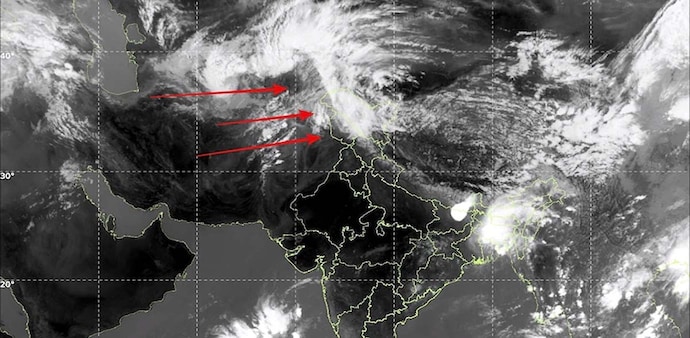
The latest thermal infrared images from the INSAT-3DS weather satellite, captured on May 21, show a vast cloud mass and cyclonic circulation stretching across Afghanistan, Pakistan, and adjoining northwest India
- May 22, 2026,
- Updated May 22, 2026 10:53 AM IST
North India’s relentless heatwave may finally see some interruption. Fresh satellite imagery released by the India Meteorological Department (IMD) has captured a massive western disturbance moving toward the northern plains, raising hopes of rain, thunderstorms, and a much-needed dip in temperatures after days of punishing heat and unusually warm nights.
The latest thermal infrared images from the INSAT-3DS weather satellite, captured on May 21, show a vast cloud mass and cyclonic circulation stretching across Afghanistan, Pakistan, and adjoining northwest India. The dense cloud bands visible in the imagery are steadily moving eastward toward the Himalayan belt and parts of north India.
North India trapped under intense heat
For several days, large parts of Delhi, Rajasthan, Haryana, Uttar Pradesh, and Madhya Pradesh have remained under severe heatwave conditions. Daytime temperatures have crossed 45 degrees Celsius in multiple cities, while nights have offered little relief.
Meteorologists say the unusually high nighttime temperatures are becoming a major concern because the human body gets very little time to recover from prolonged heat exposure. The combination of scorching days and hot nights has sharply increased discomfort levels across the region.
Satellite imagery shows strong atmospheric activity
The INSAT-3DS imagery highlights significant atmospheric instability over northern Pakistan and Jammu & Kashmir, where the most intense cloud activity is currently concentrated. Weather experts say this is a clear indication of the approaching western disturbance gaining strength.
The satellite images also show moisture incursion from the Arabian Sea along with cloud build-up over northeast India and the Bay of Bengal. Experts believe the interaction between the incoming western disturbance and this moisture could trigger thunderstorms, gusty winds, lightning activity, and scattered rainfall across several states.
Additional convective cloud clusters visible over northeast India also indicate that pre-monsoon thunderstorm activity has already become active in the eastern sector.
Rain, dust storms and hail likely in several states
According to meteorologists, the western disturbance is likely to impact Jammu & Kashmir, Himachal Pradesh, Uttarakhand, Punjab, Haryana, Delhi, and western Uttar Pradesh over the next few days.
Rainfall activity is expected in several regions, though experts say the exact intensity of the system remains uncertain. Dust storms and isolated hailstorms are also possible in some areas as the weather system advances across north India.
While the rainfall may not completely end the ongoing heatwave immediately, it could significantly lower temperatures, particularly nighttime temperatures that have remained dangerously elevated over the past week.
Monsoon signals begin emerging
The satellite imagery also points to increasing activity over the Arabian Sea and the southern Bay of Bengal, where cloud clusters are gradually beginning to organise.
Meteorologists say these developments indicate that broader monsoon conditions are slowly becoming favourable, even as pre-monsoon weather systems continue to influence different parts of the country.
North India’s relentless heatwave may finally see some interruption. Fresh satellite imagery released by the India Meteorological Department (IMD) has captured a massive western disturbance moving toward the northern plains, raising hopes of rain, thunderstorms, and a much-needed dip in temperatures after days of punishing heat and unusually warm nights.
The latest thermal infrared images from the INSAT-3DS weather satellite, captured on May 21, show a vast cloud mass and cyclonic circulation stretching across Afghanistan, Pakistan, and adjoining northwest India. The dense cloud bands visible in the imagery are steadily moving eastward toward the Himalayan belt and parts of north India.
North India trapped under intense heat
For several days, large parts of Delhi, Rajasthan, Haryana, Uttar Pradesh, and Madhya Pradesh have remained under severe heatwave conditions. Daytime temperatures have crossed 45 degrees Celsius in multiple cities, while nights have offered little relief.
Meteorologists say the unusually high nighttime temperatures are becoming a major concern because the human body gets very little time to recover from prolonged heat exposure. The combination of scorching days and hot nights has sharply increased discomfort levels across the region.
Satellite imagery shows strong atmospheric activity
The INSAT-3DS imagery highlights significant atmospheric instability over northern Pakistan and Jammu & Kashmir, where the most intense cloud activity is currently concentrated. Weather experts say this is a clear indication of the approaching western disturbance gaining strength.
The satellite images also show moisture incursion from the Arabian Sea along with cloud build-up over northeast India and the Bay of Bengal. Experts believe the interaction between the incoming western disturbance and this moisture could trigger thunderstorms, gusty winds, lightning activity, and scattered rainfall across several states.
Additional convective cloud clusters visible over northeast India also indicate that pre-monsoon thunderstorm activity has already become active in the eastern sector.
Rain, dust storms and hail likely in several states
According to meteorologists, the western disturbance is likely to impact Jammu & Kashmir, Himachal Pradesh, Uttarakhand, Punjab, Haryana, Delhi, and western Uttar Pradesh over the next few days.
Rainfall activity is expected in several regions, though experts say the exact intensity of the system remains uncertain. Dust storms and isolated hailstorms are also possible in some areas as the weather system advances across north India.
While the rainfall may not completely end the ongoing heatwave immediately, it could significantly lower temperatures, particularly nighttime temperatures that have remained dangerously elevated over the past week.
Monsoon signals begin emerging
The satellite imagery also points to increasing activity over the Arabian Sea and the southern Bay of Bengal, where cloud clusters are gradually beginning to organise.
Meteorologists say these developments indicate that broader monsoon conditions are slowly becoming favourable, even as pre-monsoon weather systems continue to influence different parts of the country.