
'If we back down today, we'll be...': Sanjeev Sanyal on India's standing firm amid US tariffs
'Nobody is going to be terribly pleased about giving us space as this happens. This includes those countries that may otherwise be friendly towards us,' says Sanjeev Sanyal
- Oct 21, 2025,
- Updated Oct 21, 2025 1:01 PM IST
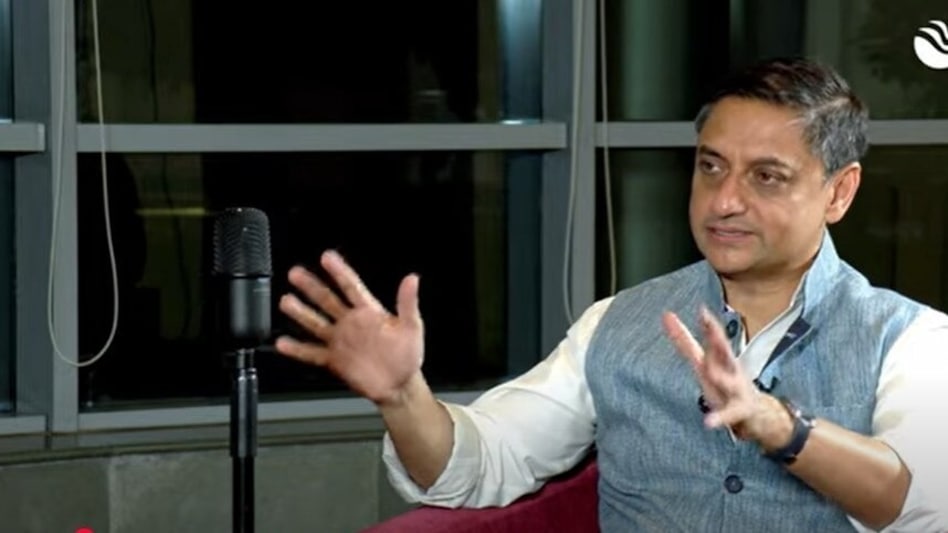
Sanjeev Sanyal, economist and member of the Prime Minister's Economic Advisory Council, said India must stop being apologetic about its rise and hold firm even as global powers grow uneasy with its expanding influence.
Speaking on how the world perceives India's emergence, he said, "Poor as we may be, just by virtue of the fact that we have a large population, it is quite clear to me that we can now fairly say that we have in nominal terms become the world's fourth largest economy, in PPP terms the world’s third largest economy, and certainly by the end of the decade we will be at number three on both counts."
He said India's economic weight now allows it to "bend many of the set parameters of the world," adding that this growing influence will inevitably make others uncomfortable - even traditional allies.
"Nobody is going to be terribly pleased about giving us space as this happens. This includes those countries that may otherwise be friendly towards us," he said. "Just like an individual, when you begin to get more successful, even your own friends and family begin becoming a little more uncomfortable with the fact that you are becoming more successful. This is also true of nations."
Sanyal cautioned against slowing down due to global discomfort, calling it "a loser's perspective." "For far too long India has punched below its weight category. So, even if we are just punching at our weight category and others are uncomfortable about it, well, we just have to thicken our skin and in a sense get others to accommodate this," he said.
Referring to the recent tariff tensions with the United States under US President Donald Trump, Sanyal said, "The obvious manifestation of this right now that we are facing is the US tariff issue that is on the top of everybody's mind, and this is a good example of how we here in India have been dealing with this. It is not an issue that we have caused. It is also not a situation where we are trying to escalate anything."
He added that India's approach has been marked by calm resolve, even when "close advisers to the US President make snide remarks, sometimes what could be even deemed as racist remarks against India." He noted, "We have in general been quite restrained. The fact that we are restrained, however, does not mean that we are backing down. And in this again, notice our behavior is quite different than what many other large countries in the world have done."
"Our current strategy is, do not escalate matters but at the same time, if it's a reasonable thing that we are asking for, do not back down," he stressed. "If we develop the reputation of somebody who backs down at every step, then let me say that there are many other things on which we will be made to back down."
Calling for a shift in mindset, Sanyal said, "Over the last 78 odd years as a free country, we have been actually quite apologetic about many things. I think the time has come to stop being so." He underscored that India's assertiveness must remain measured but firm: "This does not mean that we should be adding fuel to the fire, clearly not. But at the same time, it does mean that we should stand up for our interests and the interests of about one-sixth of the world’s population. What is good for us is good for humanity as a whole."
Placing India's position in historical context, Sanyal said that every rising power has had to claim its own space. "No rising power has been given the space. They've had to make that space in various ways," he said, citing examples from history: "When the British rose up as a great power, they had to go through decades of war with Napoleon. When the Russians rose, they had to conquer all the way through to Alaska and stand up to the then great powers in Crimea. The Germans had to win the Franco-Russian wars. The Japanese had to defeat the Russians in 1905. The Americans had to win two world wars. The Chinese had to stand up to the Americans in Korea and then in Vietnam. We are just having to stand up to President Trump."
He concluded that India's goal was to act in its own best interest without unnecessary escalation. "We will do what is reasonable for our interests. As I mentioned again, we have no interest in unnecessarily escalating or aggravating things. But that does not mean that we do not understand what is in our interest or that we will not stand up for it. And yes, if there are reasonable trade-offs to be made, we will make them. But they have to be reasonable and the net benefit should be clearly positive for us as a country."
Sanjeev Sanyal, economist and member of the Prime Minister's Economic Advisory Council, said India must stop being apologetic about its rise and hold firm even as global powers grow uneasy with its expanding influence.
Speaking on how the world perceives India's emergence, he said, "Poor as we may be, just by virtue of the fact that we have a large population, it is quite clear to me that we can now fairly say that we have in nominal terms become the world's fourth largest economy, in PPP terms the world’s third largest economy, and certainly by the end of the decade we will be at number three on both counts."
He said India's economic weight now allows it to "bend many of the set parameters of the world," adding that this growing influence will inevitably make others uncomfortable - even traditional allies.
"Nobody is going to be terribly pleased about giving us space as this happens. This includes those countries that may otherwise be friendly towards us," he said. "Just like an individual, when you begin to get more successful, even your own friends and family begin becoming a little more uncomfortable with the fact that you are becoming more successful. This is also true of nations."
Sanyal cautioned against slowing down due to global discomfort, calling it "a loser's perspective." "For far too long India has punched below its weight category. So, even if we are just punching at our weight category and others are uncomfortable about it, well, we just have to thicken our skin and in a sense get others to accommodate this," he said.
Referring to the recent tariff tensions with the United States under US President Donald Trump, Sanyal said, "The obvious manifestation of this right now that we are facing is the US tariff issue that is on the top of everybody's mind, and this is a good example of how we here in India have been dealing with this. It is not an issue that we have caused. It is also not a situation where we are trying to escalate anything."
He added that India's approach has been marked by calm resolve, even when "close advisers to the US President make snide remarks, sometimes what could be even deemed as racist remarks against India." He noted, "We have in general been quite restrained. The fact that we are restrained, however, does not mean that we are backing down. And in this again, notice our behavior is quite different than what many other large countries in the world have done."
"Our current strategy is, do not escalate matters but at the same time, if it's a reasonable thing that we are asking for, do not back down," he stressed. "If we develop the reputation of somebody who backs down at every step, then let me say that there are many other things on which we will be made to back down."
Calling for a shift in mindset, Sanyal said, "Over the last 78 odd years as a free country, we have been actually quite apologetic about many things. I think the time has come to stop being so." He underscored that India's assertiveness must remain measured but firm: "This does not mean that we should be adding fuel to the fire, clearly not. But at the same time, it does mean that we should stand up for our interests and the interests of about one-sixth of the world’s population. What is good for us is good for humanity as a whole."
Placing India's position in historical context, Sanyal said that every rising power has had to claim its own space. "No rising power has been given the space. They've had to make that space in various ways," he said, citing examples from history: "When the British rose up as a great power, they had to go through decades of war with Napoleon. When the Russians rose, they had to conquer all the way through to Alaska and stand up to the then great powers in Crimea. The Germans had to win the Franco-Russian wars. The Japanese had to defeat the Russians in 1905. The Americans had to win two world wars. The Chinese had to stand up to the Americans in Korea and then in Vietnam. We are just having to stand up to President Trump."
He concluded that India's goal was to act in its own best interest without unnecessary escalation. "We will do what is reasonable for our interests. As I mentioned again, we have no interest in unnecessarily escalating or aggravating things. But that does not mean that we do not understand what is in our interest or that we will not stand up for it. And yes, if there are reasonable trade-offs to be made, we will make them. But they have to be reasonable and the net benefit should be clearly positive for us as a country."