
IMD issues red alert as dense fog disrupts Delhi flights, AQI now severe: Disruptions to continue whole week
The upgraded alert came amid warnings of severely reduced visibility, raising the risk of major disruptions across air, road and rail networks in Delhi and large parts of north India
- Dec 30, 2025,
- Updated Dec 30, 2025 7:42 AM IST
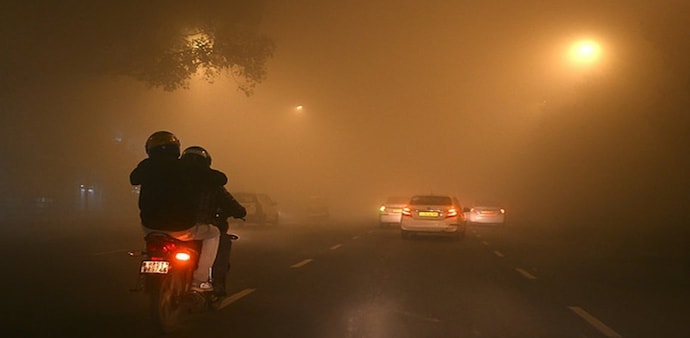
Delhi slipped deeper into a winter shutdown on Monday evening as dense fog tightened its grip on the capital, prompting the India Meteorological Department to escalate its warning from an orange alert to a red alert for dense fog, effective until Tuesday afternoon.
The upgraded alert came amid warnings of severely reduced visibility, raising the risk of major disruptions across air, road and rail networks in Delhi and large parts of north India.
Visibility levels dropped sharply through the morning hours. At Indira Gandhi International Airport and the Safdarjung observatory, visibility plunged to just 50 metres at 8 am, improving marginally to 100 metres by 9 am, according to IMD data. The poor conditions led to widespread disruption at the airport, with at least 128 flights cancelled, eight diverted and nearly 200 delayed, based on official figures and data from flight tracking website Flightradar24.
Major airlines, including Air India, IndiGo and SpiceJet, issued travel advisories, warning passengers of possible delays, diversions and cancellations over the coming days as low visibility persisted across northern India. Air India cautioned that dense fog could continue to affect arrivals and departures on Tuesday, particularly in Delhi and other northern and north-eastern cities, advising travellers to regularly check flight status and plan accordingly.
Dense fog blankets north India
The IMD said dense fog conditions are likely to continue until late afternoon, significantly affecting travel and daily activities. Satellite imagery showed a thick fog and low cloud layer stretching across Punjab, Haryana, parts of Rajasthan, Uttarakhand, Uttar Pradesh, Bihar, Jharkhand, sub-Himalayan West Bengal, Assam, Meghalaya and Bangladesh, underlining the scale of the weather system.
Delhi recorded a minimum temperature of 8.3 degrees Celsius, around 1.5 degrees above normal, while the maximum settled at 22.5 degrees Celsius, 2.1 degrees above normal, the IMD said.
Air quality back to ‘severe’
The prolonged fog has coincided with a sharp deterioration in air quality. Delhi’s 24-hour Air Quality Index (AQI) climbed to 401, placing it in the ‘severe’ category, according to data from the Central Pollution Control Board. A day earlier, the AQI stood at 390, categorised as ‘very poor’.
Data from the CPCB’s SAMEER app showed ‘severe’ air quality at 24 monitoring stations and ‘very poor’ levels at 13 others. Wazirpur recorded the worst AQI at 462. An AQI reading above 401 is classified as ‘severe’, while levels between 301 and 400 fall under the ‘very poor’ category.
Poor air quality to persist into the New Year
The Air Quality Early Warning System has forecast ‘very poor’ air quality for Tuesday and Wednesday, with conditions likely to slip back into the ‘severe’ category on New Year’s Day. The outlook for the next six days points to predominantly ‘very poor’ air quality levels.
According to the Decision Support System for Air Quality Management, transport emissions were the largest contributor to Delhi’s pollution load at 15.1 per cent, followed by industries in Delhi and surrounding areas at 7.6 per cent, residential sources at 3.6 per cent, construction activities at 2 per cent and waste burning at 1.3 per cent. Among NCR districts, Jhajjar contributed 16.7 per cent, followed by Rohtak (5.2 per cent), Sonipat (5.1 per cent), Bhiwani (3.4 per cent) and Gurugram (1.5 per cent).
Delhi slipped deeper into a winter shutdown on Monday evening as dense fog tightened its grip on the capital, prompting the India Meteorological Department to escalate its warning from an orange alert to a red alert for dense fog, effective until Tuesday afternoon.
The upgraded alert came amid warnings of severely reduced visibility, raising the risk of major disruptions across air, road and rail networks in Delhi and large parts of north India.
Visibility levels dropped sharply through the morning hours. At Indira Gandhi International Airport and the Safdarjung observatory, visibility plunged to just 50 metres at 8 am, improving marginally to 100 metres by 9 am, according to IMD data. The poor conditions led to widespread disruption at the airport, with at least 128 flights cancelled, eight diverted and nearly 200 delayed, based on official figures and data from flight tracking website Flightradar24.
Major airlines, including Air India, IndiGo and SpiceJet, issued travel advisories, warning passengers of possible delays, diversions and cancellations over the coming days as low visibility persisted across northern India. Air India cautioned that dense fog could continue to affect arrivals and departures on Tuesday, particularly in Delhi and other northern and north-eastern cities, advising travellers to regularly check flight status and plan accordingly.
Dense fog blankets north India
The IMD said dense fog conditions are likely to continue until late afternoon, significantly affecting travel and daily activities. Satellite imagery showed a thick fog and low cloud layer stretching across Punjab, Haryana, parts of Rajasthan, Uttarakhand, Uttar Pradesh, Bihar, Jharkhand, sub-Himalayan West Bengal, Assam, Meghalaya and Bangladesh, underlining the scale of the weather system.
Delhi recorded a minimum temperature of 8.3 degrees Celsius, around 1.5 degrees above normal, while the maximum settled at 22.5 degrees Celsius, 2.1 degrees above normal, the IMD said.
Air quality back to ‘severe’
The prolonged fog has coincided with a sharp deterioration in air quality. Delhi’s 24-hour Air Quality Index (AQI) climbed to 401, placing it in the ‘severe’ category, according to data from the Central Pollution Control Board. A day earlier, the AQI stood at 390, categorised as ‘very poor’.
Data from the CPCB’s SAMEER app showed ‘severe’ air quality at 24 monitoring stations and ‘very poor’ levels at 13 others. Wazirpur recorded the worst AQI at 462. An AQI reading above 401 is classified as ‘severe’, while levels between 301 and 400 fall under the ‘very poor’ category.
Poor air quality to persist into the New Year
The Air Quality Early Warning System has forecast ‘very poor’ air quality for Tuesday and Wednesday, with conditions likely to slip back into the ‘severe’ category on New Year’s Day. The outlook for the next six days points to predominantly ‘very poor’ air quality levels.
According to the Decision Support System for Air Quality Management, transport emissions were the largest contributor to Delhi’s pollution load at 15.1 per cent, followed by industries in Delhi and surrounding areas at 7.6 per cent, residential sources at 3.6 per cent, construction activities at 2 per cent and waste burning at 1.3 per cent. Among NCR districts, Jhajjar contributed 16.7 per cent, followed by Rohtak (5.2 per cent), Sonipat (5.1 per cent), Bhiwani (3.4 per cent) and Gurugram (1.5 per cent).