
'India and China economic giants, no one country should dominate': Putin's message for Trump
Putin's remarks came just days after he and Prime Minister Narendra Modi met Chinese President Xi Jinping at the Shanghai Cooperation Organisation summit in Tianjin.
- Sep 3, 2025,
- Updated Sep 3, 2025 9:17 PM IST
Russian President Vladimir Putin on Wednesday warned against Western dominance, singling out India and China as global economic giants who cannot be spoken to in a condescending manner.
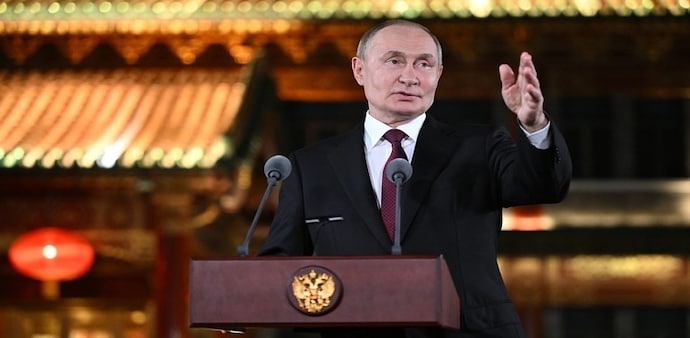
"From the international law point of view, everyone must have equal rights, must be in similar positions. There are economic giants like India and China in the international system. Our country is among the top four biggest economies if we talk in terms of purchasing power. These are current realities. But no one country should dominate the politics or global security. We do not believe that there should be domination," Putin said while speaking to reporters at the Diaoyutai Residence in Beijing.
Putin underlined that the era of threats is over. "You have a country like India, 1.5 billion people. China, with powerful economy. But they also have their own domestic mechanism and laws. When somebody tells you they are going to punish you, you have to think- how can the leadership of those big countries...if one of them shows political weakness, their political career will be over. The colonial era is now over. They have to realise that they cannot use this tone in speaking to their partners. But ultimately things will be sorted out," he said.
Putin's remarks came just days after he and Prime Minister Narendra Modi met Chinese President Xi Jinping at the Shanghai Cooperation Organisation summit in Tianjin. Their public camaraderie - including footage of Modi and Putin holding hands as they joined Xi for a private huddle - went viral on social media, feeding speculation of a tighter trilateral axis.
The timing also coincided with growing strain in India–US relations. President Donald Trump recently imposed 50 per cent tariffs on Indian goods, half of which were directly linked to New Delhi's continued purchases of Russian crude oil. New Delhi has described the measures as unjustified, while Trump has accused India of "fueling Russia's deadly attacks on Ukraine."
In Beijing, Xi Jinping framed the SCO as a counterweight to US-led institutions and set out his own vision for a new global order. "We always stand on the side of international fairness and justice, champion inclusiveness and...oppose hegemonism and power politics, thus becoming a proactive force for world peace and development," Xi told the gathering. "We should safeguard the UN-centred international system and support the multilateral trading system with the WTO at its core."
Putin echoed the call, describing the SCO as a platform to "shape a just, multipolar world order." He added: "The bloc is laying the political and socioeconomic foundations for a new system of stability, security and peaceful development in Eurasia – a system that would replace outdated Eurocentric and Euro-Atlantic models."
Russian President Vladimir Putin on Wednesday warned against Western dominance, singling out India and China as global economic giants who cannot be spoken to in a condescending manner.
"From the international law point of view, everyone must have equal rights, must be in similar positions. There are economic giants like India and China in the international system. Our country is among the top four biggest economies if we talk in terms of purchasing power. These are current realities. But no one country should dominate the politics or global security. We do not believe that there should be domination," Putin said while speaking to reporters at the Diaoyutai Residence in Beijing.
Putin underlined that the era of threats is over. "You have a country like India, 1.5 billion people. China, with powerful economy. But they also have their own domestic mechanism and laws. When somebody tells you they are going to punish you, you have to think- how can the leadership of those big countries...if one of them shows political weakness, their political career will be over. The colonial era is now over. They have to realise that they cannot use this tone in speaking to their partners. But ultimately things will be sorted out," he said.
Putin's remarks came just days after he and Prime Minister Narendra Modi met Chinese President Xi Jinping at the Shanghai Cooperation Organisation summit in Tianjin. Their public camaraderie - including footage of Modi and Putin holding hands as they joined Xi for a private huddle - went viral on social media, feeding speculation of a tighter trilateral axis.
The timing also coincided with growing strain in India–US relations. President Donald Trump recently imposed 50 per cent tariffs on Indian goods, half of which were directly linked to New Delhi's continued purchases of Russian crude oil. New Delhi has described the measures as unjustified, while Trump has accused India of "fueling Russia's deadly attacks on Ukraine."
In Beijing, Xi Jinping framed the SCO as a counterweight to US-led institutions and set out his own vision for a new global order. "We always stand on the side of international fairness and justice, champion inclusiveness and...oppose hegemonism and power politics, thus becoming a proactive force for world peace and development," Xi told the gathering. "We should safeguard the UN-centred international system and support the multilateral trading system with the WTO at its core."
Putin echoed the call, describing the SCO as a platform to "shape a just, multipolar world order." He added: "The bloc is laying the political and socioeconomic foundations for a new system of stability, security and peaceful development in Eurasia – a system that would replace outdated Eurocentric and Euro-Atlantic models."