
India-Australia ties: Modi and Albanese map out uranium supply, defense shield against threats
Across three days of intensive diplomatic maneuvering at the Third Australia-India Annual Summit, the two leaders dismantled outdated bilateral frameworks to construct a fortified economic, technological, and military partnership designed to anchor the Indo-Pacific.
- Jul 10, 2026,
- Updated Jul 10, 2026 1:04 PM IST
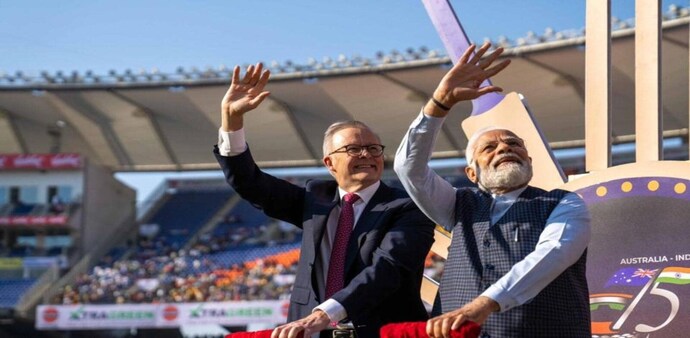
Navigating a fracturing global landscape marked by Middle East supply disruptions and escalating geostrategic friction, Indian Prime Minister Narendra Modi and Australian Prime Minister Anthony Albanese met in Melbourne to dramatically elevate their bilateral alliance.
Across three days of intensive diplomatic maneuvering at the Third Australia-India Annual Summit, the two leaders dismantled outdated bilateral frameworks to construct a fortified economic, technological, and military partnership designed to anchor the Indo-Pacific.
Constructing new military architecture
The leaders immediately signed a new Joint Declaration on Defence and Security Cooperation, executing a significant upgrade to their 2009 security pact. Driven by shared concerns over unilateral attempts to alter the regional status quo, India and Australia committed to a deeper, integrated military relationship.
Under the new framework, the two nations will expand military aircraft deployments from each other’s territories, increase the complexity of combat exercises, and fast-track real-time intelligence sharing. A newly minted Maritime Security Collaboration Roadmap will also coordinate operational deployments, capability building, and information exchange to safeguard critical sea lanes.
Unlocking strategic uranium supply
Simultaneously, the summit delivered an end to a decade-long regulatory logjam. Both nations finalized the administrative arrangements required to operationalize their 2014 Civil Nuclear Agreement, officially clearing the path for Australia to export uranium to India for peaceful energy production under International Atomic Energy Agency (IAEA) safeguards.
This breakthrough aligns with a broader Joint Statement on Energy Security, sparked by unstable commodity prices and prolonged shipping bottlenecks in the West Asia.
Erecting a tech & supply chain shield
Recognising that modern warfare extends well beyond conventional battlefields, the prime ministers launched the Australia-India Partnership on Cyber, Critical Technologies and Supply Chains (PACTS).
Succeeding a narrower 2020 framework, PACTS introduces a highly structured, five-pillar strategy overseen directly by India's Deputy National Security Advisor and Australia’s Deputy Secretary of the International and Security Group.
The initiative mandates joint action to build trusted vendor frameworks for semiconductor manufacturing, secure undersea internet cables against sabotage, and align investments in critical minerals and artificial intelligence.
Expanding institutional ties & returning artifacts
The strategic alignment extended into institutional and cultural ties. On the educational front, India issued a Letter of Intent allowing Flinders University to build a campus in Bengaluru and a Letter of Approval for Victoria University to operate in Gurugram.
In a final gesture of mutual goodwill, Australia returned three prized 11th and 12th-century stone and bronze antiquities to India, including the sacred bull Nandi and a trident of Bhadrakali, completing a summit aimed at reclaiming historical ties while securing a volatile future.
Navigating a fracturing global landscape marked by Middle East supply disruptions and escalating geostrategic friction, Indian Prime Minister Narendra Modi and Australian Prime Minister Anthony Albanese met in Melbourne to dramatically elevate their bilateral alliance.
Across three days of intensive diplomatic maneuvering at the Third Australia-India Annual Summit, the two leaders dismantled outdated bilateral frameworks to construct a fortified economic, technological, and military partnership designed to anchor the Indo-Pacific.
Constructing new military architecture
The leaders immediately signed a new Joint Declaration on Defence and Security Cooperation, executing a significant upgrade to their 2009 security pact. Driven by shared concerns over unilateral attempts to alter the regional status quo, India and Australia committed to a deeper, integrated military relationship.
Under the new framework, the two nations will expand military aircraft deployments from each other’s territories, increase the complexity of combat exercises, and fast-track real-time intelligence sharing. A newly minted Maritime Security Collaboration Roadmap will also coordinate operational deployments, capability building, and information exchange to safeguard critical sea lanes.
Unlocking strategic uranium supply
Simultaneously, the summit delivered an end to a decade-long regulatory logjam. Both nations finalized the administrative arrangements required to operationalize their 2014 Civil Nuclear Agreement, officially clearing the path for Australia to export uranium to India for peaceful energy production under International Atomic Energy Agency (IAEA) safeguards.
This breakthrough aligns with a broader Joint Statement on Energy Security, sparked by unstable commodity prices and prolonged shipping bottlenecks in the West Asia.
Erecting a tech & supply chain shield
Recognising that modern warfare extends well beyond conventional battlefields, the prime ministers launched the Australia-India Partnership on Cyber, Critical Technologies and Supply Chains (PACTS).
Succeeding a narrower 2020 framework, PACTS introduces a highly structured, five-pillar strategy overseen directly by India's Deputy National Security Advisor and Australia’s Deputy Secretary of the International and Security Group.
The initiative mandates joint action to build trusted vendor frameworks for semiconductor manufacturing, secure undersea internet cables against sabotage, and align investments in critical minerals and artificial intelligence.
Expanding institutional ties & returning artifacts
The strategic alignment extended into institutional and cultural ties. On the educational front, India issued a Letter of Intent allowing Flinders University to build a campus in Bengaluru and a Letter of Approval for Victoria University to operate in Gurugram.
In a final gesture of mutual goodwill, Australia returned three prized 11th and 12th-century stone and bronze antiquities to India, including the sacred bull Nandi and a trident of Bhadrakali, completing a summit aimed at reclaiming historical ties while securing a volatile future.