
India, Canada sign $1.9 billion uranium supply pact; sets $50 billion trade target by 2030
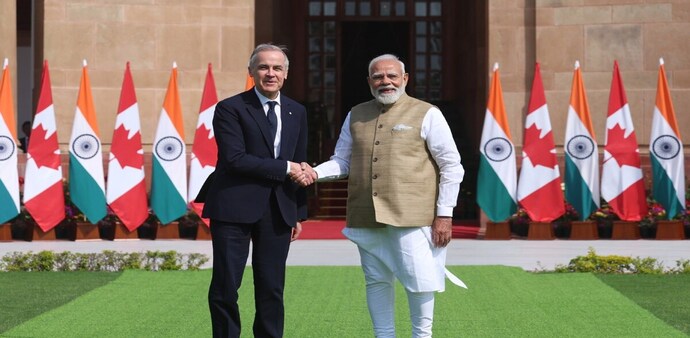
After talks between Prime Minister Narendra Modi and his Canadian counterpart Mark Carney in New Delhi, the two countries also signed pacts on critical minerals, decided to establish the India-Canada Defence Dialogue, and agreed to conclude a comprehensive economic partnership agreement by the end of 2026.
- Mar 2, 2026,
- Updated Mar 2, 2026 3:24 PM IST
Canadian firm Cameco Corp. signed a C$2.6 billion ($1.9 billion) uranium supply deal with India on March 2 during Prime Minister Mark Carney’s first official visit to the country.
Cameco will supply 22 million pounds (11,000 tons) of the reactor fuel to India from 2027 through 2035, according to a statement from Carney’s office. The two nations also agreed to cooperate in sectors including liquefied natural gas, critical minerals, solar and hydrogen.
The uranium agreement formed the centrepiece of a broader reset in ties between India and Canada, with the two sides announcing a “landmark deal for long-term uranium supply, new defence dialogue, and an ambitious target to raise trade to $50 billion by 2030.”
After talks between Prime Minister Narendra Modi and his Canadian counterpart Mark Carney in New Delhi, the two countries also signed pacts on critical minerals, decided to establish the India-Canada Defence Dialogue, and agreed to conclude a comprehensive economic partnership agreement by the end of 2026. Both leaders discussed transforming the relationship into what they described as a “next level partnership”.
Calling this an “important milestone”, PM Modi said, “Since our first meeting, our relationship has been infused with new energy, mutual trust, and positivity. I credit my friend, Prime Minister Carney, for the growing momentum in every area of cooperation.”
“India and Canada share an unwavering belief in democratic values. We celebrate diversity. The well-being of humanity is our shared vision. This vision inspires us to move forward in every field. Today, we discussed transforming this vision into a Next Level Partnership,” Modi said.
Carney framed the reset as more than symbolic. “This is not merely the renewal of a relationship, it is the expansion of a valued partnership with new ambition, focus and foresight, a partnership between two confident countries charting our own course for the future”.
The agreements signal a concerted push to deepen energy security, expand strategic cooperation, and inject fresh economic momentum into bilateral ties.
Canadian firm Cameco Corp. signed a C$2.6 billion ($1.9 billion) uranium supply deal with India on March 2 during Prime Minister Mark Carney’s first official visit to the country.
Cameco will supply 22 million pounds (11,000 tons) of the reactor fuel to India from 2027 through 2035, according to a statement from Carney’s office. The two nations also agreed to cooperate in sectors including liquefied natural gas, critical minerals, solar and hydrogen.
The uranium agreement formed the centrepiece of a broader reset in ties between India and Canada, with the two sides announcing a “landmark deal for long-term uranium supply, new defence dialogue, and an ambitious target to raise trade to $50 billion by 2030.”
After talks between Prime Minister Narendra Modi and his Canadian counterpart Mark Carney in New Delhi, the two countries also signed pacts on critical minerals, decided to establish the India-Canada Defence Dialogue, and agreed to conclude a comprehensive economic partnership agreement by the end of 2026. Both leaders discussed transforming the relationship into what they described as a “next level partnership”.
Calling this an “important milestone”, PM Modi said, “Since our first meeting, our relationship has been infused with new energy, mutual trust, and positivity. I credit my friend, Prime Minister Carney, for the growing momentum in every area of cooperation.”
“India and Canada share an unwavering belief in democratic values. We celebrate diversity. The well-being of humanity is our shared vision. This vision inspires us to move forward in every field. Today, we discussed transforming this vision into a Next Level Partnership,” Modi said.
Carney framed the reset as more than symbolic. “This is not merely the renewal of a relationship, it is the expansion of a valued partnership with new ambition, focus and foresight, a partnership between two confident countries charting our own course for the future”.
The agreements signal a concerted push to deepen energy security, expand strategic cooperation, and inject fresh economic momentum into bilateral ties.