
'India is emerging as key economic partner': German chancellor hails Indian skilled workers, pushes EU FTA
'Around 250,000 people in India are learning German. There is no place in the world where Germany issues more visas than here in Bangalore,' says German chancellor Friedrich Merz
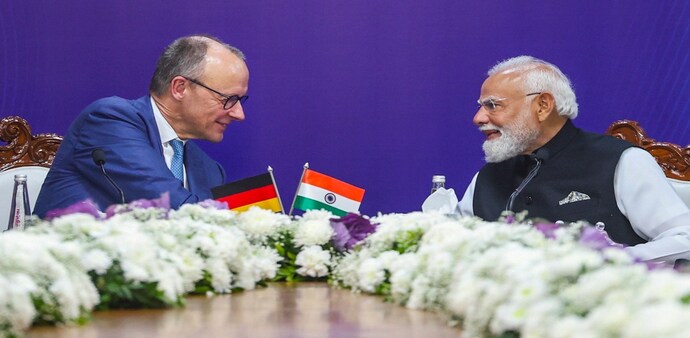
- Jan 13, 2026,
- Updated Jan 13, 2026 5:41 PM IST
Germany's Chancellor Friedrich Merz on Tuesday said that India is emerging as one of its key economic partners and that many "German companies depend on Indian skilled workers and the dynamism of this market."
"That is why we are intensifying our efforts to finalize an EU–India trade agreement. This is in our mutual interest," Merz said during his two-day visit to India. Merz arrived in India early Monday.
In a separate post, the German leader highlighted the depth of people-to-people links, pointing to the scale of language learning and mobility flows between the two countries. "Around 250,000 people in India are learning German. There is no place in the world where Germany issues more visas than here in Bangalore. Language, work, and exchange connect people - an opportunity that benefits both our economies and serves the interests of our countries," he said.
On Monday, Prime Minister Narendra Modi and the German Chancellor unveiled a set of measures aimed at strengthening cooperation across defence, trade, critical minerals and semiconductors.
Following talks in New Delhi, the two sides signed 19 agreements, including a roadmap for defence industrial collaboration, a pact to expand higher education cooperation, and another focused on the telecommunications sector.
The two leaders also jointly pitched for the early finalisation of the India-European Union free trade agreement to expand the bilateral trade basket. A visa-free transit facility for Indian passport holders travelling through Germany was announced as part of efforts to deepen people-to-people ties.
Merz, who arrived in Ahmedabad with a large business delegation, is on his first visit to India as Chancellor.
During the discussions, Modi said expanding trade and investment ties have infused "new energy" into the India-German strategic partnership, noting that bilateral trade has reached its highest-ever level and crossed the $50 billion mark.
"More than 2,000 German companies have been present in India for a long time. This reflects their unwavering confidence in India and the immense opportunities that exist here," the Prime Minister said.
Merz, in his remarks, noted that Germany's demand for skilled professionals from India - including caregivers and nurses - is rising sharply. An agreement on skill partnership signed after the talks is expected to facilitate the movement of more Indian healthcare professionals to Germany, which already hosts around 300,000 Indian expatriates and nearly 60,000 students.
The German leader also flagged shared concerns over supply chain vulnerability amid geopolitical upheaval. "We are experiencing that great powers use supply chains and raw materials increasingly as instruments of power. Together we want to oppose this," Merz said. "We reduce unilateral dependencies of our supply chains, and that makes both our economies more resilient."
Germany's Chancellor Friedrich Merz on Tuesday said that India is emerging as one of its key economic partners and that many "German companies depend on Indian skilled workers and the dynamism of this market."
"That is why we are intensifying our efforts to finalize an EU–India trade agreement. This is in our mutual interest," Merz said during his two-day visit to India. Merz arrived in India early Monday.
In a separate post, the German leader highlighted the depth of people-to-people links, pointing to the scale of language learning and mobility flows between the two countries. "Around 250,000 people in India are learning German. There is no place in the world where Germany issues more visas than here in Bangalore. Language, work, and exchange connect people - an opportunity that benefits both our economies and serves the interests of our countries," he said.
On Monday, Prime Minister Narendra Modi and the German Chancellor unveiled a set of measures aimed at strengthening cooperation across defence, trade, critical minerals and semiconductors.
Following talks in New Delhi, the two sides signed 19 agreements, including a roadmap for defence industrial collaboration, a pact to expand higher education cooperation, and another focused on the telecommunications sector.
The two leaders also jointly pitched for the early finalisation of the India-European Union free trade agreement to expand the bilateral trade basket. A visa-free transit facility for Indian passport holders travelling through Germany was announced as part of efforts to deepen people-to-people ties.
Merz, who arrived in Ahmedabad with a large business delegation, is on his first visit to India as Chancellor.
During the discussions, Modi said expanding trade and investment ties have infused "new energy" into the India-German strategic partnership, noting that bilateral trade has reached its highest-ever level and crossed the $50 billion mark.
"More than 2,000 German companies have been present in India for a long time. This reflects their unwavering confidence in India and the immense opportunities that exist here," the Prime Minister said.
Merz, in his remarks, noted that Germany's demand for skilled professionals from India - including caregivers and nurses - is rising sharply. An agreement on skill partnership signed after the talks is expected to facilitate the movement of more Indian healthcare professionals to Germany, which already hosts around 300,000 Indian expatriates and nearly 60,000 students.
The German leader also flagged shared concerns over supply chain vulnerability amid geopolitical upheaval. "We are experiencing that great powers use supply chains and raw materials increasingly as instruments of power. Together we want to oppose this," Merz said. "We reduce unilateral dependencies of our supply chains, and that makes both our economies more resilient."