
'India tops AI adoption, but reporting must stay human': Kalli Purie at SPIEF 2026
According to her, India's advantage may not necessarily lie in creating foundational AI models from scratch, but in developing innovative applications that leverage the capabilities of models already built by major technology firms.
- Jun 5, 2026,
- Updated Jun 5, 2026 10:18 PM IST
India's growing embrace of artificial intelligence gives it a unique opportunity to shape the next phase of the technology's evolution, India Today Group Vice-Chairperson and Editor-in-Chief Kalli Purie said at the St. Petersburg International Economic Forum (SPIEF) 2026.
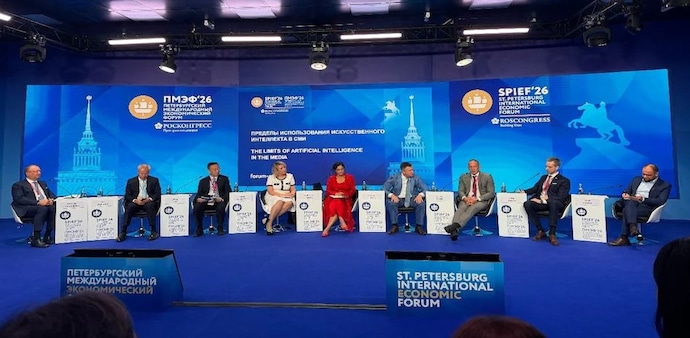
Speaking during a discussion on AI and media, Purie highlighted India's position as one of the world's most active markets for AI adoption and argued that the country's strength may lie in developing innovative applications built on top of foundational models created by major technology companies.
"India is right on top of every table with consumers engaging with AI," she said.
According to Purie, India's large digital population and rapidly growing familiarity with AI tools could help the country emerge as a leader in creating practical AI-driven solutions across industries.
"We could also be the ones that drive AI application on top of the models that have been built out by big tech right now," she added.
While acknowledging AI's transformative potential, Purie stressed that some aspects of journalism cannot be automated. As news organisations increasingly experiment with AI-powered tools, she said there is a growing need to preserve authentic human storytelling and firsthand reporting.
To reinforce that principle, India Today has launched a dedicated editorial initiative called "Handmade," aimed at encouraging reporters and editors to produce stories rooted in direct observation and lived experience.
"We tried as an opposite to the lazy journalist... to create an entire subsection called handmade by editors and reporters," Purie said.
The initiative focuses on what journalists actually witness while covering events — what they saw, heard and experienced — rather than relying solely on standardised reporting formats or information aggregated from other sources.
Wang Bin, director of the Eurasian Bureau of China Media Group, highlighted concerns over data security as organisations increasingly adopt AI tools that require broader system access. "Balancing efficiency with cybersecurity remains a major challenge," Bin said.
Bin said China was working towards developing industry-specific AI models for the media sector. He underlined that a key priority was the creation of a national AI infrastructure.
The remarks come as India witnesses a surge in AI adoption across sectors ranging from education and healthcare to finance, governance and media. The country has also emerged as one of the largest markets for AI-powered consumer platforms, with millions of users experimenting with generative AI tools.
India's growing embrace of artificial intelligence gives it a unique opportunity to shape the next phase of the technology's evolution, India Today Group Vice-Chairperson and Editor-in-Chief Kalli Purie said at the St. Petersburg International Economic Forum (SPIEF) 2026.
Speaking during a discussion on AI and media, Purie highlighted India's position as one of the world's most active markets for AI adoption and argued that the country's strength may lie in developing innovative applications built on top of foundational models created by major technology companies.
"India is right on top of every table with consumers engaging with AI," she said.
According to Purie, India's large digital population and rapidly growing familiarity with AI tools could help the country emerge as a leader in creating practical AI-driven solutions across industries.
"We could also be the ones that drive AI application on top of the models that have been built out by big tech right now," she added.
While acknowledging AI's transformative potential, Purie stressed that some aspects of journalism cannot be automated. As news organisations increasingly experiment with AI-powered tools, she said there is a growing need to preserve authentic human storytelling and firsthand reporting.
To reinforce that principle, India Today has launched a dedicated editorial initiative called "Handmade," aimed at encouraging reporters and editors to produce stories rooted in direct observation and lived experience.
"We tried as an opposite to the lazy journalist... to create an entire subsection called handmade by editors and reporters," Purie said.
The initiative focuses on what journalists actually witness while covering events — what they saw, heard and experienced — rather than relying solely on standardised reporting formats or information aggregated from other sources.
Wang Bin, director of the Eurasian Bureau of China Media Group, highlighted concerns over data security as organisations increasingly adopt AI tools that require broader system access. "Balancing efficiency with cybersecurity remains a major challenge," Bin said.
Bin said China was working towards developing industry-specific AI models for the media sector. He underlined that a key priority was the creation of a national AI infrastructure.
The remarks come as India witnesses a surge in AI adoption across sectors ranging from education and healthcare to finance, governance and media. The country has also emerged as one of the largest markets for AI-powered consumer platforms, with millions of users experimenting with generative AI tools.