
India, UAE seal fresh push on nuclear reactors, AI, defence partnership after PM-UAE president meet
Prime Minister Narendra Modi met UAE President Sheikh Mohamed bin Zayed Al Nahyan on Monday in a short 2-hour-long meeting mapping cooperation across nuclear energy, artificial intelligence, defence and counter-terrorism
- Jan 20, 2026,
- Updated Jan 20, 2026 8:01 AM IST
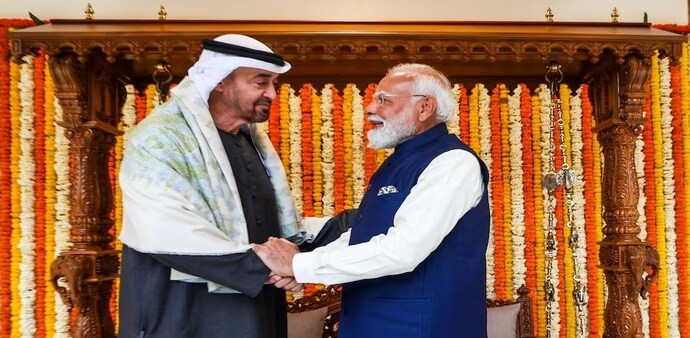
A tightly packed two-hour meeting in New Delhi on Monday pushed India–UAE ties into a higher strategic gear, with Prime Minister Narendra Modi and UAE President Sheikh Mohamed bin Zayed Al Nahyan mapping cooperation across nuclear energy, artificial intelligence, defence, energy security and counter-terrorism.
Foreign Secretary Vikram Misri said the leaders, who share an “extremely warm and close relationship,” held discussions at both restricted and delegation levels. Several agreements and letters of intent were exchanged during the visit, signalling the expanding scope of the India–UAE comprehensive strategic partnership.
The UAE delegation included senior members of the Abu Dhabi and Dubai royal families, among them Sheikh Hamdan bin Mohammed bin Maktoum, who also serves as the UAE’s Deputy Prime Minister and Defence Minister.
Energy and LNG cooperation
Energy security featured prominently, with both sides welcoming a 10-year LNG supply agreement between Hindustan Petroleum Corporation Limited and ADNOC Gas. Under the deal, India will receive 0.5 million tonnes of LNG annually from 2028, reinforcing the UAE’s position as one of India’s largest gas suppliers amid global energy volatility.
Civil nuclear push
Civil nuclear cooperation emerged as a key new pillar. The two countries agreed to explore partnerships in advanced nuclear technologies, including large reactors and Small Modular Reactors (SMRs). Officials said India’s recent enactment of the SHANTI law opens pathways for international collaboration, covering advanced reactor systems, plant operations and maintenance, and nuclear safety.
AI, data and digital infrastructure
Artificial intelligence and emerging technologies were identified as priority areas. The leaders agreed to work towards establishing a supercomputing cluster in India and to explore UAE investments in data centre capacity. They also discussed the concept of “Digital Embassies”, based on mutually recognised digital sovereignty. Sheikh Mohamed backed India’s proposal to host the AI Impact Summit in February 2026.
Defence, security and counter-terrorism
Defence ties received momentum with the signing of a Letter of Intent aimed at a Strategic Defence Partnership. The leaders noted progress from recent exchanges between service chiefs and bilateral military exercises. Both sides unequivocally condemned terrorism, including cross-border terrorism, and reaffirmed cooperation under the Financial Action Task Force framework to combat terror financing and money laundering.
Trade, investment and MSMEs
Economic cooperation remained central. Bilateral trade has touched $100 billion in FY 2024–25 since the Comprehensive Economic Partnership Agreement (CEPA) came into force in 2022. The two sides agreed to target $200 billion in trade by 2032.
They also reviewed investment initiatives, including UAE participation in developing the Special Investment Region at Dholera in Gujarat, spanning an international airport, a greenfield port, energy infrastructure and a smart urban township. Officials were asked to fast-track projects such as Bharat Mart, the Virtual Trade Corridor and Bharat-Africa Setu to connect MSMEs across West Asia, Africa and Eurasia.
Space, food and people-to-people ties
Space cooperation will deepen through a joint initiative focused on commercialising space science and technology, including launch facilities and satellite fabrication. Food security and agriculture were also discussed, with emphasis on resilient supply chains and public–private partnerships. An upcoming MoU on food safety and technical standards is expected to benefit Indian farmers while strengthening the UAE’s food resilience.
People-to-people links featured prominently, with around 4.5 million Indians living in the UAE. The leaders agreed to expand youth exchanges and to establish a ‘House of India’ in Abu Dhabi as a cultural and heritage hub.
Regional and global issues
The two leaders exchanged views on regional and global developments, reaffirming support for peace and stability in West Asia. The UAE conveyed support for India’s BRICS chairmanship in 2026, while India backed the UAE-hosted UN Water Conference later that year. Sheikh Mohamed thanked Prime Minister Modi for the warm reception, calling the visit another step in the steady deepening of bilateral ties.
(With inputs from Pranay Upadhyaya)
A tightly packed two-hour meeting in New Delhi on Monday pushed India–UAE ties into a higher strategic gear, with Prime Minister Narendra Modi and UAE President Sheikh Mohamed bin Zayed Al Nahyan mapping cooperation across nuclear energy, artificial intelligence, defence, energy security and counter-terrorism.
Foreign Secretary Vikram Misri said the leaders, who share an “extremely warm and close relationship,” held discussions at both restricted and delegation levels. Several agreements and letters of intent were exchanged during the visit, signalling the expanding scope of the India–UAE comprehensive strategic partnership.
The UAE delegation included senior members of the Abu Dhabi and Dubai royal families, among them Sheikh Hamdan bin Mohammed bin Maktoum, who also serves as the UAE’s Deputy Prime Minister and Defence Minister.
Energy and LNG cooperation
Energy security featured prominently, with both sides welcoming a 10-year LNG supply agreement between Hindustan Petroleum Corporation Limited and ADNOC Gas. Under the deal, India will receive 0.5 million tonnes of LNG annually from 2028, reinforcing the UAE’s position as one of India’s largest gas suppliers amid global energy volatility.
Civil nuclear push
Civil nuclear cooperation emerged as a key new pillar. The two countries agreed to explore partnerships in advanced nuclear technologies, including large reactors and Small Modular Reactors (SMRs). Officials said India’s recent enactment of the SHANTI law opens pathways for international collaboration, covering advanced reactor systems, plant operations and maintenance, and nuclear safety.
AI, data and digital infrastructure
Artificial intelligence and emerging technologies were identified as priority areas. The leaders agreed to work towards establishing a supercomputing cluster in India and to explore UAE investments in data centre capacity. They also discussed the concept of “Digital Embassies”, based on mutually recognised digital sovereignty. Sheikh Mohamed backed India’s proposal to host the AI Impact Summit in February 2026.
Defence, security and counter-terrorism
Defence ties received momentum with the signing of a Letter of Intent aimed at a Strategic Defence Partnership. The leaders noted progress from recent exchanges between service chiefs and bilateral military exercises. Both sides unequivocally condemned terrorism, including cross-border terrorism, and reaffirmed cooperation under the Financial Action Task Force framework to combat terror financing and money laundering.
Trade, investment and MSMEs
Economic cooperation remained central. Bilateral trade has touched $100 billion in FY 2024–25 since the Comprehensive Economic Partnership Agreement (CEPA) came into force in 2022. The two sides agreed to target $200 billion in trade by 2032.
They also reviewed investment initiatives, including UAE participation in developing the Special Investment Region at Dholera in Gujarat, spanning an international airport, a greenfield port, energy infrastructure and a smart urban township. Officials were asked to fast-track projects such as Bharat Mart, the Virtual Trade Corridor and Bharat-Africa Setu to connect MSMEs across West Asia, Africa and Eurasia.
Space, food and people-to-people ties
Space cooperation will deepen through a joint initiative focused on commercialising space science and technology, including launch facilities and satellite fabrication. Food security and agriculture were also discussed, with emphasis on resilient supply chains and public–private partnerships. An upcoming MoU on food safety and technical standards is expected to benefit Indian farmers while strengthening the UAE’s food resilience.
People-to-people links featured prominently, with around 4.5 million Indians living in the UAE. The leaders agreed to expand youth exchanges and to establish a ‘House of India’ in Abu Dhabi as a cultural and heritage hub.
Regional and global issues
The two leaders exchanged views on regional and global developments, reaffirming support for peace and stability in West Asia. The UAE conveyed support for India’s BRICS chairmanship in 2026, while India backed the UAE-hosted UN Water Conference later that year. Sheikh Mohamed thanked Prime Minister Modi for the warm reception, calling the visit another step in the steady deepening of bilateral ties.
(With inputs from Pranay Upadhyaya)