
India's big cat revival: All five wild species record population growth, shows data
India has emerged as a global conservation success story, with all five of its wild big cat species recording population growth over the past two decades. From reviving the cheetah after seven decades of extinction to boosting tiger and lion numbers, the country's conservation efforts are delivering measurable results.
- Jun 30, 2026,
- Updated Jun 30, 2026 1:45 PM IST
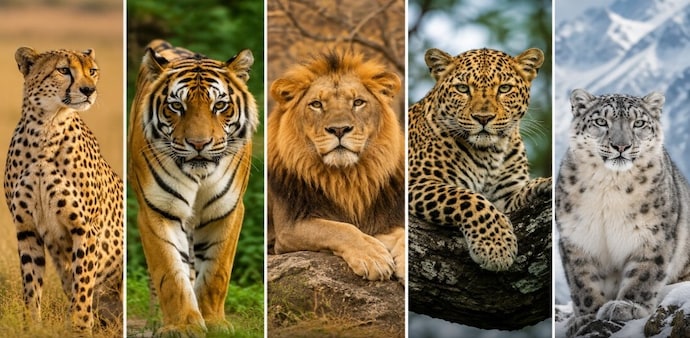
India has achieved a conservation milestone that few countries can match. It is now the only nation in the world where all five wild big cat species — tiger, Asiatic lion, leopard, snow leopard and cheetah—are present in the wild, with each showing an increase in population through sustained conservation efforts.
The latest official estimates indicate that India's tiger population stands at 3,682, leopards at 13,874, Asiatic lions are estimated to have reached 891, snow leopards number 718, while cheetahs, reintroduced after being declared extinct in the country, have grown to 57.
Cheetahs return after seven decades
Perhaps the most remarkable achievement has been the return of the cheetah. The species was declared extinct in India in 1952, making India the only country to lose its native cheetah population.
The launch of Project Cheetah in 2022 changed that. Eight cheetahs were brought from Namibia, followed by additional translocations from South Africa. Since then, several cubs have been born in India, taking the total population to 57 by 2026. The project aims to restore grassland ecosystems where cheetahs once played the role of apex predators.
MUST READ: Cabinet reshuffle around the corner? PM Modi calls top bureaucrats for high-stakes meeting
Tiger numbers rise 161%
India's tiger recovery is considered one of the world's biggest wildlife conservation success stories.
The population had fallen to 1,411 in 2006, triggering stronger conservation measures under Project Tiger and the National Tiger Conservation Authority (NTCA). Enhanced habitat protection, anti-poaching patrols, camera-trap monitoring, scientific population estimation and relocation of villages from core tiger habitats helped reverse the decline.
By 2022, the tiger population had climbed to 3,682, representing an increase of nearly 161%. India now supports nearly 70% of the world's wild tigers.
MUST READ: EV-only car searches rise 60%, Tier-2 cities emerge as India’s next electric growth engine: CarDekho
Lions, leopards and snow leopards also thrive
The Asiatic lion, once restricted to a tiny pocket of Gujarat's Gir landscape, has made a remarkable recovery. From 327 lions in 2000, the population is estimated to have reached 891 in 2025, supported by habitat protection, veterinary care and community participation.
Leopards have also benefited from stronger protection of forests and tiger reserves. Their population increased from 7,910 in 2014 to 13,874 in 2022. Experts attribute this growth to better habitat management, improved prey availability and quicker responses to human-wildlife conflict.
Meanwhile, India's first nationwide scientific assessment under the Snow Leopard Population Assessment in India (SPAI) estimated 718 snow leopards across the Himalayan region in 2024. Conservation programmes have focused on working with local communities, predator-proof livestock enclosures and reducing retaliatory killings.
| Big Cat Species | Earlier Population | Latest Population | Increase | Latest Assessment Year | Key Conservation Initiative |
| Cheetah | Extinct in India (1952); 8 reintroduced in 2022 | 57 | +49 since reintroduction | 2026 | Project Cheetah |
| Tiger | 1,411 (2006) | 3,682 | +160.95% | 2022 | Project Tiger, NTCA |
| Asiatic Lion | 327 (2000) | 891 (estimated) | +172.5% | 2025 | Gir Conservation Programme |
| Leopard | 7,910 (2014) | 13,874 | +75.4% | 2022 | Leopard Monitoring & Habitat Protection |
| Snow Leopard | First nationwide assessment | 718 | Baseline estimate | 2024 | Project Snow Leopard, SPAI |
MUST READ: Ketan Agarwal murder case: Siya Goyal's lawyer sends ₹10 crore defamation notice to her brother
Why India's model is working
Wildlife experts attribute India's success to a combination of legal protection, long-term government funding, scientific monitoring and community involvement. Dedicated programmes such as Project Tiger, Project Lion, Project Snow Leopard and Project Cheetah have been supported by technology, including camera traps, GPS monitoring, drones and the M-STrIPES patrol system.
Conservation has also increasingly involved local communities through compensation schemes, eco-development initiatives and habitat restoration, helping reduce conflicts between people and wildlife.
While challenges such as habitat fragmentation, climate change and rising human-animal conflict remain, India's ability to increase populations of all five big cat species simultaneously stands out as one of the most significant wildlife conservation achievements globally, demonstrating that sustained policy support and scientific management can reverse decades of biodiversity loss.
India has achieved a conservation milestone that few countries can match. It is now the only nation in the world where all five wild big cat species — tiger, Asiatic lion, leopard, snow leopard and cheetah—are present in the wild, with each showing an increase in population through sustained conservation efforts.
The latest official estimates indicate that India's tiger population stands at 3,682, leopards at 13,874, Asiatic lions are estimated to have reached 891, snow leopards number 718, while cheetahs, reintroduced after being declared extinct in the country, have grown to 57.
Cheetahs return after seven decades
Perhaps the most remarkable achievement has been the return of the cheetah. The species was declared extinct in India in 1952, making India the only country to lose its native cheetah population.
The launch of Project Cheetah in 2022 changed that. Eight cheetahs were brought from Namibia, followed by additional translocations from South Africa. Since then, several cubs have been born in India, taking the total population to 57 by 2026. The project aims to restore grassland ecosystems where cheetahs once played the role of apex predators.
MUST READ: Cabinet reshuffle around the corner? PM Modi calls top bureaucrats for high-stakes meeting
Tiger numbers rise 161%
India's tiger recovery is considered one of the world's biggest wildlife conservation success stories.
The population had fallen to 1,411 in 2006, triggering stronger conservation measures under Project Tiger and the National Tiger Conservation Authority (NTCA). Enhanced habitat protection, anti-poaching patrols, camera-trap monitoring, scientific population estimation and relocation of villages from core tiger habitats helped reverse the decline.
By 2022, the tiger population had climbed to 3,682, representing an increase of nearly 161%. India now supports nearly 70% of the world's wild tigers.
MUST READ: EV-only car searches rise 60%, Tier-2 cities emerge as India’s next electric growth engine: CarDekho
Lions, leopards and snow leopards also thrive
The Asiatic lion, once restricted to a tiny pocket of Gujarat's Gir landscape, has made a remarkable recovery. From 327 lions in 2000, the population is estimated to have reached 891 in 2025, supported by habitat protection, veterinary care and community participation.
Leopards have also benefited from stronger protection of forests and tiger reserves. Their population increased from 7,910 in 2014 to 13,874 in 2022. Experts attribute this growth to better habitat management, improved prey availability and quicker responses to human-wildlife conflict.
Meanwhile, India's first nationwide scientific assessment under the Snow Leopard Population Assessment in India (SPAI) estimated 718 snow leopards across the Himalayan region in 2024. Conservation programmes have focused on working with local communities, predator-proof livestock enclosures and reducing retaliatory killings.
| Big Cat Species | Earlier Population | Latest Population | Increase | Latest Assessment Year | Key Conservation Initiative |
| Cheetah | Extinct in India (1952); 8 reintroduced in 2022 | 57 | +49 since reintroduction | 2026 | Project Cheetah |
| Tiger | 1,411 (2006) | 3,682 | +160.95% | 2022 | Project Tiger, NTCA |
| Asiatic Lion | 327 (2000) | 891 (estimated) | +172.5% | 2025 | Gir Conservation Programme |
| Leopard | 7,910 (2014) | 13,874 | +75.4% | 2022 | Leopard Monitoring & Habitat Protection |
| Snow Leopard | First nationwide assessment | 718 | Baseline estimate | 2024 | Project Snow Leopard, SPAI |
MUST READ: Ketan Agarwal murder case: Siya Goyal's lawyer sends ₹10 crore defamation notice to her brother
Why India's model is working
Wildlife experts attribute India's success to a combination of legal protection, long-term government funding, scientific monitoring and community involvement. Dedicated programmes such as Project Tiger, Project Lion, Project Snow Leopard and Project Cheetah have been supported by technology, including camera traps, GPS monitoring, drones and the M-STrIPES patrol system.
Conservation has also increasingly involved local communities through compensation schemes, eco-development initiatives and habitat restoration, helping reduce conflicts between people and wildlife.
While challenges such as habitat fragmentation, climate change and rising human-animal conflict remain, India's ability to increase populations of all five big cat species simultaneously stands out as one of the most significant wildlife conservation achievements globally, demonstrating that sustained policy support and scientific management can reverse decades of biodiversity loss.