
India's engineering exports powering Turkey's drone industry? Here's what data shows
India's engineering exports powering Turkey's drone industry? Here's what data shows
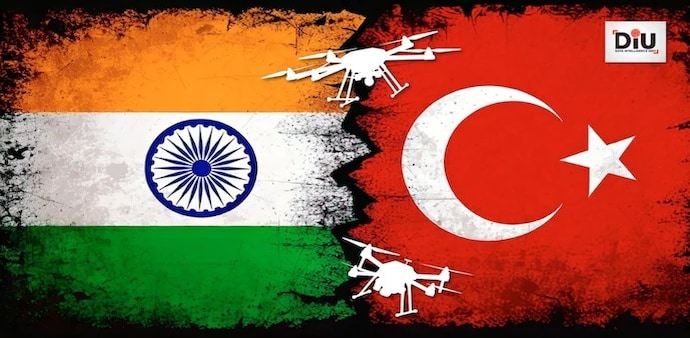
During the four-day conflict earlier this month, Pakistan deployed around 400-plus Turkish drones against India. This military support has exposed a sharp strategic pivot by Ankara towards Islamabad.
Samrat Sharma
- May 14, 2025,
- Updated May 14, 2025 5:01 PM IST
As the dust settles on a fragile ceasefire between India and Pakistan, another diplomatic faultline is emerging — this time between India and Turkey. The trigger: drones, war, and trade. India had long considered Turkey a partner, a sentiment underscored by Operation Dost in 2023 when New Delhi dispatched over 250 personnel, critical equipment, and relief material to help Ankara after a devastating earthquake. But recent developments have brought that goodwill into question.
Advertisement
During the four-day conflict earlier this month, Pakistan deployed around 400-plus Turkish drones against India. This military support has exposed a sharp strategic pivot by Ankara towards Islamabad.
India’s Ministry of External Affairs has taken note of Turkey's growing defence alignment with Pakistan. Reports indicate that Turkey has enforced a blanket ban on defence-related exports to India since 2024. This is despite Indian investment in Turkish drone-maker Zyrone Dynamics as recently as 2021. A partnership agreement had been hailed then as a new era of defence collaboration.
Turkey's official stance during the latest India-Pakistan hostilities only deepened the rift. Instead of condemning the Pahalgam terror attack that killed 26 Indian civilians, Ankara described India's military response as “provocative” and called for an “investigation” into the terror incident — echoing Pakistan’s position.
Advertisement
While Ankara restricts arms sales to New Delhi, India's own exports to Turkey may ironically be aiding its drone manufacturing. According to trade data analysed by India Today's Data Intelligence Unit (DIU), India's engineering exports to Turkey — particularly aluminium products, auto components, telecom instruments, aircraft parts, and electronic equipment — can be directly used in drone production.
Critical drone parts such as batteries, receivers, video transmitters, antennas, electronic speed controls, fight control modules, cameras, propellers, motors, frames, and controllers are among the items that India exports, and many of these components are central to drone systems.
Advertisement
Despite geopolitical tensions, India's engineering goods exports to Turkey have surged post-COVID-19. That trade flow now raises tough questions: Can India continue exporting drone-enabling technologies to a country that is arming its adversary? With Ankara openly backing Pakistan and reportedly supplying both hardware and strategic assistance during the recent conflict, India's next steps on trade and diplomacy with Turkey may be under serious review.
As the dust settles on a fragile ceasefire between India and Pakistan, another diplomatic faultline is emerging — this time between India and Turkey. The trigger: drones, war, and trade. India had long considered Turkey a partner, a sentiment underscored by Operation Dost in 2023 when New Delhi dispatched over 250 personnel, critical equipment, and relief material to help Ankara after a devastating earthquake. But recent developments have brought that goodwill into question.
Advertisement
During the four-day conflict earlier this month, Pakistan deployed around 400-plus Turkish drones against India. This military support has exposed a sharp strategic pivot by Ankara towards Islamabad.
India’s Ministry of External Affairs has taken note of Turkey's growing defence alignment with Pakistan. Reports indicate that Turkey has enforced a blanket ban on defence-related exports to India since 2024. This is despite Indian investment in Turkish drone-maker Zyrone Dynamics as recently as 2021. A partnership agreement had been hailed then as a new era of defence collaboration.
Turkey's official stance during the latest India-Pakistan hostilities only deepened the rift. Instead of condemning the Pahalgam terror attack that killed 26 Indian civilians, Ankara described India's military response as “provocative” and called for an “investigation” into the terror incident — echoing Pakistan’s position.
Advertisement
While Ankara restricts arms sales to New Delhi, India's own exports to Turkey may ironically be aiding its drone manufacturing. According to trade data analysed by India Today's Data Intelligence Unit (DIU), India's engineering exports to Turkey — particularly aluminium products, auto components, telecom instruments, aircraft parts, and electronic equipment — can be directly used in drone production.
Critical drone parts such as batteries, receivers, video transmitters, antennas, electronic speed controls, fight control modules, cameras, propellers, motors, frames, and controllers are among the items that India exports, and many of these components are central to drone systems.
Advertisement
Despite geopolitical tensions, India's engineering goods exports to Turkey have surged post-COVID-19. That trade flow now raises tough questions: Can India continue exporting drone-enabling technologies to a country that is arming its adversary? With Ankara openly backing Pakistan and reportedly supplying both hardware and strategic assistance during the recent conflict, India's next steps on trade and diplomacy with Turkey may be under serious review.
Read more!