
India’s first bullet train is almost here with 280 kmph speed, wi-fi & 557 seats. What to expect
The B28 is being developed for the 508-km Mumbai-Ahmedabad bullet train corridor. The Ministry of Railways has indicated that the first service is planned on the 97-km Surat-Vapi section before the full corridor is opened.
- Nov 2, 2026,
- Updated Nov 2, 2026 11:17 AM IST
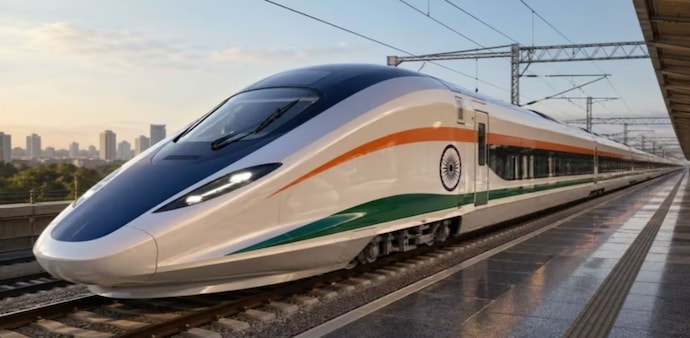
India’s first indigenously manufactured bullet train, the B28 (Bharat-made bullet trainset), is taking shape at BEML’s Bengaluru facility for the Mumbai-Ahmedabad high-speed rail corridor. The eight-coach trainset has a design/test speed of 280 kmph, while its planned operational speed is 249 kmph, according to the Railways.
The B28 is being developed for the 508-km Mumbai-Ahmedabad bullet train corridor. The Ministry of Railways has indicated that the first service is planned on the 97-km Surat-Vapi section before the full corridor is opened.
Railway Minister Ashwini Vaishnaw recently reviewed the train’s progress at BEML’s ADITYA manufacturing facility in Bengaluru, where the train set is being built.
Speed, length and capacity
The B28 will be about 202 metres long and comprise eight coaches — four motor cars and four trailer cars. It will carry approximately 557 passengers, including dedicated space for two Divyangjan or Persons with Reduced Mobility (PRM) passengers.
MUST SEE: WATCH: First glimpse of how India's first indigenous bullet train is being built
The train will have seven standard-class coaches with a 3×2 seating layout and one executive-class coach with 2×2 seating.
Passenger amenities
The trainset will feature a modern HVAC system to regulate cabin temperature and humidity, along with noise-reduction measures for a smoother ride. Passengers will get LCD information displays in English, Hindi and regional languages, automated announcements, and Wi-Fi-based infotainment with preloaded entertainment content.
Other features include ergonomic seating, wide windows, LED lighting, overhead luggage racks, charging points and bio-digester toilets. Emergency talk-back units will be installed in passenger cabins and vestibules.
Accessibility has been built into the design through level boarding, retractable footsteps, wheelchair-friendly doors, dedicated seating and toilets for Divyangjan passengers, and Braille-enabled signage.
Each end of the train will have a driver’s cab equipped with an Intelligent On-Board Control System, while emergency communication systems will allow passengers to contact staff when needed.
Energy-efficient design
The B28 will run on a 25 kV, 50 Hz single-phase AC traction system supplied through a heavy compound catenary. It will also use regenerative braking, which recovers energy during braking and improves overall energy efficiency.
With its aerodynamic design, high-speed capability and passenger-focused features, the B28 marks a major step in India’s entry into high-speed rail manufacturing.
Next rollout plans
India’s first indigenous bullet train, the B28, is expected to roll out from BEML’s Bengaluru facility by the end of 2026 or early 2027, with Railway Minister Ashwini Vaishnaw indicating that the first train could reach the tracks by April-May 2027.
The Railways plans to begin trials on the roughly 97-100 km Surat-Vapi section of the Mumbai-Ahmedabad corridor by May-June 2027, with commercial services targeted for August 2027;
BEML is initially building two eight-car trainsets, which are expected to be ready for trials in the first quarter of 2027; the ministry has also placed a ₹5,400-crore order with BEML for the wider Mumbai-Ahmedabad bullet train fleet and future high-speed routes.