
India’s indigenous Zorawar tank clears crucial missile firing trial, paving way for 2027 induction
The project — conceived after the 2020 Galwan Valley clash — has now entered its advanced testing phase. Construction of the production models is expected to commence soon after the completion of trials, with the Indian Army slated to receive its first batch of light tanks by 2027.
- Oct 17, 2025,
- Updated Oct 17, 2025 10:13 PM IST
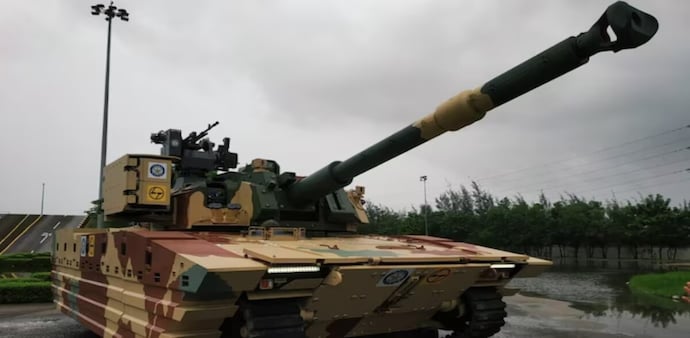
In a major stride toward self-reliance in cutting-edge defence technology, the Defence Research and Development Organisation (DRDO) has achieved a significant milestone in developing India’s first indigenous light tank — Zorawar. The Combat Vehicles Research & Development Establishment (CVRDE) of DRDO successfully demonstrated the Anti-Tank Guided Missile (ATGM) Nag Mk II firing capability, marking a critical step toward the tank’s operational readiness.
Developed by DRDO and manufactured by Larsen & Toubro (L&T), the Zorawar light tank has been engineered under the “Make-I” category of the Defence Acquisition Procedure — a flagship initiative under Atmanirbhar Bharat. The successful trials validated all key performance objectives, including range, top-attack maneuverability, and pinpoint accuracy.
The Nag Mk II missile, boasting a range of 4-10 km and equipped with fire-and-forget guidance, extends the tank’s precision strike capabilities. Building on earlier Nag variants inducted since 2019, this upgrade strengthens India’s indigenous arsenal against heavily armoured threats.
Weighing under 25 tonnes, Zorawar is specifically designed for high-altitude and riverine operations, particularly suited for deployment in challenging terrains like Eastern Ladakh. This makes it a vital asset in regions where heavier tanks face mobility constraints. The platform features a 105 mm Cockerill gun as its primary weapon, complemented by the indigenous ATGM system that significantly enhances its ability to neutralise long-range armoured targets.
China threat
The project — conceived after the 2020 Galwan Valley clash — has now entered its advanced testing phase. Construction of the production models is expected to commence soon after the completion of trials, with the Indian Army slated to receive its first batch of light tanks by 2027. Under Project Zorawar, the Army plans to induct 350 light tanks to bolster combat readiness along the Line of Actual Control (LAC).
China has already stationed its ZTQ-15 (Type 15) light tanks across the LAC, prompting India to accelerate the induction of its indigenous equivalent. The Zorawar platform has been tailored to meet India’s strategic needs — optimised for mobility, rapid deployment, and operation across extreme climatic conditions, from freezing high-altitude zones to scorching deserts.
Designed for a crew of two to three personnel, the tank will incorporate advanced protection systems against aerial and drone-based threats. Its ability to target UAVs, armoured vehicles, and enemy tanks — coupled with the integration of gun-launched ATGMs and multi-purpose smart munitions — positions it as a formidable next-generation light tank for the Indian Army.
In a major stride toward self-reliance in cutting-edge defence technology, the Defence Research and Development Organisation (DRDO) has achieved a significant milestone in developing India’s first indigenous light tank — Zorawar. The Combat Vehicles Research & Development Establishment (CVRDE) of DRDO successfully demonstrated the Anti-Tank Guided Missile (ATGM) Nag Mk II firing capability, marking a critical step toward the tank’s operational readiness.
Developed by DRDO and manufactured by Larsen & Toubro (L&T), the Zorawar light tank has been engineered under the “Make-I” category of the Defence Acquisition Procedure — a flagship initiative under Atmanirbhar Bharat. The successful trials validated all key performance objectives, including range, top-attack maneuverability, and pinpoint accuracy.
The Nag Mk II missile, boasting a range of 4-10 km and equipped with fire-and-forget guidance, extends the tank’s precision strike capabilities. Building on earlier Nag variants inducted since 2019, this upgrade strengthens India’s indigenous arsenal against heavily armoured threats.
Weighing under 25 tonnes, Zorawar is specifically designed for high-altitude and riverine operations, particularly suited for deployment in challenging terrains like Eastern Ladakh. This makes it a vital asset in regions where heavier tanks face mobility constraints. The platform features a 105 mm Cockerill gun as its primary weapon, complemented by the indigenous ATGM system that significantly enhances its ability to neutralise long-range armoured targets.
China threat
The project — conceived after the 2020 Galwan Valley clash — has now entered its advanced testing phase. Construction of the production models is expected to commence soon after the completion of trials, with the Indian Army slated to receive its first batch of light tanks by 2027. Under Project Zorawar, the Army plans to induct 350 light tanks to bolster combat readiness along the Line of Actual Control (LAC).
China has already stationed its ZTQ-15 (Type 15) light tanks across the LAC, prompting India to accelerate the induction of its indigenous equivalent. The Zorawar platform has been tailored to meet India’s strategic needs — optimised for mobility, rapid deployment, and operation across extreme climatic conditions, from freezing high-altitude zones to scorching deserts.
Designed for a crew of two to three personnel, the tank will incorporate advanced protection systems against aerial and drone-based threats. Its ability to target UAVs, armoured vehicles, and enemy tanks — coupled with the integration of gun-launched ATGMs and multi-purpose smart munitions — positions it as a formidable next-generation light tank for the Indian Army.