
India’s most ambitious rail project? India plans a world’s highest railway station in Ladakh at 17,244 Feet in ₹1.31 lakh crore
The estimated cost of ₹1.31 lakh crore would make it one of India’s most expensive railway projects.
- Nov 5, 2026,
- Updated Nov 5, 2026 3:58 PM IST
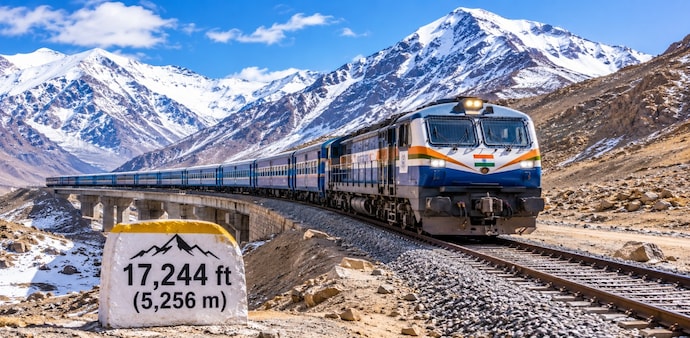
India is planning a 489-km Bilaspur–Manali–Leh railway line with an estimated cost of ₹1.31 lakh crore, including a proposed station at about 17,244 feet (5,256 metres) beneath the Tanglang La pass in Ladakh. If completed at the planned elevation, it would overtake China’s Tanggula station as the world’s highest railway station, The Times of India reported.
The proposed station would sit roughly 188 metres higher than China’s Tanggula railway station on the Qinghai–Tibet Railway, which currently holds the global record at about 5,068 metres. The Indian station is planned below Tanglang La, one of the country’s highest motorable mountain passes.
The alignment would pass through Himachal Pradesh and Ladakh, linking Bilaspur with Leh. The route is expected to include stations at key locations such as Sundernagar, Mandi, Manali, Keylong, Sarchu, Pang, Rumtse and Upshi.
The project is expected to be among India’s most difficult railway undertakings. Nearly 270 km of the 489-km corridor would run through tunnels, reflecting the extreme terrain, seismic risks, avalanches, glacial conditions and sub-zero temperatures of the Himalayan region.
The estimated cost of ₹1.31 lakh crore would make it one of India’s most expensive railway projects. The line is proposed as a broad-gauge connection intended to bring rail access to Ladakh, a region currently dependent largely on road links through mountain passes.
MUST READ: India’s first bullet train is almost here with 280 kmph speed, wi-fi & 557 seats. What to expect
What it means for India
Beyond passenger connectivity, the corridor is viewed as strategically important because it could improve logistics and defence movement in a sensitive frontier region. Faster, all-weather rail access could reduce the cost and time of transporting personnel, fuel, equipment and essential supplies to Ladakh.
For local communities and tourism, the project could open new economic opportunities by improving access between Himachal Pradesh and Leh. However, the scale of construction in ecologically fragile high-altitude terrain is likely to require careful environmental assessment and mitigation planning.
When will the Bilaspur-Manali-Leh railway line be completed?
Despite its ambitious scale, the proposed railway line is still at the planning stage. The railway ministry has completed the survey and prepared the detailed project report, with the estimated project cost pegged at around ₹1.31 lakh crore. However, preparation of a DPR does not automatically mean that construction has been approved. There is also no confirmed completion deadline for the entire corridor.
The project will require significant financial investment, detailed engineering assessments and clearances before construction can move forward. There are also challenges involving other railway projects in Himachal Pradesh that could influence the broader expansion of rail connectivity towards Ladakh.
DON'T MISS: Festive travel alert: Western Railway announces special Gujarat–Uttarakhand trains—Here’s the full schedule