
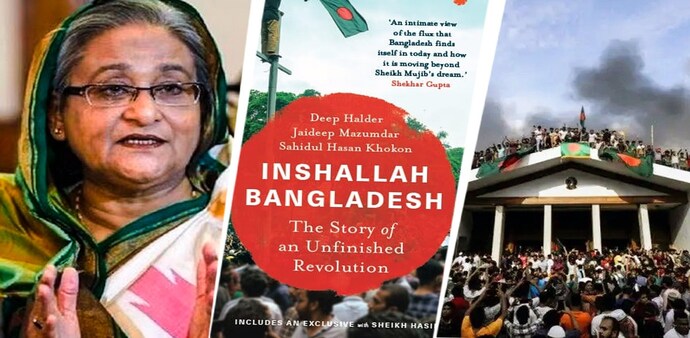
Inshallah Bangladesh reads like a political thriller with explosive details of Hasina's last hours in Dhaka, a call from New Delhi
A gripping account of how Bangladesh's student uprising spiralled into a regime collapse - and how Islamist forces quietly seized the moment
- Nov 5, 2025,
- Updated Nov 5, 2025 6:20 PM IST
We know the headlines, we do not know the stories behind them. What happened in the last few hours before Sheikh Hasina fled from Bangladesh on August 5, 2024? When Hasina turned down her security officials' advice on August 4 to call the leaders of the student movement for a talk, she had hoped the forces, especially the army, would stop their 'Long March to Dhaka'. She was wrong. The army wouldn't. Waker-Uz-Zaman, the army chief, had made up his mind.
What we knew so far was that Waker-uz-Zaman, a close relative of Hasina, saved his boss from the angry mob and refused to order actions against protestors as he feared a revolt within the army. This all made sense, until it didn't.
Some explosive revelations have been made in Inshallah Bangladesh, a new book by Deep Halder, Sahidul Hasan Khokon, and Jaideep Mazumdar.
The book opens with a personal account of one of the authors, who had to flee Bangladesh after being seen as close to the Awami League - enough to draw the wrath of Islamist forces. It then traces how Bangladesh went from a student protest to a regime collapse, and is now slowly slipping into the radical hands of Jamaat.
Panic At Gonobhaban
It was August 4, when student leaders advanced their 'Long March to Dhaka' from August 6 to August 5. The prime minister directed the security agencies to prevent the entry of people into Dhaka. However, some of the army generals and officials present at the meeting told the prime minister that using force to thwart the march may lead to a civil war.
They suggested that the prime minister call the student leaders for talks at Gonobhaban right away, the book reveals. Hasina, however, brushed aside the advice. She repeated what she had said before - that the movement was manufactured, the students misled, and external forces were at play. At such a time, she implored, "all forces should join hands and protect the sovereignty of Bangladesh."
Later that evening, the police chief told Hasina that his force would require backup from the army as lakhs of people were moving towards Dhaka. The prime minister then asked the army chief to redeploy troops and station them at all entry points into Dhaka.
Waker-uz-Zaman, however, told the prime minister point-blank that while troops would be deployed on the streets of Dhaka, "they would not open fire or take any coercive action against the agitators." Hasina was stunned, according to the book. The army chief then said something even more serious - that many retired officers, soldiers, and their families, as well as relatives of those still serving, were part of the protests. "His troops would not open fire on them or harm them in any way," the authors write. "Orders to do so may even trigger a revolt within."
Asaduzzaman Khan Kamal, then home minister and probably number two after Hasina, now claims that what happened in Bangladesh was a CIA operation - and Waker-uz-Zaman was part of it. A dismissed three-star general quoted in the book backs the charge: "Waker-uz-Zaman had betrayed not only the prime minister but the country itself."
Ahead of her ouster, Hasina herself had claimed that a 'White Man' had offered her a military base on St Martin's Island in exchange for a smooth return to power. In May this year, too, Hasina wrote in a Facebook post: "When America wanted St. Martin's Island, my father did not agree. He had to give his life. And that was my destiny. Because I never had the thought of selling the country to stay in power."
Khan recalls that Hasina had warned long before her government's fall that the US was trying to push her out of power as it wanted St Martin's Island. "What we did not know was that General Waker-uz-Zaman was on their payroll," he tells the authors. He adds that intelligence agencies "did not warn the prime minister that Waker had decided to betray her."
It wasn't the CIA alone. Pakistan's spy agency, the Inter-Services Intelligence, or ISI, had been working closely with the Jamaat, Khan adds. In fact, some ISI-trained men had infiltrated Jamaat's ranks and were instrumental in killing policemen in late June.
He also rejects the charge that Hasina did nothing to salvage the situation. "I had rushed to the Prime Minister many times during the June–July agitation. Only to be told by her that the army chief has assured her he would be able to manage the ever-growing crowd of agitating students," he says. "When I told Waker, in the presence of the prime minister, that ISI-trained men were doing the dirty job of killing policemen and the police had to open fire, Waker had told me his men would 'handle the situation'."
Khan says he was a witness to Waker's betrayal.
The former home minister recalls that Waker had said there was no need to open fire as the "army personnel on the ground would ensure that no agitator enters Dhaka." Khan says he wasn't convinced, so he had proposed that his policemen would man Gonobhaban. Waker, however, said "there was no need for that either" as he would ensure that the army would not allow anybody near the prime minister's residence. "Sheikh Hasina had trusted Waker that evening," Khan says. "You know what happened the next day."
A Call From Delhi Saved Hasina's Life
At 12 pm on 5 August, General Waker-uz-Zaman reached Gonobhaban - the prime minister's official residence - along with the navy and air force chiefs. They told Hasina she would have to leave Gonobhaban. "The army chief was insistent that she pack her bags and leave immediately."
Hasina at first resisted, but relented after a call from a top Indian official around 1.30 pm. Around 2:42 pm, the prime minister was airborne. The Awami League government had fallen in Dhaka.
The authors spoke to members of Hasina's personal staff, members of the National Committee on Security Affairs, a senior staff officer of Bangladesh, Army Chief Waker-uz-Zaman, two former Awami League ministers, officers of the NSI and Special Branch, and two top police officers to reconstruct the events at Gonobhaban during the last twenty-four hours of the prime minister's stay.
Most of them are now in hiding in India.
The General's Betrayal
But for Khan, this was not the story of a premier's survival - it was a general's betrayal. "It was Waker-uz-Zaman who betrayed my prime minister! Yes, the man himself. Related to Sheikh Hasina through his wife, Begum Sarahnaz Kamalika Rahman, Waker backstabbed the honourable prime minister," laments the former home minister. "If he hadn't done so, Hasina would have still been in Bangladesh. Fake students' revolution would have been quashed long ago."
According to Khan, Waker had aligned with the fundamentalist forces in Bangladesh to bring Hasina down. "It was a perfect CIA [Central Intelligence Agency] plot, hatched over a long period of time, to overthrow Hasina," the home minister says. "We did not know the CIA had Waker in its pocket."
Islamist takeover of Dhaka
The authors report how under Mohammad Yunus, Bangladesh has fallen into an Islamist sinkhole. The book documents a series of steps that Yunus has taken since assuming power that have emboldened the pro-Pakistan Jamaat-e-Islami. To some, it is Jamaat that is calling the shots, not Yunus. According to the book, a telling example of the ground gained by Islamist and pro-Pakistan forces was the commemoration of Muhammad Ali Jinnah's 76th death anniversary at the National Press Club in Dhaka on 11 September 2024.
Urdu songs and couplets praising Jinnah were recited and sung, and speakers argued that without Jinnah and his 'towering achievement' of carving Pakistan out of India, Bangladesh would not have existed. The event, attended by Pakistani Deputy High Commissioner Kamran Dhangal, Pakistani students studying in Bangladesh, and leading Islamist figures, would have been unthinkable before August 5 - the day Sheikh Hasina left Dhaka.
Jinnah has been a reviled figure in Bangladesh since he was the one who imposed Urdu on the Bengali-speaking people. "To celebrate Jinnah and Urdu is to completely reverse the ideals of the freedom movement and turn back the clock. This is diabolic and amounts to a sinister denial of history," says historian Rubul Ahmed Arefin. "Urdu is the language that led to the breakup of Pakistan. We fought for Bangla, and to see paeans to Jinnah sung in Urdu drives a knife through our hearts."
Weeks after Hasina's fall, Bangladesh Jamaat-e-Islami's leaders held a meeting with top Qawmi scholars of the country, where participants spoke openly about establishing a country based on Islamic rules under the leadership of Jamaat chief Dr Shafiqur Rahman. At the meeting, Mufti AzharulIslam, a top leader of the Hefazat, said something that would unsettle many: "In my opinion, it will be possible to form an Islamic state through him (Rahman)."
It was exactly what Hasina had claimed - that it wasn't a student uprising, but a regime change operation. Now, she tells the authors: "Don't call it a revolution! It was a terror attack on Bangladesh planned by America and executed by Pakistan."
'Inshallah Bangladesh' reads like a political thriller - fast and often unsettling. The authors weave reportage with first-hand testimonies to show how Bangladesh's secular identity is crumbling even as the country prepares for the next polls.
We know the headlines, we do not know the stories behind them. What happened in the last few hours before Sheikh Hasina fled from Bangladesh on August 5, 2024? When Hasina turned down her security officials' advice on August 4 to call the leaders of the student movement for a talk, she had hoped the forces, especially the army, would stop their 'Long March to Dhaka'. She was wrong. The army wouldn't. Waker-Uz-Zaman, the army chief, had made up his mind.
What we knew so far was that Waker-uz-Zaman, a close relative of Hasina, saved his boss from the angry mob and refused to order actions against protestors as he feared a revolt within the army. This all made sense, until it didn't.
Some explosive revelations have been made in Inshallah Bangladesh, a new book by Deep Halder, Sahidul Hasan Khokon, and Jaideep Mazumdar.
The book opens with a personal account of one of the authors, who had to flee Bangladesh after being seen as close to the Awami League - enough to draw the wrath of Islamist forces. It then traces how Bangladesh went from a student protest to a regime collapse, and is now slowly slipping into the radical hands of Jamaat.
Panic At Gonobhaban
It was August 4, when student leaders advanced their 'Long March to Dhaka' from August 6 to August 5. The prime minister directed the security agencies to prevent the entry of people into Dhaka. However, some of the army generals and officials present at the meeting told the prime minister that using force to thwart the march may lead to a civil war.
They suggested that the prime minister call the student leaders for talks at Gonobhaban right away, the book reveals. Hasina, however, brushed aside the advice. She repeated what she had said before - that the movement was manufactured, the students misled, and external forces were at play. At such a time, she implored, "all forces should join hands and protect the sovereignty of Bangladesh."
Later that evening, the police chief told Hasina that his force would require backup from the army as lakhs of people were moving towards Dhaka. The prime minister then asked the army chief to redeploy troops and station them at all entry points into Dhaka.
Waker-uz-Zaman, however, told the prime minister point-blank that while troops would be deployed on the streets of Dhaka, "they would not open fire or take any coercive action against the agitators." Hasina was stunned, according to the book. The army chief then said something even more serious - that many retired officers, soldiers, and their families, as well as relatives of those still serving, were part of the protests. "His troops would not open fire on them or harm them in any way," the authors write. "Orders to do so may even trigger a revolt within."
Asaduzzaman Khan Kamal, then home minister and probably number two after Hasina, now claims that what happened in Bangladesh was a CIA operation - and Waker-uz-Zaman was part of it. A dismissed three-star general quoted in the book backs the charge: "Waker-uz-Zaman had betrayed not only the prime minister but the country itself."
Ahead of her ouster, Hasina herself had claimed that a 'White Man' had offered her a military base on St Martin's Island in exchange for a smooth return to power. In May this year, too, Hasina wrote in a Facebook post: "When America wanted St. Martin's Island, my father did not agree. He had to give his life. And that was my destiny. Because I never had the thought of selling the country to stay in power."
Khan recalls that Hasina had warned long before her government's fall that the US was trying to push her out of power as it wanted St Martin's Island. "What we did not know was that General Waker-uz-Zaman was on their payroll," he tells the authors. He adds that intelligence agencies "did not warn the prime minister that Waker had decided to betray her."
It wasn't the CIA alone. Pakistan's spy agency, the Inter-Services Intelligence, or ISI, had been working closely with the Jamaat, Khan adds. In fact, some ISI-trained men had infiltrated Jamaat's ranks and were instrumental in killing policemen in late June.
He also rejects the charge that Hasina did nothing to salvage the situation. "I had rushed to the Prime Minister many times during the June–July agitation. Only to be told by her that the army chief has assured her he would be able to manage the ever-growing crowd of agitating students," he says. "When I told Waker, in the presence of the prime minister, that ISI-trained men were doing the dirty job of killing policemen and the police had to open fire, Waker had told me his men would 'handle the situation'."
Khan says he was a witness to Waker's betrayal.
The former home minister recalls that Waker had said there was no need to open fire as the "army personnel on the ground would ensure that no agitator enters Dhaka." Khan says he wasn't convinced, so he had proposed that his policemen would man Gonobhaban. Waker, however, said "there was no need for that either" as he would ensure that the army would not allow anybody near the prime minister's residence. "Sheikh Hasina had trusted Waker that evening," Khan says. "You know what happened the next day."
A Call From Delhi Saved Hasina's Life
At 12 pm on 5 August, General Waker-uz-Zaman reached Gonobhaban - the prime minister's official residence - along with the navy and air force chiefs. They told Hasina she would have to leave Gonobhaban. "The army chief was insistent that she pack her bags and leave immediately."
Hasina at first resisted, but relented after a call from a top Indian official around 1.30 pm. Around 2:42 pm, the prime minister was airborne. The Awami League government had fallen in Dhaka.
The authors spoke to members of Hasina's personal staff, members of the National Committee on Security Affairs, a senior staff officer of Bangladesh, Army Chief Waker-uz-Zaman, two former Awami League ministers, officers of the NSI and Special Branch, and two top police officers to reconstruct the events at Gonobhaban during the last twenty-four hours of the prime minister's stay.
Most of them are now in hiding in India.
The General's Betrayal
But for Khan, this was not the story of a premier's survival - it was a general's betrayal. "It was Waker-uz-Zaman who betrayed my prime minister! Yes, the man himself. Related to Sheikh Hasina through his wife, Begum Sarahnaz Kamalika Rahman, Waker backstabbed the honourable prime minister," laments the former home minister. "If he hadn't done so, Hasina would have still been in Bangladesh. Fake students' revolution would have been quashed long ago."
According to Khan, Waker had aligned with the fundamentalist forces in Bangladesh to bring Hasina down. "It was a perfect CIA [Central Intelligence Agency] plot, hatched over a long period of time, to overthrow Hasina," the home minister says. "We did not know the CIA had Waker in its pocket."
Islamist takeover of Dhaka
The authors report how under Mohammad Yunus, Bangladesh has fallen into an Islamist sinkhole. The book documents a series of steps that Yunus has taken since assuming power that have emboldened the pro-Pakistan Jamaat-e-Islami. To some, it is Jamaat that is calling the shots, not Yunus. According to the book, a telling example of the ground gained by Islamist and pro-Pakistan forces was the commemoration of Muhammad Ali Jinnah's 76th death anniversary at the National Press Club in Dhaka on 11 September 2024.
Urdu songs and couplets praising Jinnah were recited and sung, and speakers argued that without Jinnah and his 'towering achievement' of carving Pakistan out of India, Bangladesh would not have existed. The event, attended by Pakistani Deputy High Commissioner Kamran Dhangal, Pakistani students studying in Bangladesh, and leading Islamist figures, would have been unthinkable before August 5 - the day Sheikh Hasina left Dhaka.
Jinnah has been a reviled figure in Bangladesh since he was the one who imposed Urdu on the Bengali-speaking people. "To celebrate Jinnah and Urdu is to completely reverse the ideals of the freedom movement and turn back the clock. This is diabolic and amounts to a sinister denial of history," says historian Rubul Ahmed Arefin. "Urdu is the language that led to the breakup of Pakistan. We fought for Bangla, and to see paeans to Jinnah sung in Urdu drives a knife through our hearts."
Weeks after Hasina's fall, Bangladesh Jamaat-e-Islami's leaders held a meeting with top Qawmi scholars of the country, where participants spoke openly about establishing a country based on Islamic rules under the leadership of Jamaat chief Dr Shafiqur Rahman. At the meeting, Mufti AzharulIslam, a top leader of the Hefazat, said something that would unsettle many: "In my opinion, it will be possible to form an Islamic state through him (Rahman)."
It was exactly what Hasina had claimed - that it wasn't a student uprising, but a regime change operation. Now, she tells the authors: "Don't call it a revolution! It was a terror attack on Bangladesh planned by America and executed by Pakistan."
'Inshallah Bangladesh' reads like a political thriller - fast and often unsettling. The authors weave reportage with first-hand testimonies to show how Bangladesh's secular identity is crumbling even as the country prepares for the next polls.