
Is there a way to end poverty? World Bank President Ajay Banga has some ideas
World Bank President Ajay Banga said he believes wealth creation is best done through entrepreneurship and the private sector.
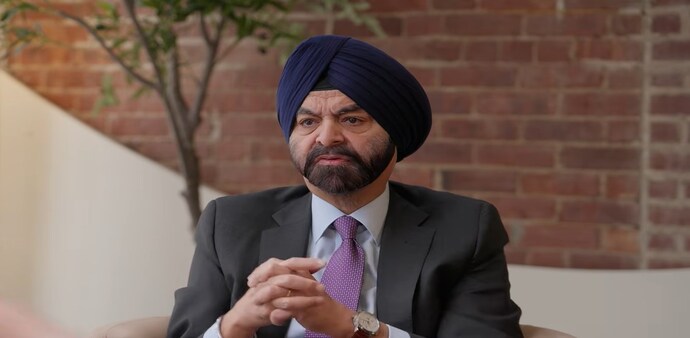
- Apr 21, 2026,
- Updated Apr 21, 2026 12:51 PM IST
To put it simply, a job not only brings one's earnings but also hope and optimism, said Ajay Banga, President of the World Bank Group. He added that “wealth redistribution" is a wrong way to look at financial equity. Banga said wealth is meant to be created and redistribution is the utopian way.
Speaking to Nikhil Kamath in his interview series, ‘People by WTF’, Banga said the point of the World Bank’s existence is to “make jobs for young people, create jobs” and to “kill poverty”.
“That's the idea. Get rid of poverty. And the best way to get rid of poverty, the best way to put a nail in the coffin of poverty is to give somebody a job because then you get not only the earnings that allow them to subsist and have a family and care for them, but you get them hope and optimism. You will hear me talk about hope and optimism, as a very important driver of human behavior. And a job gives you that,” he said.
Banga clarified that he is not talking particularly about the kind of job – it could mean working for someone, or being an entrepreneur, or a small farmer, or even a large entrepreneur. “It could be someone with a successful business like yours. Or it could be somebody who's working like me for somebody else. It doesn't matter,” he said. “The idea of having earnings is what I'm talking about,” he added.
Kamath asked if his understanding that the world does have enough but the distribution is not equal and hence there is poverty on one side and excess on the other is correct.
“Yeah, I don't think like that because I think you're looking at a utopian system where somehow you could wave a magic wand and take from Peter to feed Paul. And I'd be a little careful about that thinking. That's not the way I believe,” he said.
“I believe that what creates wealth first of all is entrepreneurship and the private sector. I believe the government's role is to create the infrastructure and the ability and the human capital and the rules and governance that enable the private sector to create jobs. I mean 85 to 90 per cent of jobs in the world are created in some form or the other in the private sector or in private sector oriented enterprises in the state-owned sector right that's kind of how this happens and most of those are created with medium and small and microenterprises and so that cycle that virtuous cycle of enabling these people to succeed so all of us can also be that way,” he said.
To put it simply, a job not only brings one's earnings but also hope and optimism, said Ajay Banga, President of the World Bank Group. He added that “wealth redistribution" is a wrong way to look at financial equity. Banga said wealth is meant to be created and redistribution is the utopian way.
Speaking to Nikhil Kamath in his interview series, ‘People by WTF’, Banga said the point of the World Bank’s existence is to “make jobs for young people, create jobs” and to “kill poverty”.
“That's the idea. Get rid of poverty. And the best way to get rid of poverty, the best way to put a nail in the coffin of poverty is to give somebody a job because then you get not only the earnings that allow them to subsist and have a family and care for them, but you get them hope and optimism. You will hear me talk about hope and optimism, as a very important driver of human behavior. And a job gives you that,” he said.
Banga clarified that he is not talking particularly about the kind of job – it could mean working for someone, or being an entrepreneur, or a small farmer, or even a large entrepreneur. “It could be someone with a successful business like yours. Or it could be somebody who's working like me for somebody else. It doesn't matter,” he said. “The idea of having earnings is what I'm talking about,” he added.
Kamath asked if his understanding that the world does have enough but the distribution is not equal and hence there is poverty on one side and excess on the other is correct.
“Yeah, I don't think like that because I think you're looking at a utopian system where somehow you could wave a magic wand and take from Peter to feed Paul. And I'd be a little careful about that thinking. That's not the way I believe,” he said.
“I believe that what creates wealth first of all is entrepreneurship and the private sector. I believe the government's role is to create the infrastructure and the ability and the human capital and the rules and governance that enable the private sector to create jobs. I mean 85 to 90 per cent of jobs in the world are created in some form or the other in the private sector or in private sector oriented enterprises in the state-owned sector right that's kind of how this happens and most of those are created with medium and small and microenterprises and so that cycle that virtuous cycle of enabling these people to succeed so all of us can also be that way,” he said.