
Janmashtami 2024: Check date, timing and cultural significance Dahi Handi festival
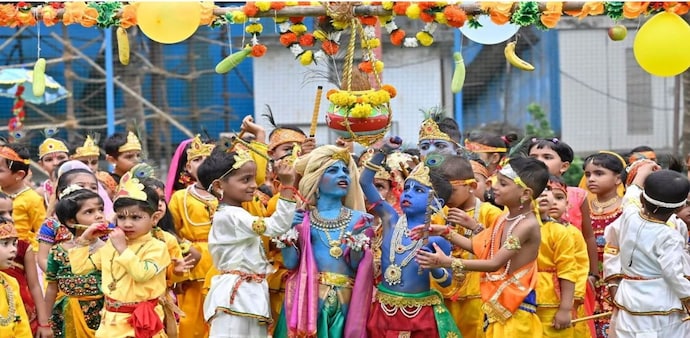
Dahi Handi, literally meaning "pot of curd," is a thrilling and colorful celebration that involves forming human pyramids to reach and break a high-hanging pot filled with curd and other goodies. The pot is suspended at a considerable height, making it a challenging task to break.
- Aug 25, 2024,
- Updated Aug 25, 2024 9:20 PM IST
Janmashtami, the birth anniversary of Lord Krishna, is a major Hindu festival celebrated with great fervor across India. This year, Janmashtami falls on August 26. One of the most popular traditions associated with Janmashtami is the Dahi Handi festival, which will be celebrated on August 27.
Dahi Handi, literally meaning "pot of curd," is a thrilling and colorful celebration that involves forming human pyramids to reach and break a high-hanging pot filled with curd and other goodies. The pot is suspended at a considerable height, making it a challenging task to break. Teams of young men, known as "Govindas," compete to form the tallest pyramids and claim the prize inside the pot.
The origins of Dahi Handi can be traced back to the childhood of Lord Krishna. According to Hindu mythology, Krishna and his friends were mischievous and loved to play pranks. They would often steal curd from the houses of their neighbors. To prevent them from doing so, the villagers would hang pots of curd high up on trees, out of reach of the young Krishna. However, Krishna and his friends were clever and found ways to reach the pots by forming pyramids.
Timings of Dahi Handi
The Ashtami Tithi starts at 3:03 AM on August 26 and ends at 2:01 AM on August 27.
Historic Importance
Dahi Handi celebrates Lord Krishna's playful nature. As a child, Krishna loved butter and curd and often stole them from neighbors, earning him the nickname "maakhan chor" (butter thief). His mother, Yashoda, became frustrated and started hanging the butter, curd, and milk out of his reach. To get to it, Krishna and his friends would build human pyramids to reach the food and share it among themselves.
The Dahi Handi event has become an important part of Indian culture, especially during Janmashtami. It symbolizes strength, teamwork, and coordination. In the event, people form pyramids with up to nine tiers, with the strongest individuals at the base to support everyone else. This tradition not only celebrates Lord Krishna’s playful nature but also adds joy and excitement to the festivities.
Janmashtami, the birth anniversary of Lord Krishna, is a major Hindu festival celebrated with great fervor across India. This year, Janmashtami falls on August 26. One of the most popular traditions associated with Janmashtami is the Dahi Handi festival, which will be celebrated on August 27.
Dahi Handi, literally meaning "pot of curd," is a thrilling and colorful celebration that involves forming human pyramids to reach and break a high-hanging pot filled with curd and other goodies. The pot is suspended at a considerable height, making it a challenging task to break. Teams of young men, known as "Govindas," compete to form the tallest pyramids and claim the prize inside the pot.
The origins of Dahi Handi can be traced back to the childhood of Lord Krishna. According to Hindu mythology, Krishna and his friends were mischievous and loved to play pranks. They would often steal curd from the houses of their neighbors. To prevent them from doing so, the villagers would hang pots of curd high up on trees, out of reach of the young Krishna. However, Krishna and his friends were clever and found ways to reach the pots by forming pyramids.
Timings of Dahi Handi
The Ashtami Tithi starts at 3:03 AM on August 26 and ends at 2:01 AM on August 27.
Historic Importance
Dahi Handi celebrates Lord Krishna's playful nature. As a child, Krishna loved butter and curd and often stole them from neighbors, earning him the nickname "maakhan chor" (butter thief). His mother, Yashoda, became frustrated and started hanging the butter, curd, and milk out of his reach. To get to it, Krishna and his friends would build human pyramids to reach the food and share it among themselves.
The Dahi Handi event has become an important part of Indian culture, especially during Janmashtami. It symbolizes strength, teamwork, and coordination. In the event, people form pyramids with up to nine tiers, with the strongest individuals at the base to support everyone else. This tradition not only celebrates Lord Krishna’s playful nature but also adds joy and excitement to the festivities.