
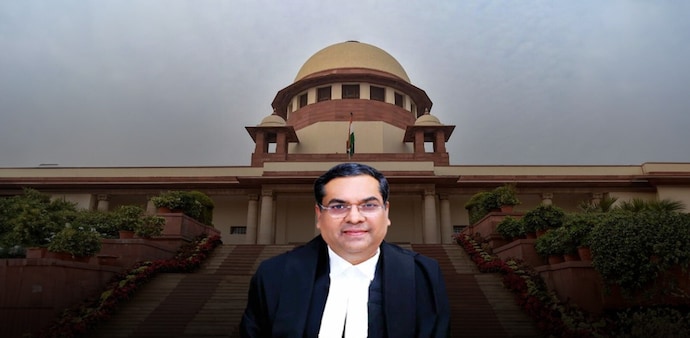
Justice Sanjiv Khanna sworn in as the 51st Chief Justice of India today
Justice Khanna, who is 64 years old, will serve a six-month term, expected to conclude on May 13, 2025.
- Nov 11, 2024,
- Updated Nov 11, 2024 10:18 AM IST
Justice Sanjiv Khanna has sworn in as the 51st Chief Justice of India at a ceremony at Rashtrapati Bhavan today. He will take over from Justice DY Chandrachud, who retired on Sunday after a distinguished tenure.
The oath of office was administered by President Droupadi Murmu at 10 AM. Justice Khanna, who is 64 years old, will serve a six-month term, expected to conclude on May 13, 2025.
Born into a prominent legal family, Justice Khanna is the son of former Delhi High Court judge, Justice Dev Raj Khanna, and the nephew of well-respected former Supreme Court judge H R Khanna. His legal career began in 1983 as an advocate within the Delhi Bar Council. He was appointed to the Delhi High Court in 2005 and elevated to the Supreme Court in 2019.
His judicial experience covers a wide spectrum of legal disciplines, including constitutional law, taxation, arbitration, commercial law, and environmental law. Additionally, Justice Khanna served as the senior standing counsel for the Income Tax Department, representing the National Capital Territory of Delhi.
Justice Khanna has contributed to several landmark judgments throughout his career. Notable among these are the affirmation of the integrity of Electronic Voting Machines (EVMs) and the landmark decision to abrogate Article 370, which previously granted special status to Jammu and Kashmir.
Among his significant decisions, Justice Khanna upheld the integrity of electronic voting machines (EVMs), asserting their security in eliminating booth capturing and bogus voting, thus reinforcing trust in the electoral process.
He also led a bench that deemed the electoral bonds scheme unconstitutional, emphasizing the importance of transparency in political funding. Furthermore, he was involved in granting interim bail to Delhi Chief Minister Arvind Kejriwal, allowing him to campaign for the Lok Sabha elections earlier this year.
Justice Khanna was also instrumental in a ruling involving former Delhi Deputy Chief Minister Manish Sisodia, where he emphasised that delays in legal proceedings could be considered a valid ground for bail under the Prevention of Money Laundering Act (PMLA).
On his final day, Chief Justice DY Chandrachud expressed emotion in reflecting on his time in office, stating, "There is no greater feeling than being able to serve those in need." His departure marks the end of an impactful era in the Indian judiciary.
Justice Sanjiv Khanna has sworn in as the 51st Chief Justice of India at a ceremony at Rashtrapati Bhavan today. He will take over from Justice DY Chandrachud, who retired on Sunday after a distinguished tenure.
The oath of office was administered by President Droupadi Murmu at 10 AM. Justice Khanna, who is 64 years old, will serve a six-month term, expected to conclude on May 13, 2025.
Born into a prominent legal family, Justice Khanna is the son of former Delhi High Court judge, Justice Dev Raj Khanna, and the nephew of well-respected former Supreme Court judge H R Khanna. His legal career began in 1983 as an advocate within the Delhi Bar Council. He was appointed to the Delhi High Court in 2005 and elevated to the Supreme Court in 2019.
His judicial experience covers a wide spectrum of legal disciplines, including constitutional law, taxation, arbitration, commercial law, and environmental law. Additionally, Justice Khanna served as the senior standing counsel for the Income Tax Department, representing the National Capital Territory of Delhi.
Justice Khanna has contributed to several landmark judgments throughout his career. Notable among these are the affirmation of the integrity of Electronic Voting Machines (EVMs) and the landmark decision to abrogate Article 370, which previously granted special status to Jammu and Kashmir.
Among his significant decisions, Justice Khanna upheld the integrity of electronic voting machines (EVMs), asserting their security in eliminating booth capturing and bogus voting, thus reinforcing trust in the electoral process.
He also led a bench that deemed the electoral bonds scheme unconstitutional, emphasizing the importance of transparency in political funding. Furthermore, he was involved in granting interim bail to Delhi Chief Minister Arvind Kejriwal, allowing him to campaign for the Lok Sabha elections earlier this year.
Justice Khanna was also instrumental in a ruling involving former Delhi Deputy Chief Minister Manish Sisodia, where he emphasised that delays in legal proceedings could be considered a valid ground for bail under the Prevention of Money Laundering Act (PMLA).
On his final day, Chief Justice DY Chandrachud expressed emotion in reflecting on his time in office, stating, "There is no greater feeling than being able to serve those in need." His departure marks the end of an impactful era in the Indian judiciary.