
'Largest Hindu kingdom was in Cambodia': Ex-Singapore diplomat urges India to deepen ties with ASEAN
The traditional links between Southeast Asia and India are very deep, very powerful, but they are today unrealised, says Kishore Mahbubani
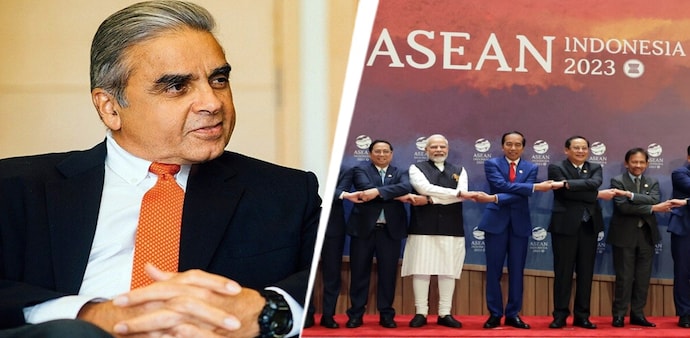
- Oct 8, 2025,
- Updated Oct 8, 2025 9:21 PM IST
Former Singapore diplomat Kishore Mahbubani has called on India to deepen its engagement with Southeast Asia, urging New Delhi to recognise the vast, untapped potential in its relationship with ASEAN. He also highlighted the long-standing historical and cultural connections between India and Southeast Asia, which remain largely unrealised today.
"Way back in the 1990s, long before India emerged into the position where it is today, there was some resistance to bringing India in as a partner of the ASEAN regional forum. And the Singapore Prime Minister then successfully engineered India's entry against the opposition of Malaysia and Indonesia. And people in Delhi still remember that Singapore helped us," Mahbubani said during a discussion hosted by IIM Alumni Singapore. This historical act, he pointed out, laid the foundation for the strategic trust that continues to define India-Singapore relations.
However, Mahbubani stressed that this trust must be extended to ASEAN as a whole. He noted that India's relationship with the region holds immense potential, yet much of it remains untapped. The diplomat spoke of the long historical ties between India and Southeast Asia, which date back over 2,000 years. He pointed out that historically, two countries, China and India, had the greatest influence in Southeast Asia.
"The two countries that had the greatest influence in Southeast Asia were China and India. But what's significant is that out of the 10 Southeast Asian states, nine have an Indic base and only one has a Sinic base - Vietnam," Mahbubani explained. "And many people are not even aware that the largest Hindu kingdom ever in human history was not in India. It was in Cambodia, a thousand years ago. So, the traditional links between Southeast Asia and India are very deep, very powerful, but they are today unrealised."
Mahbubani acknowledged that China's role and presence in Southeast Asia is much greater, but he said this goes against the 2,000-year pattern. "So it will be in India's national interest to try and step up its links with Southeast Asia, given this big historical base. And I would say that it's a mistake to underestimate ASEAN's potential because there are three growth poles in Asia - China, India, and ASEAN. I call it the new CIA."
Looking ahead, the former diplomat highlighted ASEAN's growing significance as a regional economic powerhouse, alongside China and India. He pointed out the rise of the middle class across these regions, noting that in the year 2000, just 150 million people out of a combined population of 3.5 billion (including China, India, and ASEAN) enjoyed middle-class living standards. However, by 2020, this number had surged to 1.5 billion, and by 2030, it is expected to reach 2.5 to 3 billion.
"Now, this is the largest increase in middle-class populations. So instead of looking for growth outside these regions, China, India, and ASEAN - if they work together, they can easily be by far the biggest growth pole in the world," he said.
Former Singapore diplomat Kishore Mahbubani has called on India to deepen its engagement with Southeast Asia, urging New Delhi to recognise the vast, untapped potential in its relationship with ASEAN. He also highlighted the long-standing historical and cultural connections between India and Southeast Asia, which remain largely unrealised today.
"Way back in the 1990s, long before India emerged into the position where it is today, there was some resistance to bringing India in as a partner of the ASEAN regional forum. And the Singapore Prime Minister then successfully engineered India's entry against the opposition of Malaysia and Indonesia. And people in Delhi still remember that Singapore helped us," Mahbubani said during a discussion hosted by IIM Alumni Singapore. This historical act, he pointed out, laid the foundation for the strategic trust that continues to define India-Singapore relations.
However, Mahbubani stressed that this trust must be extended to ASEAN as a whole. He noted that India's relationship with the region holds immense potential, yet much of it remains untapped. The diplomat spoke of the long historical ties between India and Southeast Asia, which date back over 2,000 years. He pointed out that historically, two countries, China and India, had the greatest influence in Southeast Asia.
"The two countries that had the greatest influence in Southeast Asia were China and India. But what's significant is that out of the 10 Southeast Asian states, nine have an Indic base and only one has a Sinic base - Vietnam," Mahbubani explained. "And many people are not even aware that the largest Hindu kingdom ever in human history was not in India. It was in Cambodia, a thousand years ago. So, the traditional links between Southeast Asia and India are very deep, very powerful, but they are today unrealised."
Mahbubani acknowledged that China's role and presence in Southeast Asia is much greater, but he said this goes against the 2,000-year pattern. "So it will be in India's national interest to try and step up its links with Southeast Asia, given this big historical base. And I would say that it's a mistake to underestimate ASEAN's potential because there are three growth poles in Asia - China, India, and ASEAN. I call it the new CIA."
Looking ahead, the former diplomat highlighted ASEAN's growing significance as a regional economic powerhouse, alongside China and India. He pointed out the rise of the middle class across these regions, noting that in the year 2000, just 150 million people out of a combined population of 3.5 billion (including China, India, and ASEAN) enjoyed middle-class living standards. However, by 2020, this number had surged to 1.5 billion, and by 2030, it is expected to reach 2.5 to 3 billion.
"Now, this is the largest increase in middle-class populations. So instead of looking for growth outside these regions, China, India, and ASEAN - if they work together, they can easily be by far the biggest growth pole in the world," he said.