
'Let us not import, but find and make in India', says Anil Agarwal on critical minerals
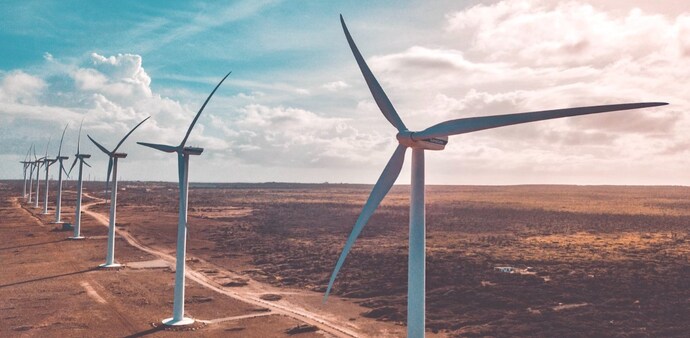
India is targeting a wind power capacity of 140 GW by 2030 more than 3 times the current capacity of 40 GW. The demand for minerals which are required to build this infrastructure will grow exponentially, the Vedanta chairman wrote in a post on X (formally Twitter)
- Apr 29, 2024,
- Updated Apr 29, 2024 11:25 AM IST
Vedanta chairman Anil Agarwal highlighted the need to explore and mine for critical minerals in the country as India targets to increase its wind energy capacity by 2030. "Let us not import, but explore, find and make in India," he wrote in a post on X (formally Twitter).
Agarwal made the observation while sharing a video of a wind turbine blade being transported.
"Amazing. Look at the size of just one wind turbine blade! Usually, we only see these at a distance in wind farms! Each of these requires not only concrete, iron and steel but critical minerals like aluminium, zinc and copper. Offshore wind has 9 times the mineral intensity of conventional power," read his post.
"India is targeting a wind power capacity of 140 GW by 2030 more than 3 times the current capacity of 40 GW. The demand for minerals which are required to build this infrastructure will grow exponentially," the Vedanta chairman wrote.
In February, the government opened up the bidding for 20 blocks with critical minerals like lithium, cobalt, graphite, and molybdenum, which are used in solar modules, wind turbines, transmission networks and batteries.
The government got more than 50 bids in the first auction of critical minerals from Vedanta, Coal India, NLC India, Shree Cement, Orient Cements, Ola Electric, the Dalmia Group, the Rungta Group and Jindal Power.
India classified 24 minerals as 'critical' in December 2023 by amending the Mines and Minerals Development and Regulation Act, 1957.
The government's intent is to secure enough supplies to meet its commitments to reduce emissions and to allow the growth of emerging industries like solar power generation, electric vehicles, and semiconductor chip manufacturing.
India has found lithium reserves in Jammu and Kashmir and Chhattisgarh.
The demand for critical minerals is expected to increase four-fold by 2040, according to the International Energy Agency and a 2023 review of the market showed that China controls more than half of all the lithium refining capacity expected to come up by 2030.
India has also stepped up efforts to diversify supplies with investments in South America.
The Ministry of Mines, along with other departments is hosting a summit on critical minerals in New Delhi from April 29 to April 30. The summit aims to promote collaboration, knowledge sharing, and innovation in the field of critical mineral beneficiation and processing.
India added a record renewable energy capacity of 18.48 GW in 2023-24, which is over 21 percent higher than 15.27 GW a year ago, according to data from the Ministry of New & Renewable Energy.
However, industry experts said there is a need to add at least 50 GW of renewable energy capacity annually for the next six years to meet the ambitious target of 500 GW of renewables by 2030.
Vedanta chairman Anil Agarwal highlighted the need to explore and mine for critical minerals in the country as India targets to increase its wind energy capacity by 2030. "Let us not import, but explore, find and make in India," he wrote in a post on X (formally Twitter).
Agarwal made the observation while sharing a video of a wind turbine blade being transported.
"Amazing. Look at the size of just one wind turbine blade! Usually, we only see these at a distance in wind farms! Each of these requires not only concrete, iron and steel but critical minerals like aluminium, zinc and copper. Offshore wind has 9 times the mineral intensity of conventional power," read his post.
"India is targeting a wind power capacity of 140 GW by 2030 more than 3 times the current capacity of 40 GW. The demand for minerals which are required to build this infrastructure will grow exponentially," the Vedanta chairman wrote.
In February, the government opened up the bidding for 20 blocks with critical minerals like lithium, cobalt, graphite, and molybdenum, which are used in solar modules, wind turbines, transmission networks and batteries.
The government got more than 50 bids in the first auction of critical minerals from Vedanta, Coal India, NLC India, Shree Cement, Orient Cements, Ola Electric, the Dalmia Group, the Rungta Group and Jindal Power.
India classified 24 minerals as 'critical' in December 2023 by amending the Mines and Minerals Development and Regulation Act, 1957.
The government's intent is to secure enough supplies to meet its commitments to reduce emissions and to allow the growth of emerging industries like solar power generation, electric vehicles, and semiconductor chip manufacturing.
India has found lithium reserves in Jammu and Kashmir and Chhattisgarh.
The demand for critical minerals is expected to increase four-fold by 2040, according to the International Energy Agency and a 2023 review of the market showed that China controls more than half of all the lithium refining capacity expected to come up by 2030.
India has also stepped up efforts to diversify supplies with investments in South America.
The Ministry of Mines, along with other departments is hosting a summit on critical minerals in New Delhi from April 29 to April 30. The summit aims to promote collaboration, knowledge sharing, and innovation in the field of critical mineral beneficiation and processing.
India added a record renewable energy capacity of 18.48 GW in 2023-24, which is over 21 percent higher than 15.27 GW a year ago, according to data from the Ministry of New & Renewable Energy.
However, industry experts said there is a need to add at least 50 GW of renewable energy capacity annually for the next six years to meet the ambitious target of 500 GW of renewables by 2030.