
LNG vs hydrogen trains: How India’s two new fuel technologies are changing rail travel
Indian Railways is testing two alternative fuels, but the technologies, infrastructure and emissions profiles are very different
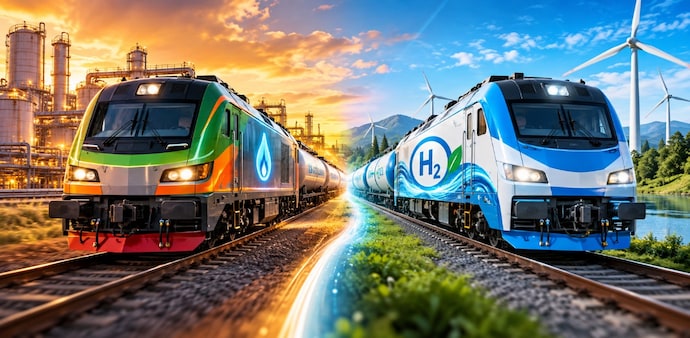
- Sep 30, 2026,
- Updated Sep 30, 2026 1:00 AM IST
Indian Railways now has two very different answers to the question of what should power trains beyond conventional diesel.
India's first hydrogen fuel-cell train began operations between Jind and Sonipat in Haryana in July. Two months later, the Railways introduced its first LNG-diesel dual-fuel train from Sabarmati in Gujarat.
Both projects are being positioned as cleaner alternatives to diesel.
The hydrogen train represents a fundamentally different way of powering a train. The LNG train, on the other hand, is essentially a modified diesel-powered train that can use another fuel alongside diesel.
That difference could determine where each technology makes sense for Indian Railways.
Hydrogen vs LNG: What is actually different?
-
Hydrogen train: Uses a fuel cell to generate electricity onboard.
-
LNG train: Uses a modified internal-combustion engine that can run on LNG and diesel.
-
Hydrogen: The fuel cell produces electricity through a reaction between hydrogen and oxygen, with water vapour as the direct by-product.
-
LNG: Still burns fuel in an engine and therefore continues to produce carbon emissions.
Advertisement -
Hydrogen: Requires dedicated hydrogen production, storage and refuelling infrastructure.
-
LNG: Can work with the existing diesel engine architecture after conversion.
-
Hydrogen: Designed as a new propulsion system.
-
LNG: Designed primarily to reduce diesel consumption without completely replacing the existing propulsion system.
Don't Miss: Govt explores alternative air routes amid ban on Pakistan airspace
The hydrogen train is not a diesel train with a new fuel
This is the biggest distinction.
India's hydrogen train generates its own electricity onboard. Hydrogen stored on the train reacts with oxygen in a fuel cell, producing electricity that powers the train.
The 10-coach train has two Hydrogen Driving Power Cars with a combined power output of 2,400 kW, supported by lithium iron phosphate batteries.
The train is operating on the Jind-Sonipat section and was developed as an indigenous pilot project. Indian Railways has also built dedicated hydrogen storage and dispensing infrastructure at Jind.
The railway ministry said in July that the train had already travelled more than 1,200 km and saved over 3,200 litres of diesel.
In other words, Railways is testing not just a new fuel but an entirely different propulsion ecosystem.
The LNG train keeps the diesel engine
The LNG project takes a much less radical route.
Indian Railways converted two 1,400-HP Driving Power Cars at the Sabarmati Integrated Coaching Depot to operate on both LNG and diesel.
The train is therefore not an LNG-only train.
It can continue using diesel when necessary, while LNG replaces part of the diesel requirement. The system is designed to substitute around 40% of diesel consumption with LNG. More than 2,000 km of field trials were conducted before its launch.
This makes LNG more of a fuel-switching strategy than a complete change in propulsion technology.
LNG train in numbers
-
2 converted Driving Power Cars
-
1,400 HP per power car
-
Around 40% diesel substitution
-
More than 2,000 km of field trials
Advertisement -
8-coach rake
-
Estimated annual saving of around ₹11.9 lakh per Driving Power Car
-
Estimated annual saving of around ₹23.9 lakh for an eight-coach rake, based on trial data
So which one is cleaner?
The answer depends on what is being measured.
At the point where the train operates, the hydrogen fuel-cell system produces water vapour as its direct by-product and has no tailpipe carbon emissions.
LNG is different. It is still a fossil fuel. Its advantage is that it can reduce the amount of diesel used by the train and, according to Railway project estimates, lower emissions including CO₂, nitrogen oxides and particulate matter compared with conventional diesel operation.
There is also an important qualification with hydrogen. Its overall environmental benefit depends on how the hydrogen is produced. India's Jind project is linked to hydrogen production through electrolysis, which is the route associated with green hydrogen when renewable electricity is used.
So, hydrogen can offer a zero-tailpipe-emission propulsion system, while LNG is primarily a way of cutting diesel use without abandoning combustion engines.
The infrastructure gap matters
Hydrogen's biggest difference from LNG is what has to be built around the train.
For hydrogen, Railways needs infrastructure for producing or procuring hydrogen, storing it at high pressure, dispensing it and safely operating the fuel-cell system.
The Jind facility has hydrogen storage capacity of around 3,000 kg, with hydrogen stored at pressures of up to 500 bar and dispensed at 350 bar.
The LNG train does not require the same kind of new propulsion ecosystem. Its existing engine has been modified to accommodate LNG while retaining diesel capability.
That means the two projects are also testing different questions.
-
Hydrogen: Can India build and operate a new hydrogen railway ecosystem?
-
LNG: Can Indian Railways cut diesel consumption using existing train technology?
Why does Railways need alternatives when electrification is already high?
This is where India's railway story becomes important.
Indian Railways has rapidly electrified its broad-gauge network, sharply reducing its dependence on diesel. The hydrogen project is being tested on the Jind-Sonipat section, while the LNG train is being introduced as another option for alternative-fuel operations.
That means these trains are not necessarily competing with electric locomotives across India's main railway network.
Instead, they are experiments in what Railways can use on sections where alternative propulsion may be considered.
Hydrogen could eventually offer a completely different zero-tailpipe-emission option, but it requires new infrastructure and fuel supply chains.
LNG offers something more immediate: retain the basic engine architecture, introduce another fuel and reduce diesel consumption.
Must Read: Mumbai-Ahmedabad bullet train project hits milestone as first steel bridge launched in Maharashtra
The bigger difference is the stage of transition
The two trains therefore represent two different stages of India's attempt to move away from diesel.
LNG is an adaptation. Hydrogen is a technological shift.
The LNG train asks how much diesel Railways can eliminate without replacing its existing propulsion system.
The hydrogen train asks whether Railways can eventually operate trains using an entirely different energy system.
For India, the outcome will depend not only on emissions but also on fuel availability, infrastructure requirements, maintenance, operating costs and whether either technology can be scaled beyond pilot projects.
For now, the two trains are less a choice between LNG and hydrogen and more two separate experiments in what India's post-diesel railway could look like.
Indian Railways now has two very different answers to the question of what should power trains beyond conventional diesel.
India's first hydrogen fuel-cell train began operations between Jind and Sonipat in Haryana in July. Two months later, the Railways introduced its first LNG-diesel dual-fuel train from Sabarmati in Gujarat.
Both projects are being positioned as cleaner alternatives to diesel.
The hydrogen train represents a fundamentally different way of powering a train. The LNG train, on the other hand, is essentially a modified diesel-powered train that can use another fuel alongside diesel.
That difference could determine where each technology makes sense for Indian Railways.
Hydrogen vs LNG: What is actually different?
-
Hydrogen train: Uses a fuel cell to generate electricity onboard.
-
LNG train: Uses a modified internal-combustion engine that can run on LNG and diesel.
-
Hydrogen: The fuel cell produces electricity through a reaction between hydrogen and oxygen, with water vapour as the direct by-product.
-
LNG: Still burns fuel in an engine and therefore continues to produce carbon emissions.
Advertisement -
Hydrogen: Requires dedicated hydrogen production, storage and refuelling infrastructure.
-
LNG: Can work with the existing diesel engine architecture after conversion.
-
Hydrogen: Designed as a new propulsion system.
-
LNG: Designed primarily to reduce diesel consumption without completely replacing the existing propulsion system.
Don't Miss: Govt explores alternative air routes amid ban on Pakistan airspace
The hydrogen train is not a diesel train with a new fuel
This is the biggest distinction.
India's hydrogen train generates its own electricity onboard. Hydrogen stored on the train reacts with oxygen in a fuel cell, producing electricity that powers the train.
The 10-coach train has two Hydrogen Driving Power Cars with a combined power output of 2,400 kW, supported by lithium iron phosphate batteries.
The train is operating on the Jind-Sonipat section and was developed as an indigenous pilot project. Indian Railways has also built dedicated hydrogen storage and dispensing infrastructure at Jind.
The railway ministry said in July that the train had already travelled more than 1,200 km and saved over 3,200 litres of diesel.
In other words, Railways is testing not just a new fuel but an entirely different propulsion ecosystem.
The LNG train keeps the diesel engine
The LNG project takes a much less radical route.
Indian Railways converted two 1,400-HP Driving Power Cars at the Sabarmati Integrated Coaching Depot to operate on both LNG and diesel.
The train is therefore not an LNG-only train.
It can continue using diesel when necessary, while LNG replaces part of the diesel requirement. The system is designed to substitute around 40% of diesel consumption with LNG. More than 2,000 km of field trials were conducted before its launch.
This makes LNG more of a fuel-switching strategy than a complete change in propulsion technology.
LNG train in numbers
-
2 converted Driving Power Cars
-
1,400 HP per power car
-
Around 40% diesel substitution
-
More than 2,000 km of field trials
Advertisement -
8-coach rake
-
Estimated annual saving of around ₹11.9 lakh per Driving Power Car
-
Estimated annual saving of around ₹23.9 lakh for an eight-coach rake, based on trial data
So which one is cleaner?
The answer depends on what is being measured.
At the point where the train operates, the hydrogen fuel-cell system produces water vapour as its direct by-product and has no tailpipe carbon emissions.
LNG is different. It is still a fossil fuel. Its advantage is that it can reduce the amount of diesel used by the train and, according to Railway project estimates, lower emissions including CO₂, nitrogen oxides and particulate matter compared with conventional diesel operation.
There is also an important qualification with hydrogen. Its overall environmental benefit depends on how the hydrogen is produced. India's Jind project is linked to hydrogen production through electrolysis, which is the route associated with green hydrogen when renewable electricity is used.
So, hydrogen can offer a zero-tailpipe-emission propulsion system, while LNG is primarily a way of cutting diesel use without abandoning combustion engines.
The infrastructure gap matters
Hydrogen's biggest difference from LNG is what has to be built around the train.
For hydrogen, Railways needs infrastructure for producing or procuring hydrogen, storing it at high pressure, dispensing it and safely operating the fuel-cell system.
The Jind facility has hydrogen storage capacity of around 3,000 kg, with hydrogen stored at pressures of up to 500 bar and dispensed at 350 bar.
The LNG train does not require the same kind of new propulsion ecosystem. Its existing engine has been modified to accommodate LNG while retaining diesel capability.
That means the two projects are also testing different questions.
-
Hydrogen: Can India build and operate a new hydrogen railway ecosystem?
-
LNG: Can Indian Railways cut diesel consumption using existing train technology?
Why does Railways need alternatives when electrification is already high?
This is where India's railway story becomes important.
Indian Railways has rapidly electrified its broad-gauge network, sharply reducing its dependence on diesel. The hydrogen project is being tested on the Jind-Sonipat section, while the LNG train is being introduced as another option for alternative-fuel operations.
That means these trains are not necessarily competing with electric locomotives across India's main railway network.
Instead, they are experiments in what Railways can use on sections where alternative propulsion may be considered.
Hydrogen could eventually offer a completely different zero-tailpipe-emission option, but it requires new infrastructure and fuel supply chains.
LNG offers something more immediate: retain the basic engine architecture, introduce another fuel and reduce diesel consumption.
Must Read: Mumbai-Ahmedabad bullet train project hits milestone as first steel bridge launched in Maharashtra
The bigger difference is the stage of transition
The two trains therefore represent two different stages of India's attempt to move away from diesel.
LNG is an adaptation. Hydrogen is a technological shift.
The LNG train asks how much diesel Railways can eliminate without replacing its existing propulsion system.
The hydrogen train asks whether Railways can eventually operate trains using an entirely different energy system.
For India, the outcome will depend not only on emissions but also on fuel availability, infrastructure requirements, maintenance, operating costs and whether either technology can be scaled beyond pilot projects.
For now, the two trains are less a choice between LNG and hydrogen and more two separate experiments in what India's post-diesel railway could look like.