
'Look forward to welcoming next month': US confirms India’s entry into Pax Silica tech coalition
US Under Secretary of State for Economic Affairs Jacob Helberg made the announcement on January 29 while speaking at the Hudson Institute, underscoring India’s growing role in the global semiconductor and artificial intelligence supply chain.
- Jan 30, 2026,
- Updated Jan 30, 2026 2:55 PM IST
The United States has officially confirmed that India will join Pax Silica, its flagship economic security and technology coalition, in February 2026 — marking what Washington describes as a historic expansion of the alliance into the world’s largest democracy.
US Under Secretary of State for Economic Affairs Jacob Helberg made the announcement on January 29 while speaking at the Hudson Institute, underscoring India’s growing role in the global semiconductor and artificial intelligence supply chain.
“We look forward to welcoming India next month,” Helberg said, noting that while the initial core of Pax Silica focused on advanced manufacturing hubs such as Japan and South Korea, India’s inclusion is essential to securing the broader supply chain — from critical minerals to AI infrastructure.
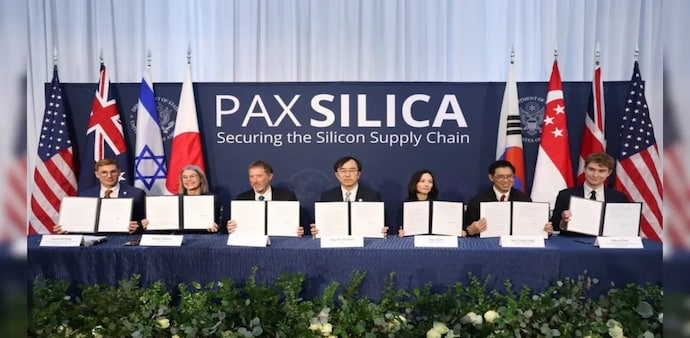
Launched in December 2025, Pax Silica is a US-led initiative aimed at safeguarding the global semiconductor and AI ecosystem and reducing dependence on non-aligned or adversarial nations. The alliance currently includes the United States, Japan, South Korea, Israel, Australia, Singapore, and the United Kingdom, with Qatar and the United Arab Emirates joining shortly after the initial signing.
Helberg described the effort as an expanding coalition of “capable partners,” moving beyond the traditional Western bloc to include key powers in the Middle East and South Asia.
“We’re rapidly expanding this coalition of capable partners,” he said. “As we grow, we will create functional working groups that leverage each partner country’s unique expertise — ensuring our work remains tangible and focused on results, not dialogue for its own sake.”
He cited examples such as Dutch lithography, Taiwanese fabrication, and Indian software, signalling that India’s vast engineering talent pool and emerging hardware manufacturing ecosystem are central to its induction.
Helberg framed Pax Silica as a response to what he called the “weaponisation” of technology supply chains in an era of intensifying global competition.
“This AI race is a fundamental struggle for the architecture of the 21st century,” he said. “Dependency is being used as a leash, and supply chains of the AI revolution are being turned into tools of political coercion.”
According to Helberg, Pax Silica operates along three broad tracks — membership, policy, and projects — with a focus on aligning export controls, investment screening, and R&D subsidies to ensure trusted technologies do not leak to adversaries.
In a post on X, Helberg said India’s entry marked “a decisive shift toward reliable and secure supply chains,” calling it a historic moment for the US-India partnership.
Pax Silica’s mandate spans semiconductors, advanced manufacturing, AI infrastructure, critical minerals, energy inputs, and logistics, reflecting a broader shift in US economic policy toward proactive coalition-building rather than reactive market interventions.
(With inputs from PTI)
The United States has officially confirmed that India will join Pax Silica, its flagship economic security and technology coalition, in February 2026 — marking what Washington describes as a historic expansion of the alliance into the world’s largest democracy.
US Under Secretary of State for Economic Affairs Jacob Helberg made the announcement on January 29 while speaking at the Hudson Institute, underscoring India’s growing role in the global semiconductor and artificial intelligence supply chain.
“We look forward to welcoming India next month,” Helberg said, noting that while the initial core of Pax Silica focused on advanced manufacturing hubs such as Japan and South Korea, India’s inclusion is essential to securing the broader supply chain — from critical minerals to AI infrastructure.
Launched in December 2025, Pax Silica is a US-led initiative aimed at safeguarding the global semiconductor and AI ecosystem and reducing dependence on non-aligned or adversarial nations. The alliance currently includes the United States, Japan, South Korea, Israel, Australia, Singapore, and the United Kingdom, with Qatar and the United Arab Emirates joining shortly after the initial signing.
Helberg described the effort as an expanding coalition of “capable partners,” moving beyond the traditional Western bloc to include key powers in the Middle East and South Asia.
“We’re rapidly expanding this coalition of capable partners,” he said. “As we grow, we will create functional working groups that leverage each partner country’s unique expertise — ensuring our work remains tangible and focused on results, not dialogue for its own sake.”
He cited examples such as Dutch lithography, Taiwanese fabrication, and Indian software, signalling that India’s vast engineering talent pool and emerging hardware manufacturing ecosystem are central to its induction.
Helberg framed Pax Silica as a response to what he called the “weaponisation” of technology supply chains in an era of intensifying global competition.
“This AI race is a fundamental struggle for the architecture of the 21st century,” he said. “Dependency is being used as a leash, and supply chains of the AI revolution are being turned into tools of political coercion.”
According to Helberg, Pax Silica operates along three broad tracks — membership, policy, and projects — with a focus on aligning export controls, investment screening, and R&D subsidies to ensure trusted technologies do not leak to adversaries.
In a post on X, Helberg said India’s entry marked “a decisive shift toward reliable and secure supply chains,” calling it a historic moment for the US-India partnership.
Pax Silica’s mandate spans semiconductors, advanced manufacturing, AI infrastructure, critical minerals, energy inputs, and logistics, reflecting a broader shift in US economic policy toward proactive coalition-building rather than reactive market interventions.
(With inputs from PTI)