
'Looks less like an honor than an entry fee': Geostrategist flags risks in Trump's peace board
Washington's invitation to India to join this body, while simultaneously maintaining punitive 50% tariffs on Indian exports, underscores the Trump's transactional approach toward New Delhi, says Chellaney
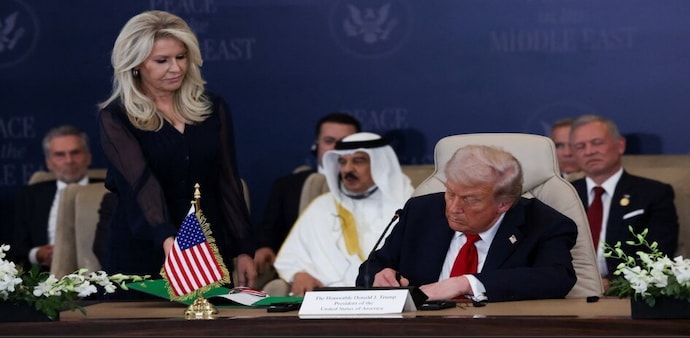
- Jan 19, 2026,
- Updated Jan 19, 2026 3:19 PM IST
Geostrategist Brahma Chellaney on Monday warned India against joining US President Donald Trump's proposed "Board of Peace" for Gaza, arguing that the invitation comes with a steep financial cost and little strategic clarity.
India has been invited by Trump to be part of the Board of Peace for Gaza along with other global partners. Trump's Board of Peace is being projected by Washington as a new international body to usher in peace and stability in Gaza and beyond.
Reacting to Washington's outreach, Chellaney argued that the proposed body was being pitched as a new international peacekeeping mechanism even though its charter makes no direct reference to Gaza.
"Trump's so-called 'Board of Peace' — whose charter makes no mention of Gaza, even though Gaza would almost certainly be its first test case — is being marketed as a new international peacekeeping body," Chellaney said.
"Permanent membership, however, comes with a $1 billion price tag," he said, adding that the timing of the invitation raised uncomfortable questions for India. "Washington's invitation to India to join this body, while simultaneously maintaining punitive 50% tariffs on Indian exports, underscores the Trump administration’s starkly transactional, ‘carrot-and-stick’ approach toward New Delhi," he said.
The noted geostrategist also flagged the optics of India being invited alongside Pakistan, suggesting a revival of diplomatic hyphenation that New Delhi has long resisted. "By inviting India and Pakistan together, the administration appears to be reviving a hyphenation strategy, treating both as regional anchors whose participation would lend legitimacy to a U.S.-led alternative to the United Nations," he said. "Pairing India with Pakistan also signals that New Delhi's ‘strategic partner’ status confers no special consideration — political, economic or diplomatic."
The requirement that members contribute $1 billion within the board's first year, Chellaney said, further undermines the premise of the invitation. "Given the requirement of a $1 billion contribution within the board’s first year, the invitation looks less like an honor than an entry fee to a club whose rules, mandate and objectives remain undefined, if not vague," he said.
India's longstanding preference for multilateral frameworks anchored in the United Nations, he warned, could be compromised by joining a US-led body operating outside the UN system. "India has traditionally favored UN-led peacekeeping missions. Joining a US-led ‘Executive Board’ that effectively sidesteps the UN Charter would pose a serious challenge to India’s longstanding commitment to strategic autonomy and multilateralism," Chellaney said.
He argued that the trade pressure being applied by Washington could not be separated from the geopolitical ask now being made of New Delhi.
"Moreover, the 50% tariffs are not merely a trade dispute; they are a direct penalty for India’s insistence on strategic autonomy," Chellaney said. "Yet Washington is simultaneously asking India to help stabilize the Middle East — and to underwrite that effort with a $1 billion contribution — while extracting billions more from the Indian economy through weaponized trade."
According to Chellaney, the broader pattern suggests that India is being viewed less as a strategic equal and more as a transactional instrument. "Geopolitically, India is deemed vital for managing the Global South and countering China's influence in the Middle East and elsewhere. Economically, however, a rising India is increasingly treated as a competitor to be pressured into a trade deal on Washington’s terms."
Chellaney ended with a warning about the risks embedded in the proposal itself. "More fundamentally," he said, "New Delhi should remember that, given Trump's record, a 'Board of Peace' may well evolve into a Board of Conflict."
Geostrategist Brahma Chellaney on Monday warned India against joining US President Donald Trump's proposed "Board of Peace" for Gaza, arguing that the invitation comes with a steep financial cost and little strategic clarity.
India has been invited by Trump to be part of the Board of Peace for Gaza along with other global partners. Trump's Board of Peace is being projected by Washington as a new international body to usher in peace and stability in Gaza and beyond.
Reacting to Washington's outreach, Chellaney argued that the proposed body was being pitched as a new international peacekeeping mechanism even though its charter makes no direct reference to Gaza.
"Trump's so-called 'Board of Peace' — whose charter makes no mention of Gaza, even though Gaza would almost certainly be its first test case — is being marketed as a new international peacekeeping body," Chellaney said.
"Permanent membership, however, comes with a $1 billion price tag," he said, adding that the timing of the invitation raised uncomfortable questions for India. "Washington's invitation to India to join this body, while simultaneously maintaining punitive 50% tariffs on Indian exports, underscores the Trump administration’s starkly transactional, ‘carrot-and-stick’ approach toward New Delhi," he said.
The noted geostrategist also flagged the optics of India being invited alongside Pakistan, suggesting a revival of diplomatic hyphenation that New Delhi has long resisted. "By inviting India and Pakistan together, the administration appears to be reviving a hyphenation strategy, treating both as regional anchors whose participation would lend legitimacy to a U.S.-led alternative to the United Nations," he said. "Pairing India with Pakistan also signals that New Delhi's ‘strategic partner’ status confers no special consideration — political, economic or diplomatic."
The requirement that members contribute $1 billion within the board's first year, Chellaney said, further undermines the premise of the invitation. "Given the requirement of a $1 billion contribution within the board’s first year, the invitation looks less like an honor than an entry fee to a club whose rules, mandate and objectives remain undefined, if not vague," he said.
India's longstanding preference for multilateral frameworks anchored in the United Nations, he warned, could be compromised by joining a US-led body operating outside the UN system. "India has traditionally favored UN-led peacekeeping missions. Joining a US-led ‘Executive Board’ that effectively sidesteps the UN Charter would pose a serious challenge to India’s longstanding commitment to strategic autonomy and multilateralism," Chellaney said.
He argued that the trade pressure being applied by Washington could not be separated from the geopolitical ask now being made of New Delhi.
"Moreover, the 50% tariffs are not merely a trade dispute; they are a direct penalty for India’s insistence on strategic autonomy," Chellaney said. "Yet Washington is simultaneously asking India to help stabilize the Middle East — and to underwrite that effort with a $1 billion contribution — while extracting billions more from the Indian economy through weaponized trade."
According to Chellaney, the broader pattern suggests that India is being viewed less as a strategic equal and more as a transactional instrument. "Geopolitically, India is deemed vital for managing the Global South and countering China's influence in the Middle East and elsewhere. Economically, however, a rising India is increasingly treated as a competitor to be pressured into a trade deal on Washington’s terms."
Chellaney ended with a warning about the risks embedded in the proposal itself. "More fundamentally," he said, "New Delhi should remember that, given Trump's record, a 'Board of Peace' may well evolve into a Board of Conflict."