
Lost for 158 years: Endangered Himalayan flower blooms again in Arunachal Pradesh
The elusive flower was located in the Chuna Valley near Mago village at an altitude of around 3,600 metres, where harsh alpine conditions and short growing seasons make survival challenging for most plant species.
- Jul 9, 2026,
- Updated Jul 9, 2026 1:50 PM IST
For more than a century and a half, it existed only in botanical records and preserved herbarium specimens. Now, a tiny purple-blue flower that had disappeared from India's scientific record has made an extraordinary return.
Scientists have rediscovered Cyananthus hookeri, a rare Himalayan alpine plant last documented in India in 1867, during a high-altitude survey in Arunachal Pradesh's Tawang district. The finding ends a 158-year gap in the species' recorded presence in the country and adds a significant chapter to India's botanical history.
The landmark discovery was made by a research team from the Botanical Survey of India (BSI), comprising Sudhansu Sekhar Dash, Subhajit Lahiri and Monalisa Das. Their findings have been published in the international conservation journal Oryx.
The elusive flower was located in the Chuna Valley near Mago village at an altitude of around 3,600 metres, where harsh alpine conditions and short growing seasons make survival challenging for most plant species. Despite decades of botanical exploration across the eastern Himalayas, the species had remained undetected in India since the 19th century.
The rediscovery is particularly significant because it represents the first confirmed record of Cyananthus hookeri in Arunachal Pradesh. Although the species is known from isolated pockets of Bhutan, Nepal, Tibet and parts of China, it had never before been scientifically documented from the state.
The plant also carries a historical legacy. It was first collected in India by renowned British botanist Sir Joseph Dalton Hooker during his Himalayan expeditions in Sikkim in 1867. The species was later named in his honour, making the latest discovery a remarkable link between modern field research and one of the earliest chapters of Himalayan botany.
Despite its dramatic return, scientists say the flower remains in a precarious position.
During the expedition, researchers counted fewer than 50 mature plants, all confined to a highly restricted alpine habitat. Such a tiny population makes the species especially vulnerable to habitat disturbance, climate change and other environmental pressures that increasingly threaten fragile mountain ecosystems.
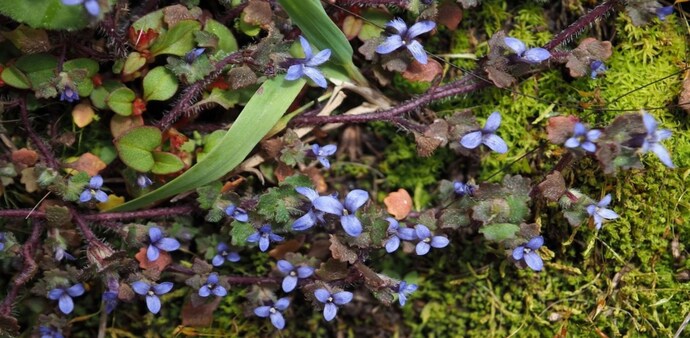
Cyananthus hookeri is a delicate alpine herb belonging to the Campanulaceae, or bellflower, family. Its vivid purple-blue blossoms stand out against the rocky Himalayan landscape, but its beauty also masks its vulnerability. The species survives only within a narrow ecological niche, making it one of the region's more fragile botanical treasures.
Given the extremely limited population and restricted distribution, the researchers have recommended that the species be classified as Endangered in India under the International Union for Conservation of Nature (IUCN) Red List criteria.
The rediscovery also underscores the ecological importance of Arunachal Pradesh, which forms part of the Eastern Himalaya—one of the world's richest biodiversity hotspots. Many remote valleys in the region remain scientifically underexplored, leaving open the possibility that other species thought to be lost or locally extinct may still persist in isolated mountain habitats.
For conservationists, the discovery is both a celebration and a warning. While the return of Cyananthus hookeri demonstrates nature's resilience, its survival now depends on protecting the fragile alpine landscapes where fewer than 50 known plants continue to bloom after nearly 160 years of silence.
For more than a century and a half, it existed only in botanical records and preserved herbarium specimens. Now, a tiny purple-blue flower that had disappeared from India's scientific record has made an extraordinary return.
Scientists have rediscovered Cyananthus hookeri, a rare Himalayan alpine plant last documented in India in 1867, during a high-altitude survey in Arunachal Pradesh's Tawang district. The finding ends a 158-year gap in the species' recorded presence in the country and adds a significant chapter to India's botanical history.
The landmark discovery was made by a research team from the Botanical Survey of India (BSI), comprising Sudhansu Sekhar Dash, Subhajit Lahiri and Monalisa Das. Their findings have been published in the international conservation journal Oryx.
The elusive flower was located in the Chuna Valley near Mago village at an altitude of around 3,600 metres, where harsh alpine conditions and short growing seasons make survival challenging for most plant species. Despite decades of botanical exploration across the eastern Himalayas, the species had remained undetected in India since the 19th century.
The rediscovery is particularly significant because it represents the first confirmed record of Cyananthus hookeri in Arunachal Pradesh. Although the species is known from isolated pockets of Bhutan, Nepal, Tibet and parts of China, it had never before been scientifically documented from the state.
The plant also carries a historical legacy. It was first collected in India by renowned British botanist Sir Joseph Dalton Hooker during his Himalayan expeditions in Sikkim in 1867. The species was later named in his honour, making the latest discovery a remarkable link between modern field research and one of the earliest chapters of Himalayan botany.
Despite its dramatic return, scientists say the flower remains in a precarious position.
During the expedition, researchers counted fewer than 50 mature plants, all confined to a highly restricted alpine habitat. Such a tiny population makes the species especially vulnerable to habitat disturbance, climate change and other environmental pressures that increasingly threaten fragile mountain ecosystems.
Cyananthus hookeri is a delicate alpine herb belonging to the Campanulaceae, or bellflower, family. Its vivid purple-blue blossoms stand out against the rocky Himalayan landscape, but its beauty also masks its vulnerability. The species survives only within a narrow ecological niche, making it one of the region's more fragile botanical treasures.
Given the extremely limited population and restricted distribution, the researchers have recommended that the species be classified as Endangered in India under the International Union for Conservation of Nature (IUCN) Red List criteria.
The rediscovery also underscores the ecological importance of Arunachal Pradesh, which forms part of the Eastern Himalaya—one of the world's richest biodiversity hotspots. Many remote valleys in the region remain scientifically underexplored, leaving open the possibility that other species thought to be lost or locally extinct may still persist in isolated mountain habitats.
For conservationists, the discovery is both a celebration and a warning. While the return of Cyananthus hookeri demonstrates nature's resilience, its survival now depends on protecting the fragile alpine landscapes where fewer than 50 known plants continue to bloom after nearly 160 years of silence.