
LPG , Induction or Hydrogen: What should you choose to spend less every month
The focus is no longer just on convenience, but on finding the most cost effective option.
- Apr 13, 2026,
- Updated Apr 13, 2026 8:23 PM IST
As household expenses continue to rise, many Indian families are taking a closer look at what it costs to run their kitchens every month. Cooking fuel, once a routine expense, is now under scrutiny as newer options enter the market and traditional ones become more expensive.
From LPG cylinders that have steadily become costlier to the growing shift towards induction cooktops in urban homes, and even conversations around hydrogen as a future fuel, the way India cooks is slowly changing.
The focus is no longer just on convenience, but on finding the most cost effective option.
For decades, LPG has remained the backbone of Indian kitchens, reliable, widely available, and easy to use. But with improving electricity supply in cities and the introduction of alternative technologies, households are beginning to rethink their choices.
So where does each option stand in 2026
LPG: Still the most practical choice
LPG (Liquefied Petroleum Gas) continues to be the primary cooking fuel for millions of Indian households. It remains widely available and does not depend on electricity, making it reliable even in areas that face power cuts.
However, prices have steadily increased over the years. In most cities, a domestic LPG cylinder costs between 900 and 1,100. For a small to medium family, one cylinder usually lasts around 25 to 30 days.
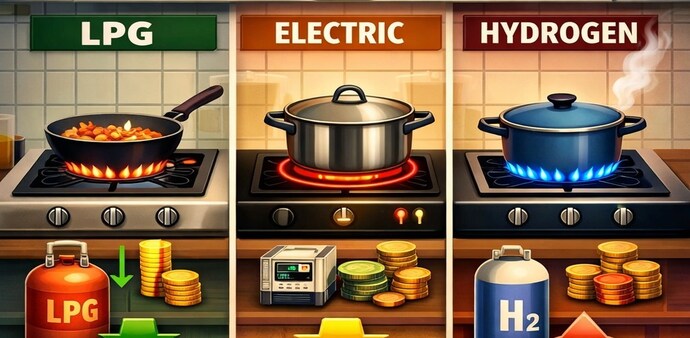
Estimated monthly cost: 900 to 1,200
Advantage
Easily available across India Works without electricity Familiar and simple to use
Disadvantage
Prices fluctuate Requires regular refills Safety concerns if not handled properly
Electric cooking: Growing in urban homes
Electric cooking, especially through induction cooktops, is becoming more common in cities. It is clean, easy to maintain, and removes the need to book gas cylinders.
Induction stoves are also energy efficient, as they heat utensils directly instead of wasting heat.
However, the total cost depends on electricity tariffs, which vary from state to state.
Estimated monthly cost: 700 to 1,100
Advantage
Can be cheaper than LPG in some areas No refilling required Safer in terms of no gas leaks
Disadvantage
Depends on electricity supply Not ideal during power cuts Requires compatible utensils
Hydrogen cooking: A future possibility
Hydrogen stoves are still in the early stages and are not widely available for household use yet. The idea is simple, use hydrogen as a clean fuel that produces only water as a byproduct.
Some companies and researchers are testing hydrogen based cooking systems, but they are not yet ready for mass adoption in India.
Costs are also unclear at this stage because the technology is still developing.
Estimated monthly cost: Not available yet
Advantage
Clean and environmentally friendly Could reduce dependence on fossil fuels
Disadvantage
Not commercially available High setup and infrastructure requirements Cost still uncertain
So, which is cheapest in 2026
Based on current trends, electric cooking can be slightly cheaper than LPG in cities with stable and affordable electricity.
LPG remains the most practical and reliable option for most households, especially where electricity is inconsistent.
Hydrogen is not yet a realistic choice for everyday use.
What should you do?
For now, there is no one size fits all answer.
If you live in a city with a stable power supply, electric cooking can help reduce monthly costs.
If you face frequent power cuts, LPG is still the safer and more dependable option.
Hydrogen is something to watch for the future, but not something to switch to today.
India’s kitchens are at a turning point. While LPG continues to dominate, alternatives like electric and hydrogen cooking are slowly gaining attention. But in 2026, the choice still comes down to a balance of cost, convenience, and reliability.
As household expenses continue to rise, many Indian families are taking a closer look at what it costs to run their kitchens every month. Cooking fuel, once a routine expense, is now under scrutiny as newer options enter the market and traditional ones become more expensive.
From LPG cylinders that have steadily become costlier to the growing shift towards induction cooktops in urban homes, and even conversations around hydrogen as a future fuel, the way India cooks is slowly changing.
The focus is no longer just on convenience, but on finding the most cost effective option.
For decades, LPG has remained the backbone of Indian kitchens, reliable, widely available, and easy to use. But with improving electricity supply in cities and the introduction of alternative technologies, households are beginning to rethink their choices.
So where does each option stand in 2026
LPG: Still the most practical choice
LPG (Liquefied Petroleum Gas) continues to be the primary cooking fuel for millions of Indian households. It remains widely available and does not depend on electricity, making it reliable even in areas that face power cuts.
However, prices have steadily increased over the years. In most cities, a domestic LPG cylinder costs between 900 and 1,100. For a small to medium family, one cylinder usually lasts around 25 to 30 days.
Estimated monthly cost: 900 to 1,200
Advantage
Easily available across India Works without electricity Familiar and simple to use
Disadvantage
Prices fluctuate Requires regular refills Safety concerns if not handled properly
Electric cooking: Growing in urban homes
Electric cooking, especially through induction cooktops, is becoming more common in cities. It is clean, easy to maintain, and removes the need to book gas cylinders.
Induction stoves are also energy efficient, as they heat utensils directly instead of wasting heat.
However, the total cost depends on electricity tariffs, which vary from state to state.
Estimated monthly cost: 700 to 1,100
Advantage
Can be cheaper than LPG in some areas No refilling required Safer in terms of no gas leaks
Disadvantage
Depends on electricity supply Not ideal during power cuts Requires compatible utensils
Hydrogen cooking: A future possibility
Hydrogen stoves are still in the early stages and are not widely available for household use yet. The idea is simple, use hydrogen as a clean fuel that produces only water as a byproduct.
Some companies and researchers are testing hydrogen based cooking systems, but they are not yet ready for mass adoption in India.
Costs are also unclear at this stage because the technology is still developing.
Estimated monthly cost: Not available yet
Advantage
Clean and environmentally friendly Could reduce dependence on fossil fuels
Disadvantage
Not commercially available High setup and infrastructure requirements Cost still uncertain
So, which is cheapest in 2026
Based on current trends, electric cooking can be slightly cheaper than LPG in cities with stable and affordable electricity.
LPG remains the most practical and reliable option for most households, especially where electricity is inconsistent.
Hydrogen is not yet a realistic choice for everyday use.
What should you do?
For now, there is no one size fits all answer.
If you live in a city with a stable power supply, electric cooking can help reduce monthly costs.
If you face frequent power cuts, LPG is still the safer and more dependable option.
Hydrogen is something to watch for the future, but not something to switch to today.
India’s kitchens are at a turning point. While LPG continues to dominate, alternatives like electric and hydrogen cooking are slowly gaining attention. But in 2026, the choice still comes down to a balance of cost, convenience, and reliability.