
MNF's secret plan to blow up Pakistan embassy: What Zoramthanga reveals in new memoir
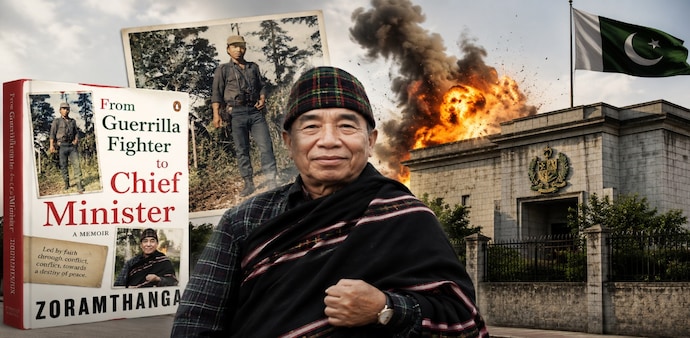
Pakistan's ISI sheltered MNF President Laldenga for four years in Islamabad. But there came a point when the MNF even plotted to blow up Pakistan's embassy in Kathmandu, Zoramthanga reveals in memoir - From Guerrilla Fighter To Chief Minister.
- Jun 7, 2026,
- Updated Jun 7, 2026 10:13 AM IST
Long before peace returned to Mizoram, the state was caught in an insurgency that lasted nearly two decades. The conflict began when the Mizo National Front (MNF), then an underground outfit that later evolved into a political party, opposed Mizoram's inclusion in India. The tensions with New Delhi escalated after the MNF declared independence in March 1966.
The MNF first sought support from Pakistan and then from China. Both countries provided arms, training, and financial assistance to the insurgent outfit.
"We are not the government, but we can do many things. We can give you arms and ammunition as much as you require - it depends only on how much you can take," an ISI Major General once told visiting MNF delegates in Dhaka.
The ISI did provide arms and ammunition in batches as the MNF stepped up the insurgency.
Pakistan's ISI even sheltered MNF's President Laldenga for four years in Islamabad. But there came a point when the MNF even plotted to blow up Pakistan's embassy in Kathmandu.
Zoramthanga, a former MNF guerrilla, Laldenga's one-time secretary, and a three-time chief minister of Mizoram, recounts the episode in his memoir - From Guerrilla Fighter To Chief Minister.
The memoir that came out this April traces the root cause of the insurgency, support from Islamabad and Beijing, and peace talks with New Delhi that eventually resulted in the Peace Accord in June 1986.
"As a first step, we will give you AK-47 rifles, 40 mm rocket launchers, light machine guns, grenades, and ammunition sufficient for 3000 personnel. Over and above these, we will give you as many as you can take," the Chinese side said this to the MNF delegation during a visit to Peking (now Beijing) in September 1970. Zoramthanga was part of this delegation.
Laldenga in Islamabad, meeting with Bhutto
After the fighting began, MNF set up its headquarters in Rangamati in the Chittagong Hill Tracts in East Pakistan. Laldenga operated from there. However, after East Pakistan became Bangladesh and Sheikh Mujibur Rahman took charge in 1971, it became difficult for the MNF to carry out anti-India operations.
The MNF had to shift its base, and Denga decided on Islamabad.
"By the time we came to Islamabad in March 1972, the ISI officials arranged everything to ensure our stay was comfortable," Zoramthanga writes, adding that he and Lal Denga requested a meeting with President ZA Bhutto.
When Denga and Zoramthanga met him in Bhutto's Islamabad official residence, Bhutto was accompanied by Lt Gen Gilani, Director General of the ISI.
"Laldenga first expressed his happiness and satisfaction with the ISI for arranging our stay comfortably," Zoramthanga says. "He then went on to explain in detail how, after the fall of Dhaka and the surrender of Gen Niazi, we — the MNF forces — managed to escape through the torturous and trackless forests of Arakan, how we fought our way through Akyab and Rangoon, and how at last we managed to come to Karachi."
While Laldenga thanked Pakistan, he also had one grievance against the government under General Yahya Khan.
According to the book, Laldenga told Bhutto that China had given arms for 3,000 soldiers through Pakistan, but those were not handed over to the MNF. Bhutto said to Gen Gilani, "We also receive arms from China. We can give the Mizo army from our share, and we can take their share from China. Isn't it?" Gen Gilani nodded, saying, "Yes, that's it."
Bhutto said he was amazed and wondered why it had not been allowed. He then assured, "Now, you have become our guests and old friends. First, take rest in Islamabad; then let’s see what we can do for future development."
Plan to blow up Pakistan's embassy in Nepal
Zoramthanga maintains that the MNF was clear from the start that it wanted a peaceful resolution with New Delhi. And before Laldenga left East Pakistan, the former chief minister notes, the MNF leaders had a "final discussion that our next main political agenda was to find the best way to resume the stalled talks with the Indian Central government."
While in Pakistan, Zoramthanga made secret visits to India's Kabul embassy to open a channel for peace talks with New Delhi. After a few rounds of talks in Kabul, both sides decided to hold the next round of talks in Geneva.
On 14 August 1975, Laldenga, his wife, and Zoramthanga took a flight from Lahore to Karachi, and then, in a Pakistan International Airlines aircraft, headed towards Geneva.
In Geneva, Laldenga and Zoramthanga met with Indian officials. To achieve a real breakthrough for a peace agreement, they concluded, conducting secret talks in foreign countries was not enough. "We needed to consult our leaders from the underground headquarters and, with them, work out proposals for further talks with the Central government."
To do this, Laldenga and Zoramthanga had to go to Delhi. But before that, they had to return to Islamabad, and from there, they were to wait for directions from New Delhi. And if MNF's proposals were approved by New Delhi, Laldenga, his family, and his staff would leave Pakistan.
However, Zoramthanga writes that he feared that if Laldenga's visit and contacts were discovered by the ISI, "we would all be in trouble."
"Pakistan had made it clear from the beginning that they could not involve themselves in any peaceful agreement with India," the former chief minister recalls. "Once they realised that we were engaged in peace talks with India, they would take strong exception—perhaps put us under house arrest and destroy all the progress made with India."
Considering this, Zoramthanga concluded that he would not return to Pakistan. What if Pakistan arrested Laldenga? The former insurgent leader began preparing for this eventuality. And the plan went like this: If Laldenga were indeed arrested or placed under house arrest, New Delhi would let Zoramthanga enter India. He would then go to the underground headquarters and bring with him five or six selected MNF men, he writes. The MNF men would then proceed to Kathmandu and storm the Pakistan Embassy.
"Collecting all the embassy staff at gunpoint, we would send news to the press and to the Pakistan government, declaring: 'The Mizo people want peace with India; the underground MNF leaders also want peace; and the Central government also wants peace. But because the Pakistan government has incarcerated Mr Laldenga by force, the peace agreement cannot be finalized. Now, Mr Laldenga and his family are living in Satellite Town, Rawalpindi, near Islamabad. Unless the Pakistan government brings them to Delhi, we will blow up the Pakistan Embassy and all its staff by suicide bombing.'"
To convert that plan into reality, Zoramthanga was to remain stationed in Europe. After working out all arrangements, Laldenga, his wife, and Zoramthanga took a flight to Rome. While Laldenga and his wife departed for Islamabad, Zoramthanga stayed back in Rome.
"I stayed back to do two things: one was to wait for their return from Islamabad with their family and other staff, and the other was to carry out the Kathmandu Mission if they could not come back as planned," the former chief minister writes.
This plan never had to be carried out as Laldenga quietly slipped out of Pakistan in August 1975 for Cologne, Germany. Zoramthanga, too, was now in Germany.
After months in Germany awaiting clearance from New Delhi, Laldenga, his family, and Zoramthanga boarded an Air India flight to India on 24 January 1976. They landed in Delhi on 26 January.
While Laldenga had made it to Delhi, peace was still a decade away. The talks repeatedly broke down, and tensions escalated to the point where Laldenga was first placed under house arrest and later jailed by Prime Minister Morarji Desai's government. He was released after Indira Gandhi returned to power. After years of setbacks, failed negotiations, and twists & turns, the MNF and the Centre finally signed the historic Mizoram Peace Accord in June 1986.
Long before peace returned to Mizoram, the state was caught in an insurgency that lasted nearly two decades. The conflict began when the Mizo National Front (MNF), then an underground outfit that later evolved into a political party, opposed Mizoram's inclusion in India. The tensions with New Delhi escalated after the MNF declared independence in March 1966.
The MNF first sought support from Pakistan and then from China. Both countries provided arms, training, and financial assistance to the insurgent outfit.
"We are not the government, but we can do many things. We can give you arms and ammunition as much as you require - it depends only on how much you can take," an ISI Major General once told visiting MNF delegates in Dhaka.
The ISI did provide arms and ammunition in batches as the MNF stepped up the insurgency.
Pakistan's ISI even sheltered MNF's President Laldenga for four years in Islamabad. But there came a point when the MNF even plotted to blow up Pakistan's embassy in Kathmandu.
Zoramthanga, a former MNF guerrilla, Laldenga's one-time secretary, and a three-time chief minister of Mizoram, recounts the episode in his memoir - From Guerrilla Fighter To Chief Minister.
The memoir that came out this April traces the root cause of the insurgency, support from Islamabad and Beijing, and peace talks with New Delhi that eventually resulted in the Peace Accord in June 1986.
"As a first step, we will give you AK-47 rifles, 40 mm rocket launchers, light machine guns, grenades, and ammunition sufficient for 3000 personnel. Over and above these, we will give you as many as you can take," the Chinese side said this to the MNF delegation during a visit to Peking (now Beijing) in September 1970. Zoramthanga was part of this delegation.
Laldenga in Islamabad, meeting with Bhutto
After the fighting began, MNF set up its headquarters in Rangamati in the Chittagong Hill Tracts in East Pakistan. Laldenga operated from there. However, after East Pakistan became Bangladesh and Sheikh Mujibur Rahman took charge in 1971, it became difficult for the MNF to carry out anti-India operations.
The MNF had to shift its base, and Denga decided on Islamabad.
"By the time we came to Islamabad in March 1972, the ISI officials arranged everything to ensure our stay was comfortable," Zoramthanga writes, adding that he and Lal Denga requested a meeting with President ZA Bhutto.
When Denga and Zoramthanga met him in Bhutto's Islamabad official residence, Bhutto was accompanied by Lt Gen Gilani, Director General of the ISI.
"Laldenga first expressed his happiness and satisfaction with the ISI for arranging our stay comfortably," Zoramthanga says. "He then went on to explain in detail how, after the fall of Dhaka and the surrender of Gen Niazi, we — the MNF forces — managed to escape through the torturous and trackless forests of Arakan, how we fought our way through Akyab and Rangoon, and how at last we managed to come to Karachi."
While Laldenga thanked Pakistan, he also had one grievance against the government under General Yahya Khan.
According to the book, Laldenga told Bhutto that China had given arms for 3,000 soldiers through Pakistan, but those were not handed over to the MNF. Bhutto said to Gen Gilani, "We also receive arms from China. We can give the Mizo army from our share, and we can take their share from China. Isn't it?" Gen Gilani nodded, saying, "Yes, that's it."
Bhutto said he was amazed and wondered why it had not been allowed. He then assured, "Now, you have become our guests and old friends. First, take rest in Islamabad; then let’s see what we can do for future development."
Plan to blow up Pakistan's embassy in Nepal
Zoramthanga maintains that the MNF was clear from the start that it wanted a peaceful resolution with New Delhi. And before Laldenga left East Pakistan, the former chief minister notes, the MNF leaders had a "final discussion that our next main political agenda was to find the best way to resume the stalled talks with the Indian Central government."
While in Pakistan, Zoramthanga made secret visits to India's Kabul embassy to open a channel for peace talks with New Delhi. After a few rounds of talks in Kabul, both sides decided to hold the next round of talks in Geneva.
On 14 August 1975, Laldenga, his wife, and Zoramthanga took a flight from Lahore to Karachi, and then, in a Pakistan International Airlines aircraft, headed towards Geneva.
In Geneva, Laldenga and Zoramthanga met with Indian officials. To achieve a real breakthrough for a peace agreement, they concluded, conducting secret talks in foreign countries was not enough. "We needed to consult our leaders from the underground headquarters and, with them, work out proposals for further talks with the Central government."
To do this, Laldenga and Zoramthanga had to go to Delhi. But before that, they had to return to Islamabad, and from there, they were to wait for directions from New Delhi. And if MNF's proposals were approved by New Delhi, Laldenga, his family, and his staff would leave Pakistan.
However, Zoramthanga writes that he feared that if Laldenga's visit and contacts were discovered by the ISI, "we would all be in trouble."
"Pakistan had made it clear from the beginning that they could not involve themselves in any peaceful agreement with India," the former chief minister recalls. "Once they realised that we were engaged in peace talks with India, they would take strong exception—perhaps put us under house arrest and destroy all the progress made with India."
Considering this, Zoramthanga concluded that he would not return to Pakistan. What if Pakistan arrested Laldenga? The former insurgent leader began preparing for this eventuality. And the plan went like this: If Laldenga were indeed arrested or placed under house arrest, New Delhi would let Zoramthanga enter India. He would then go to the underground headquarters and bring with him five or six selected MNF men, he writes. The MNF men would then proceed to Kathmandu and storm the Pakistan Embassy.
"Collecting all the embassy staff at gunpoint, we would send news to the press and to the Pakistan government, declaring: 'The Mizo people want peace with India; the underground MNF leaders also want peace; and the Central government also wants peace. But because the Pakistan government has incarcerated Mr Laldenga by force, the peace agreement cannot be finalized. Now, Mr Laldenga and his family are living in Satellite Town, Rawalpindi, near Islamabad. Unless the Pakistan government brings them to Delhi, we will blow up the Pakistan Embassy and all its staff by suicide bombing.'"
To convert that plan into reality, Zoramthanga was to remain stationed in Europe. After working out all arrangements, Laldenga, his wife, and Zoramthanga took a flight to Rome. While Laldenga and his wife departed for Islamabad, Zoramthanga stayed back in Rome.
"I stayed back to do two things: one was to wait for their return from Islamabad with their family and other staff, and the other was to carry out the Kathmandu Mission if they could not come back as planned," the former chief minister writes.
This plan never had to be carried out as Laldenga quietly slipped out of Pakistan in August 1975 for Cologne, Germany. Zoramthanga, too, was now in Germany.
After months in Germany awaiting clearance from New Delhi, Laldenga, his family, and Zoramthanga boarded an Air India flight to India on 24 January 1976. They landed in Delhi on 26 January.
While Laldenga had made it to Delhi, peace was still a decade away. The talks repeatedly broke down, and tensions escalated to the point where Laldenga was first placed under house arrest and later jailed by Prime Minister Morarji Desai's government. He was released after Indira Gandhi returned to power. After years of setbacks, failed negotiations, and twists & turns, the MNF and the Centre finally signed the historic Mizoram Peace Accord in June 1986.