
'MoD should partner with Skyroot': Ex-Army Commander wants Indian military to dominate LEO surveillance
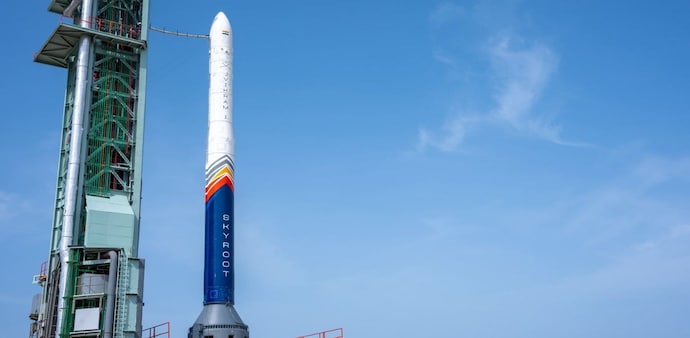
Vikram-1 lifted off from ISRO's Satish Dhawan Space Centre on July 18 under Mission Aagaman, marking India's first successful orbital launch by a private company from Indian soil
- Jul 20, 2026,
- Updated Jul 20, 2026 4:13 PM IST
India's successful launch of Vikram-1, the country's first privately developed orbital rocket, has triggered calls from senior retired military officers for the Ministry of Defence (MoD) to back the emerging private space sector with dedicated funding and strategic partnerships.
Former Army Commander Lt Gen Raj Shukla (Retd) on Saturday urged the government to allocate ₹1,000 crore from the defence budget to Skyroot Aerospace and leverage its launch capability for military applications.
Don't Miss: 'I joined ISRO at Rs 35,000 salary': Skyroot CEO's message to students dreaming of aerospace
"MoD should partner with Skyroot. Allocate 1000 crores from the MoD budget. Dominate the LEO Space for Persistent Surveillance and Offensive ISR," Shukla wrote in a post on X.
Call For Military Use Of Private Space Capability
Shukla's remarks came days after Skyroot Aerospace successfully launched Vikram-1 from the Satish Dhawan Space Centre, becoming the first private Indian company to place payloads into orbit from Indian soil.
The retired Army commander argued that India should use the breakthrough to strengthen its military presence in Low Earth Orbit (LEO) through persistent surveillance and offensive intelligence, surveillance, and reconnaissance (ISR) capabilities.
His comments reflect growing calls to integrate India's rapidly expanding private space ecosystem into the country's defence strategy.
Must Watch: “Average Age Just 28”: PM Modi Hails Skyroot Team Behind India’s New Space Milestone
'Lost Opportunity Due To Lack Of Vision'
Backing Shukla's proposal, retired Lieutenant General PR Shankar said he had advocated a similar approach years ago.
"I had suggested something like this to the previous COAS in IITM when he was the VCOAS and Agnikul was in an advanced stage. I made this video on #Skyroot and #Agnikul yesterday...while it showcases our growing prowess...it is also a reminder of our lost opportunity due to lack of vision," Shankar said.
Separately, Maj Gen Ajay Seth congratulated Skyroot Aerospace, calling the launch a landmark achievement for India's startup ecosystem. He said that after the US and China, India is third to have launch capability in the private sector. "Stupendous achievement," he wrote on X.
Why Vikram-1 Matters
Vikram-1 lifted off from ISRO's Satish Dhawan Space Centre on July 18 under Mission Aagaman, marking India's first successful orbital launch by a private company from Indian soil.
Developed by Skyroot Aerospace, the four-stage launch vehicle can carry 350 kg of payload into Low Earth Orbit (LEO). Built using an all-carbon composite structure, solid-fuel boosters, and a 3D-printed liquid engine, the rocket represents a milestone for India's private space industry.
The mission placed two satellites — SCOPE and Grahaa — into orbit while carrying additional payloads for in-orbit experiments. Customer payloads also included DCUBED's technology demonstration payload and Cosmoserve Space's Embrace, a robotic arm designed to capture orbital debris.
Private Space Push After 2020 Reforms
The Centre opened the space ecosystem to private players in 2020. Since then, startups have entered launch vehicle development, satellite manufacturing, and space applications, supported by ISRO and IN-SPACe.
Skyroot had earlier conducted the successful suborbital launch of Vikram-S in November 2022 before developing Vikram-1 as its first orbital launch vehicle.
India's successful launch of Vikram-1, the country's first privately developed orbital rocket, has triggered calls from senior retired military officers for the Ministry of Defence (MoD) to back the emerging private space sector with dedicated funding and strategic partnerships.
Former Army Commander Lt Gen Raj Shukla (Retd) on Saturday urged the government to allocate ₹1,000 crore from the defence budget to Skyroot Aerospace and leverage its launch capability for military applications.
Don't Miss: 'I joined ISRO at Rs 35,000 salary': Skyroot CEO's message to students dreaming of aerospace
"MoD should partner with Skyroot. Allocate 1000 crores from the MoD budget. Dominate the LEO Space for Persistent Surveillance and Offensive ISR," Shukla wrote in a post on X.
Call For Military Use Of Private Space Capability
Shukla's remarks came days after Skyroot Aerospace successfully launched Vikram-1 from the Satish Dhawan Space Centre, becoming the first private Indian company to place payloads into orbit from Indian soil.
The retired Army commander argued that India should use the breakthrough to strengthen its military presence in Low Earth Orbit (LEO) through persistent surveillance and offensive intelligence, surveillance, and reconnaissance (ISR) capabilities.
His comments reflect growing calls to integrate India's rapidly expanding private space ecosystem into the country's defence strategy.
Must Watch: “Average Age Just 28”: PM Modi Hails Skyroot Team Behind India’s New Space Milestone
'Lost Opportunity Due To Lack Of Vision'
Backing Shukla's proposal, retired Lieutenant General PR Shankar said he had advocated a similar approach years ago.
"I had suggested something like this to the previous COAS in IITM when he was the VCOAS and Agnikul was in an advanced stage. I made this video on #Skyroot and #Agnikul yesterday...while it showcases our growing prowess...it is also a reminder of our lost opportunity due to lack of vision," Shankar said.
Separately, Maj Gen Ajay Seth congratulated Skyroot Aerospace, calling the launch a landmark achievement for India's startup ecosystem. He said that after the US and China, India is third to have launch capability in the private sector. "Stupendous achievement," he wrote on X.
Why Vikram-1 Matters
Vikram-1 lifted off from ISRO's Satish Dhawan Space Centre on July 18 under Mission Aagaman, marking India's first successful orbital launch by a private company from Indian soil.
Developed by Skyroot Aerospace, the four-stage launch vehicle can carry 350 kg of payload into Low Earth Orbit (LEO). Built using an all-carbon composite structure, solid-fuel boosters, and a 3D-printed liquid engine, the rocket represents a milestone for India's private space industry.
The mission placed two satellites — SCOPE and Grahaa — into orbit while carrying additional payloads for in-orbit experiments. Customer payloads also included DCUBED's technology demonstration payload and Cosmoserve Space's Embrace, a robotic arm designed to capture orbital debris.
Private Space Push After 2020 Reforms
The Centre opened the space ecosystem to private players in 2020. Since then, startups have entered launch vehicle development, satellite manufacturing, and space applications, supported by ISRO and IN-SPACe.
Skyroot had earlier conducted the successful suborbital launch of Vikram-S in November 2022 before developing Vikram-1 as its first orbital launch vehicle.