


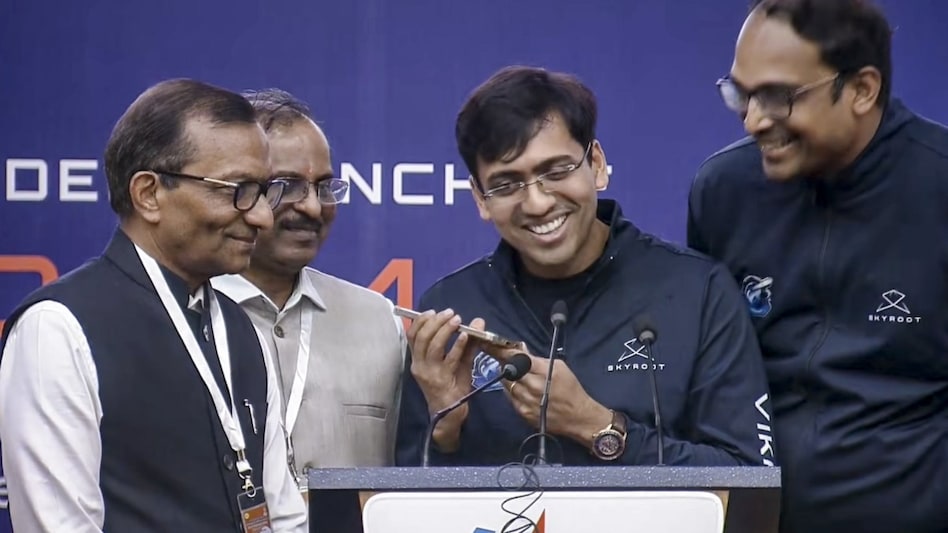
 Skyroot Aerospace co-founder and CEO Pawan Kumar Chandana
Nearly three weeks before Skyroot Aerospace successfully launched Vikram-1, India's first privately built orbital rocket, co-founder and Chief Executive Officer Pawan Chandana revealed that he had joined ISRO on a monthly salary of just Rs 35,000.
Chandana, who holds a dual degree (B.Tech and M.Tech) in Mechanical Engineering from IIT Kharagpur, worked as a scientist at ISRO from September 2012 to June 2018 before co-founding Skyroot Aerospace.

 Setback for IT giants: US suspends Microsoft, Infosys, TCS, Wipro, HCL from green card programme
 NPCI likely to defer UPI MDR rollout, announcement expected on Friday: Report
 Trump says US will not attack Iran before November 3 midterm elections, blockade to continue
 No UPI MDR discussion at GST Council meet; rates unchanged, ITC protection among key takeaways
 Trump to honour Elon Musk, Nvidia's Jensen Huang with US' top science and technology medals
 Trump Under Pressure To Crack Down On Russia’s Oil ‘Shadow Fleet’ Before Octtober 18
 RBI Forex Reserves Crash $50 Billion In A Month! Why Is The Rupee Still Under Pressure?
 Why E-Commerce And Internet Could Be India’s Next Big Consumption Growth Story
 Stock Market | D Street Under Pressure | Where Do Markets Go From Here?
 What Are REITs? Is This The Best Way To Invest In Real Estate? Investment Guide | Money Today
 Market extends fall as Nifty hits 52-week low; investors lose nearly Rs 13 lakh crore in two days
 TCS adds 4,258 employees in Q2, marks third quarter of headcount addition
  Exit Ola Electric stock, switch to ICICI Lombard: Analyst
 Recovery in Max Healthcare stock depends on easing of regulation fears: Analyst
 Rs 4,341 cr dividend payout bonanza! TCS declares Q2 dividend; check record date & payment date
 Fastest-growing Asian economies in 2026: Taiwan leads, India among top performers Trump to honour Elon Musk, Nvidia's Jensen Huang with US' top science and technology medalsNPCI likely to defer UPI MDR rollout, announcement expected on Friday: Report
 Apple teases October 13 launch with 'Welcome home' message: What to expectTrump says US will not attack Iran before November 3 midterm elections, blockade to continue












