
'More optics than substance': Brahma Chellaney on Modi–Xi talks in Tianjin
The absence of tangible outcomes was papered over with rhetorical flourishes, says Brahma Chellaney
- Aug 31, 2025,
- Updated Aug 31, 2025 4:30 PM IST
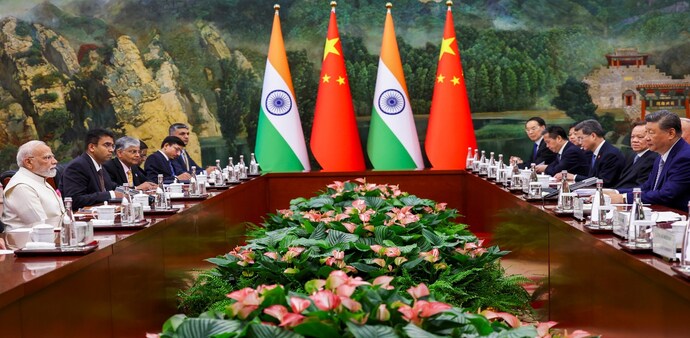
Prime Minister Narendra Modi's bilateral meeting with Chinese President Xi Jinping on the sidelines of the Shanghai Cooperation Organisation (SCO) summit in Tianjin drew criticism from geostrategist Brahma Chellaney, who said the engagement produced "more optics than substance."
"Despite the two leaders' upbeat public messaging, there was no progress on the core disputes over security, trade, and the border that continue to bedevil the relationship," Chellaney said on Sunday. He added that "the absence of tangible outcomes was papered over with rhetorical flourishes - claims that 'it is the right choice for India and China to be friends,' that cooperation 'would foster global well-being,' and that neither views the other as a rival."
The Ministry of External Affairs (MEA), in its official statement, stated areas of agreement. According to the statement, Modi and Xi welcomed the positive momentum and steady progress in bilateral relations since their last meeting in Kazan in October 2024 and reaffirmed that the two countries were development partners and not rivals.
The statement underlined that both sides saw a stable relationship and cooperation between their 2.8 billion citizens as essential for their development and for shaping a multipolar world and Asia.
On the sensitive border issue, the MEA noted Modi had underlined the importance of peace and tranquility. Both leaders expressed satisfaction at the disengagement of troops at friction points completed in 2024 and reaffirmed commitment to a "fair, reasonable, and mutually acceptable" resolution of the boundary question. They also acknowledged recent talks between their Special Representatives and pledged continued support for that process.
The two leaders discussed expanding people-to-people links, including through direct flights and visa facilitation, and pointed to the resumption of the Kailash Mansarovar Yatra and tourist visas. On trade, they recognised their economies’ role in stabilizing global commerce and agreed to explore ways of reducing India’s persistent trade deficit with China. Modi stressed that both countries pursued strategic autonomy and that their bilateral ties should not be seen through the lens of a third country.
In addition to multilateral issues such as terrorism and fair trade, Modi voiced India's support for China's SCO presidency and formally invited Xi to attend the BRICS summit that India will host in 2026. Xi thanked him and assured support for India's presidency. Modi also met Cai Qi, a member of the Politburo Standing Committee of the Communist Party of China, to discuss strengthening exchanges in line with the consensus reached at the leaders’ meeting.
Prime Minister Narendra Modi's bilateral meeting with Chinese President Xi Jinping on the sidelines of the Shanghai Cooperation Organisation (SCO) summit in Tianjin drew criticism from geostrategist Brahma Chellaney, who said the engagement produced "more optics than substance."
"Despite the two leaders' upbeat public messaging, there was no progress on the core disputes over security, trade, and the border that continue to bedevil the relationship," Chellaney said on Sunday. He added that "the absence of tangible outcomes was papered over with rhetorical flourishes - claims that 'it is the right choice for India and China to be friends,' that cooperation 'would foster global well-being,' and that neither views the other as a rival."
The Ministry of External Affairs (MEA), in its official statement, stated areas of agreement. According to the statement, Modi and Xi welcomed the positive momentum and steady progress in bilateral relations since their last meeting in Kazan in October 2024 and reaffirmed that the two countries were development partners and not rivals.
The statement underlined that both sides saw a stable relationship and cooperation between their 2.8 billion citizens as essential for their development and for shaping a multipolar world and Asia.
On the sensitive border issue, the MEA noted Modi had underlined the importance of peace and tranquility. Both leaders expressed satisfaction at the disengagement of troops at friction points completed in 2024 and reaffirmed commitment to a "fair, reasonable, and mutually acceptable" resolution of the boundary question. They also acknowledged recent talks between their Special Representatives and pledged continued support for that process.
The two leaders discussed expanding people-to-people links, including through direct flights and visa facilitation, and pointed to the resumption of the Kailash Mansarovar Yatra and tourist visas. On trade, they recognised their economies’ role in stabilizing global commerce and agreed to explore ways of reducing India’s persistent trade deficit with China. Modi stressed that both countries pursued strategic autonomy and that their bilateral ties should not be seen through the lens of a third country.
In addition to multilateral issues such as terrorism and fair trade, Modi voiced India's support for China's SCO presidency and formally invited Xi to attend the BRICS summit that India will host in 2026. Xi thanked him and assured support for India's presidency. Modi also met Cai Qi, a member of the Politburo Standing Committee of the Communist Party of China, to discuss strengthening exchanges in line with the consensus reached at the leaders’ meeting.