
'No bloody corridor, hold elections by December': Bangladesh Army chief's ultimatum to Yunus
The national interest must come first in any action. Whatever is done must be guided by political consensus, the army chief said.
- May 22, 2025,
- Updated May 22, 2025 8:22 PM IST
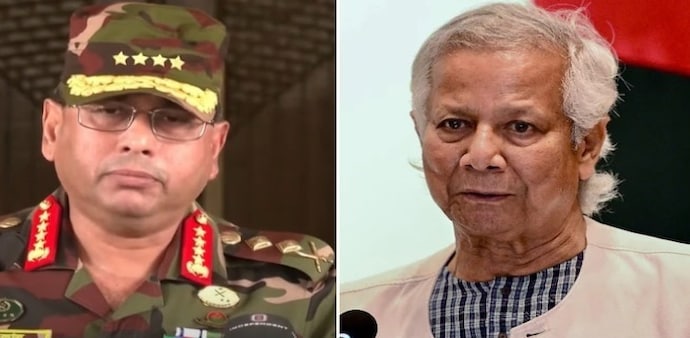
Bangladesh's Army Chief General Waker-Uz-Zaman has reportedly delivered a direct warning to interim chief Muhammad Yunus: hold national elections by December. At a closed-door military durbar this week, the Army chief also shut down the Yunus government's proposed "humanitarian" corridor to Myanmar's Rakhine State, calling it a "bloody corridor" and a threat to national sovereignty.
"The Bangladesh Army will never be involved in any activity that is harmful to sovereignty. Nor will anyone be allowed to do so," Zaman said, according to Dhaka Tribune. "National interest must come first in any action. Whatever is done must be guided by political consensus."
The corridor, backed by the UN and reportedly pushed by the United States, was announced unilaterally in April by Foreign Adviser Touhid Hossain. It aimed to deliver aid to Rakhine through Bangladesh's Chattogram Division, where over a million Rohingya refugees have already settled amid ongoing violence in Myanmar. The plan quickly sparked criticism from opposition parties like the BNP and Left groups, who termed it "unilateral and illegal".
Critics also accused the Yunus government of allowing foreign interference under the pretext of humanitarianism. "In reality, the US and UN initiative has substantial, multifaceted security concerns, including a severe risk to sovereignty for Bangladesh and Myanmar," said an opinion piece in Dhaka Tribune. "There are fears that humanitarian aid could be used as a pretext for foreign influence, and this corridor could serve as a channel for military logistics or intelligence."
The article also added that China's Belt and Road Initiative has substantial infrastructure developments in Rakhine, such as the Kyaukphyu Port. Despite its ostensibly humanitarian purpose, it pointed, the humanitarian corridor may be perceived by China as a conduit for Western powers to access an area of strategic importance.
Following the Army's intervention, National Security Adviser Khalilur Rahman, a close Yunus ally, reversed course. "The UN only asked if Bangladesh could assist in sending humanitarian aid near the border, to be delivered to the Rakhine state by UN partners. We said we can consider,” Rahman clarified to The Daily Star, denying any formal agreement on the corridor.
This retreat is the latest flashpoint in the rapidly deteriorating relationship between Yunus and General Waker. While Waker did not oppose Yunus during the post-Hasina transition in August 2024, the two are now deeply at odds over governance and foreign policy. Reports suggest that the army chief is upset with Yunus as the latter is unwilling and delaying elections on one pretext or the other.
Yunus, appointed to lead a reform-oriented interim government after student protests toppled Sheikh Hasina, has delayed elections and released hundreds of convicted Islamist radicals and nearly 300 Bangladesh Rifles mutineers — moves that have outraged the military. The BDR mutineers were convicted of killing 57 officers in a 2009 uprising, and their release has been championed by groups reportedly close to the Yunus administration, including Hizb-ut-Tahrir.
Tensions escalated further after Yunus' military adviser, Lt Gen Kamrul Hassan, allegedly sought US support to replace General Waker. When Waker attempted to dismiss him, Yunus blocked the order.
At the recent military durbar, General Waker stated, “The right to shape the nation's future belongs to an elected government.” He reiterated that key decisions like port operations, legal reforms, and any humanitarian corridors must not be taken without military consultation and a political mandate.
He also warned against rising unrest. "Violence and chaos in the name of mass mobilization will no longer be tolerated,” the general said, suggesting a tougher military stance on public disorder as political tensions rise.
Bangladesh's Army Chief General Waker-Uz-Zaman has reportedly delivered a direct warning to interim chief Muhammad Yunus: hold national elections by December. At a closed-door military durbar this week, the Army chief also shut down the Yunus government's proposed "humanitarian" corridor to Myanmar's Rakhine State, calling it a "bloody corridor" and a threat to national sovereignty.
"The Bangladesh Army will never be involved in any activity that is harmful to sovereignty. Nor will anyone be allowed to do so," Zaman said, according to Dhaka Tribune. "National interest must come first in any action. Whatever is done must be guided by political consensus."
The corridor, backed by the UN and reportedly pushed by the United States, was announced unilaterally in April by Foreign Adviser Touhid Hossain. It aimed to deliver aid to Rakhine through Bangladesh's Chattogram Division, where over a million Rohingya refugees have already settled amid ongoing violence in Myanmar. The plan quickly sparked criticism from opposition parties like the BNP and Left groups, who termed it "unilateral and illegal".
Critics also accused the Yunus government of allowing foreign interference under the pretext of humanitarianism. "In reality, the US and UN initiative has substantial, multifaceted security concerns, including a severe risk to sovereignty for Bangladesh and Myanmar," said an opinion piece in Dhaka Tribune. "There are fears that humanitarian aid could be used as a pretext for foreign influence, and this corridor could serve as a channel for military logistics or intelligence."
The article also added that China's Belt and Road Initiative has substantial infrastructure developments in Rakhine, such as the Kyaukphyu Port. Despite its ostensibly humanitarian purpose, it pointed, the humanitarian corridor may be perceived by China as a conduit for Western powers to access an area of strategic importance.
Following the Army's intervention, National Security Adviser Khalilur Rahman, a close Yunus ally, reversed course. "The UN only asked if Bangladesh could assist in sending humanitarian aid near the border, to be delivered to the Rakhine state by UN partners. We said we can consider,” Rahman clarified to The Daily Star, denying any formal agreement on the corridor.
This retreat is the latest flashpoint in the rapidly deteriorating relationship between Yunus and General Waker. While Waker did not oppose Yunus during the post-Hasina transition in August 2024, the two are now deeply at odds over governance and foreign policy. Reports suggest that the army chief is upset with Yunus as the latter is unwilling and delaying elections on one pretext or the other.
Yunus, appointed to lead a reform-oriented interim government after student protests toppled Sheikh Hasina, has delayed elections and released hundreds of convicted Islamist radicals and nearly 300 Bangladesh Rifles mutineers — moves that have outraged the military. The BDR mutineers were convicted of killing 57 officers in a 2009 uprising, and their release has been championed by groups reportedly close to the Yunus administration, including Hizb-ut-Tahrir.
Tensions escalated further after Yunus' military adviser, Lt Gen Kamrul Hassan, allegedly sought US support to replace General Waker. When Waker attempted to dismiss him, Yunus blocked the order.
At the recent military durbar, General Waker stated, “The right to shape the nation's future belongs to an elected government.” He reiterated that key decisions like port operations, legal reforms, and any humanitarian corridors must not be taken without military consultation and a political mandate.
He also warned against rising unrest. "Violence and chaos in the name of mass mobilization will no longer be tolerated,” the general said, suggesting a tougher military stance on public disorder as political tensions rise.