
'No such offer was made': Centre denies report claiming Bhutan turned down E20 petrol from India
'No such offer was made': Centre denies report claiming Bhutan turned down E20 petrol from India
'No such offer has been made by the Oil Marketing Companies, and there is no proposal for export of E20 petrol to Bhutan,' says the Ministry of Petroleum and Natural Gas
Business Today Desk
- Jul 5, 2026,
- Updated Jul 5, 2026 12:01 PM IST
The Ministry of Petroleum and Natural Gas (MoPNG) on Sunday dismissed reports claiming Bhutan had declined an offer from India to import E20 petrol, saying no such proposal had ever been made.
In a fact-check statement, the ministry said reports suggesting Bhutan had turned down ethanol-blended fuel from India were "incorrect".
Advertisement
"Claims that Bhutan declined an offer to import E20 petrol from India are incorrect," the ministry said. "No such offer has been made by the Oil Marketing Companies (OMCs), and there is no proposal for export of E20 petrol to Bhutan."
The ministry also urged the public to rely only on official information. "Please rely only on official information from MoPNG and the Oil Marketing Companies."
Don't Miss | Centre debunks E20 myths & concerns, cites tests on engine safety and water use
Reports Claimed Bhutan Declined E20 Fuel
Advertisement
The clarification came days after reports suggested Bhutan had declined an offer from Indian Oil Marketing Companies (OMCs) to supply E20 petrol.
According to local media reports, the Himalayan kingdom's concerns were not about ethanol-blended fuel itself but about its ability to safely store it.
A report by The Bhutanese said Bhutan's fuel storage infrastructure was inadequate to handle E20 petrol because ethanol readily absorbs moisture, making storage more demanding than conventional petrol.
Storage Infrastructure Cited As Concern
According to the report, ethanol's hygroscopic nature means it can absorb water from the atmosphere.
If moisture enters storage tanks, ethanol-blended fuel can separate into different layers, reducing fuel quality and potentially affecting engine performance.
The report said Bhutan considered this a particular challenge because many of its fuel storage facilities are located in mountainous regions, where seepage and moisture intrusion are difficult to prevent.
Advertisement
Storage tanks in such terrain are more vulnerable to water contamination, increasing the risk of fuel degradation before the fuel reaches consumers.
The concerns were cited by officials familiar with the discussions, according to The Bhutanese.
India's E20 Rollout
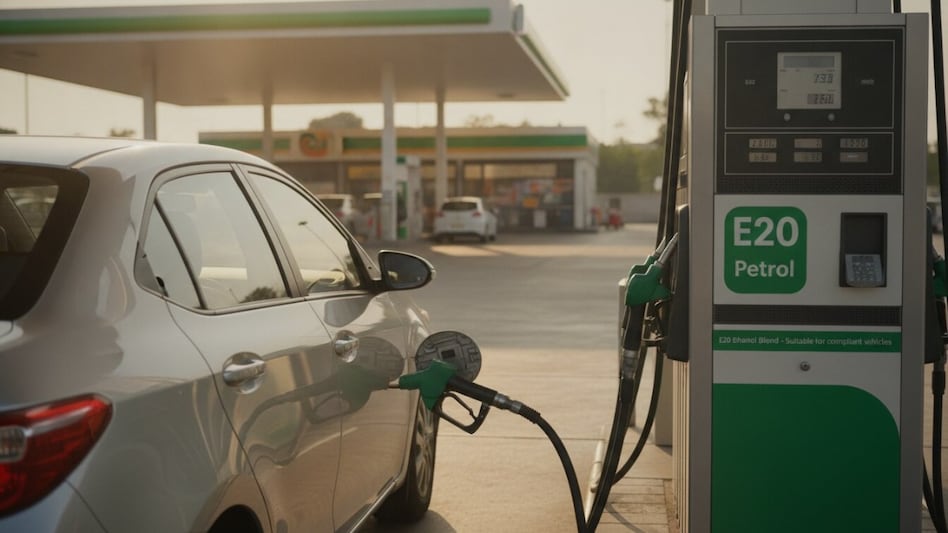
India has accelerated its ethanol blending programme to reduce crude oil imports, cut emissions and boost domestic biofuel production. E20 petrol, which contains 20 per cent ethanol, has been rolled out across the country as part of the government's clean fuel transition.
The Ministry of Petroleum and Natural Gas (MoPNG) on Sunday dismissed reports claiming Bhutan had declined an offer from India to import E20 petrol, saying no such proposal had ever been made.
In a fact-check statement, the ministry said reports suggesting Bhutan had turned down ethanol-blended fuel from India were "incorrect".
Advertisement
"Claims that Bhutan declined an offer to import E20 petrol from India are incorrect," the ministry said. "No such offer has been made by the Oil Marketing Companies (OMCs), and there is no proposal for export of E20 petrol to Bhutan."
The ministry also urged the public to rely only on official information. "Please rely only on official information from MoPNG and the Oil Marketing Companies."
Don't Miss | Centre debunks E20 myths & concerns, cites tests on engine safety and water use
Reports Claimed Bhutan Declined E20 Fuel
Advertisement
The clarification came days after reports suggested Bhutan had declined an offer from Indian Oil Marketing Companies (OMCs) to supply E20 petrol.
According to local media reports, the Himalayan kingdom's concerns were not about ethanol-blended fuel itself but about its ability to safely store it.
A report by The Bhutanese said Bhutan's fuel storage infrastructure was inadequate to handle E20 petrol because ethanol readily absorbs moisture, making storage more demanding than conventional petrol.
Storage Infrastructure Cited As Concern
According to the report, ethanol's hygroscopic nature means it can absorb water from the atmosphere.
If moisture enters storage tanks, ethanol-blended fuel can separate into different layers, reducing fuel quality and potentially affecting engine performance.
The report said Bhutan considered this a particular challenge because many of its fuel storage facilities are located in mountainous regions, where seepage and moisture intrusion are difficult to prevent.
Advertisement
Storage tanks in such terrain are more vulnerable to water contamination, increasing the risk of fuel degradation before the fuel reaches consumers.
The concerns were cited by officials familiar with the discussions, according to The Bhutanese.
India's E20 Rollout
India has accelerated its ethanol blending programme to reduce crude oil imports, cut emissions and boost domestic biofuel production. E20 petrol, which contains 20 per cent ethanol, has been rolled out across the country as part of the government's clean fuel transition.
Read more!