
‘Now that India has signed…’: India-Israel FTA may be finalised this year, says Israeli envoy
"At the end of February, actually two weeks from now, we plan to have a round of negotiations," said the Israeli envoy about India-Israel FTA.
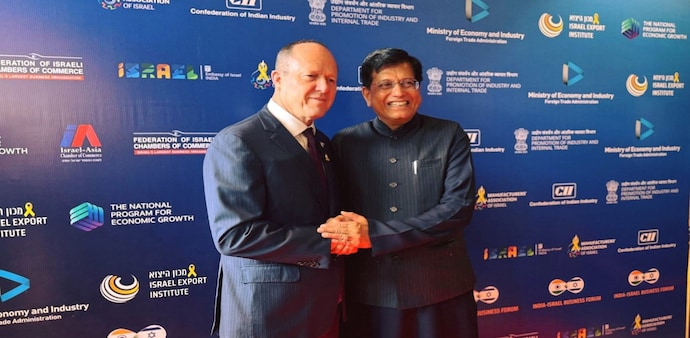
- Feb 13, 2026,
- Updated Feb 13, 2026 9:00 AM IST
Having signed the Terms of Reference for the free trade agreement (FTA) between India and Israel during Commerce Minister Piyush Goyal’s Tel Aviv, the two countries are planning to finalise the deal this year, said Ambassador of Israel to India, Reuven Azar.
Azar said that an Israeli delegation will come to India, and the deal will be negotiated in two phases.
"We have signed the Terms of Reference (ToR) for the free trade agreement during the visit of Minister Piyush Goyal. At the end of February, actually two weeks from now, we plan to have a round of negotiations. A delegation from Israel will come to India to engage. We are thinking of having this in two stages, to first concentrate on the sort of low-hanging fruit and then go to the tougher issues,” said Azar.
The envoy added: “But the intention is to try to finalise it this year, now that India has already signed agreements with the main big markets, with the EU, the United States, the UAE, Australia, New Zealand, and Britain."
Goyal, in November last year, led a 60-member business delegation. He and Israeli Economy and Industry Minister Nir Barkat agreed that the first phase of discussion would tackle areas where agreement is easily possible, something the envoy reiterated.
The commerce minister said they would not touch the ‘sensitive issues’ at the outset. "It is quite possible that we may come out with the first phase on an FTA, so that we can kickstart the benefits faster," he had said.
According to the Embassy of India in Israel, India and Israel established diplomatic relations in 1992. In 1992, trade between the two countries was valued at US$ 200 million, mainly in diamonds. Over the years, trade has diversified and reached a peak of $10.77 billion in the financial year 2022-23, excluding defence. However, in the financial years 2023-24 and 2024-25, bilateral trade excluding defence declined to $6.53 billion and $3.75 billion respectively.
Having signed the Terms of Reference for the free trade agreement (FTA) between India and Israel during Commerce Minister Piyush Goyal’s Tel Aviv, the two countries are planning to finalise the deal this year, said Ambassador of Israel to India, Reuven Azar.
Azar said that an Israeli delegation will come to India, and the deal will be negotiated in two phases.
"We have signed the Terms of Reference (ToR) for the free trade agreement during the visit of Minister Piyush Goyal. At the end of February, actually two weeks from now, we plan to have a round of negotiations. A delegation from Israel will come to India to engage. We are thinking of having this in two stages, to first concentrate on the sort of low-hanging fruit and then go to the tougher issues,” said Azar.
The envoy added: “But the intention is to try to finalise it this year, now that India has already signed agreements with the main big markets, with the EU, the United States, the UAE, Australia, New Zealand, and Britain."
Goyal, in November last year, led a 60-member business delegation. He and Israeli Economy and Industry Minister Nir Barkat agreed that the first phase of discussion would tackle areas where agreement is easily possible, something the envoy reiterated.
The commerce minister said they would not touch the ‘sensitive issues’ at the outset. "It is quite possible that we may come out with the first phase on an FTA, so that we can kickstart the benefits faster," he had said.
According to the Embassy of India in Israel, India and Israel established diplomatic relations in 1992. In 1992, trade between the two countries was valued at US$ 200 million, mainly in diamonds. Over the years, trade has diversified and reached a peak of $10.77 billion in the financial year 2022-23, excluding defence. However, in the financial years 2023-24 and 2024-25, bilateral trade excluding defence declined to $6.53 billion and $3.75 billion respectively.