
Operation Sindoor: Satellite images show dome pierced, Lashkar base destroyed in Bahawalpur & Muridke
Operation Sindoor: Satellite images show dome pierced, Lashkar base destroyed in Bahawalpur & Muridke
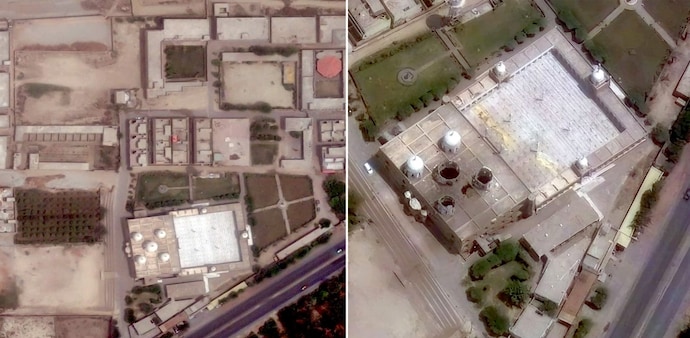
Captured by Maxar Technologies, the post-strike satellite visuals offer clear before-and-after comparisons of two major sites, Bahawalpur and Muridke
Business Today Desk
- May 8, 2025,
- Updated May 8, 2025 9:39 AM IST
A day after India launched precision strikes on terror camps across Pakistan and Pakistan-occupied Kashmir in retaliation for the April 22 Pahalgam terror attack, the first set of satellite images has surfaced, showing direct hits and extensive destruction at key militant hubs.
Captured by Maxar Technologies, the post-strike satellite visuals offer clear before-and-after comparisons of two major sites, Bahawalpur and Muridke, known to host operations of Jaish-e-Mohammed (JeM) and Lashkar-e-Taiba (LeT) respectively.
Advertisement
One of the most striking images reveals that Indian missiles pierced the dome of the Subham Allah mosque in Bahawalpur, a location often linked to Jaish-e-Mohammed's activities. The structural damage in the aftermath confirms a direct precision strike.
In Muridke, the satellite imagery shows the complete destruction of a Lashkar-e-Taiba facility, adding to what officials are calling a decisive and targeted response to the terror attack in Pahalgam that killed 26 people, mostly tourists.
Operation Sindoor: India’s largest cross-border strike since Balakot
Advertisement
In the early hours of Wednesday, India carried out its most extensive cross-border operation since Balakot, striking nine high-value terror sites across Pakistan and PoK. The entire mission, codenamed Operation Sindoor, was executed in just 25 minutes, and involved a multi-domain offensive using air, naval, and ground-based assets.
The strikes were launched under the cover of darkness, with Indian intelligence having vetted the locations based on confirmed terrorist activity and infrastructure.
According to top government sources, over 80 terrorists affiliated with banned outfits, JeM, LeT, and Hizbul Mujahideen, were killed in the attack. The strikes were "measured, precise, and intelligence-driven," the government said in a briefing following the operation.
Officials said the intent was not just retaliatory, but to deliver a clear message of India’s capacity and resolve in responding to terror threats, especially after an attack as brazen as the one in Pahalgam.
Advertisement
A day after India launched precision strikes on terror camps across Pakistan and Pakistan-occupied Kashmir in retaliation for the April 22 Pahalgam terror attack, the first set of satellite images has surfaced, showing direct hits and extensive destruction at key militant hubs.
Captured by Maxar Technologies, the post-strike satellite visuals offer clear before-and-after comparisons of two major sites, Bahawalpur and Muridke, known to host operations of Jaish-e-Mohammed (JeM) and Lashkar-e-Taiba (LeT) respectively.
Advertisement
One of the most striking images reveals that Indian missiles pierced the dome of the Subham Allah mosque in Bahawalpur, a location often linked to Jaish-e-Mohammed's activities. The structural damage in the aftermath confirms a direct precision strike.
In Muridke, the satellite imagery shows the complete destruction of a Lashkar-e-Taiba facility, adding to what officials are calling a decisive and targeted response to the terror attack in Pahalgam that killed 26 people, mostly tourists.
Operation Sindoor: India’s largest cross-border strike since Balakot
Advertisement
In the early hours of Wednesday, India carried out its most extensive cross-border operation since Balakot, striking nine high-value terror sites across Pakistan and PoK. The entire mission, codenamed Operation Sindoor, was executed in just 25 minutes, and involved a multi-domain offensive using air, naval, and ground-based assets.
The strikes were launched under the cover of darkness, with Indian intelligence having vetted the locations based on confirmed terrorist activity and infrastructure.
According to top government sources, over 80 terrorists affiliated with banned outfits, JeM, LeT, and Hizbul Mujahideen, were killed in the attack. The strikes were "measured, precise, and intelligence-driven," the government said in a briefing following the operation.
Officials said the intent was not just retaliatory, but to deliver a clear message of India’s capacity and resolve in responding to terror threats, especially after an attack as brazen as the one in Pahalgam.
Advertisement
Read more!