
Pakistan Air Force launches airstrikes on Khyber Pakhtunkhwa village, at least 30 dead: Reports
Earlier, on September 13-14, at least 31 TTP militants were killed in two separate encounters in Khyber Pakhtunkhwa.
- Sep 22, 2025,
- Updated Sep 22, 2025 2:34 PM IST
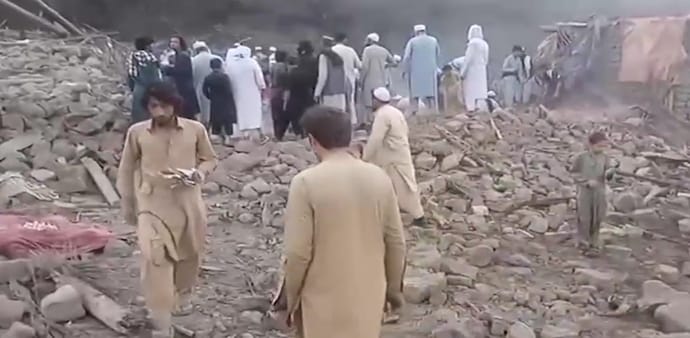
The Pakistan Air Force launched airstrikes in Khyber Pakhtunkhwa on Monday, leaving at least 30 people dead, among them women and children. At least eight LS-6 bombs were dropped from JF-17 fighter jets on Matre Dara, a Pashtun-majority village, at around 2 am. The explosions destroyed large parts of the settlement. Several people were also injured, though official confirmation was awaited, news agency PTI reported.
Local media said the Air Force was targeting Tehreek-e-Taliban Pakistan (TTP) hideouts in the area. However, all those killed were civilians.
The strike comes amid a series of military operations in the province, which borders Afghanistan. On Sunday, the army announced that seven TTP members had been killed in an intelligence-based operation in Dera Ismail Khan district. According to the Inter-Services Public Relations (ISPR), three of the dead were Afghan nationals, and two were suicide bombers.
Earlier, on September 13-14, at least 31 TTP militants were killed in two separate encounters in Khyber Pakhtunkhwa.
Pakistan has recently seen an increase in attacks, particularly in provinces along the Afghan border. Last week, Prime Minister Shehbaz Sharif said Afghanistan must decide whether to support militant groups or work with Pakistan.
Following Operation Sindoor, which destroyed nine militant hideouts across Pakistan and Pakistan-occupied Kashmir (PoK), groups like Jaish-e-Mohammed (JeM) and Hizbul Mujahideen (HM) are reportedly shifting their bases deeper into Khyber Pakhtunkhwa.
The province’s rugged terrain and closeness to the Afghan border offer concealment, with many hideouts tracing back to the anti-Soviet war of the 1980s and the US-led invasion of Afghanistan after 9/11.
The Pakistan Air Force launched airstrikes in Khyber Pakhtunkhwa on Monday, leaving at least 30 people dead, among them women and children. At least eight LS-6 bombs were dropped from JF-17 fighter jets on Matre Dara, a Pashtun-majority village, at around 2 am. The explosions destroyed large parts of the settlement. Several people were also injured, though official confirmation was awaited, news agency PTI reported.
Local media said the Air Force was targeting Tehreek-e-Taliban Pakistan (TTP) hideouts in the area. However, all those killed were civilians.
The strike comes amid a series of military operations in the province, which borders Afghanistan. On Sunday, the army announced that seven TTP members had been killed in an intelligence-based operation in Dera Ismail Khan district. According to the Inter-Services Public Relations (ISPR), three of the dead were Afghan nationals, and two were suicide bombers.
Earlier, on September 13-14, at least 31 TTP militants were killed in two separate encounters in Khyber Pakhtunkhwa.
Pakistan has recently seen an increase in attacks, particularly in provinces along the Afghan border. Last week, Prime Minister Shehbaz Sharif said Afghanistan must decide whether to support militant groups or work with Pakistan.
Following Operation Sindoor, which destroyed nine militant hideouts across Pakistan and Pakistan-occupied Kashmir (PoK), groups like Jaish-e-Mohammed (JeM) and Hizbul Mujahideen (HM) are reportedly shifting their bases deeper into Khyber Pakhtunkhwa.
The province’s rugged terrain and closeness to the Afghan border offer concealment, with many hideouts tracing back to the anti-Soviet war of the 1980s and the US-led invasion of Afghanistan after 9/11.