
‘Pakistan finds ways to stay relevant to its three godfathers’: Ex-diplomat says Islamabad is gaming US’ attitude
The former diplomat said that Pakistan has been offered a package of transactions by the US, including cryptocurrency, critical minerals, exploration rights on petroleum and also some things relevant to CENTCOM for counterterrorism.
- Sep 26, 2025,
- Updated Sep 26, 2025 4:17 PM IST
While a few years back, US President Donald Trump accused Pakistan of deceiving Washington that spent $33 billion on the Pakistani army, he now seems to think it is governed by two great leaders, PM Shehbaz Sharif and army chief Asim Munir. That drastic change has much to do with Islamabad’s capability to remain relevant to its “three godfathers” as well as play the game, said Former High Commissioner of India to Pakistan, Poland, Canada and Lithuania, Ajay Bisaria.
Speaking at the session, ‘India, US, and the Geopolitical Shifts’, on Day 2 of India Today Conclave Mumbai, Bisaria said, “Trump 2.0 is a completely different game compared to Trump 1.0. He governs more from the right. He's governed more by the MAGA (Make America Great Again) ideologues and so on. And the Pakistan story is part of it. It's part of transactionalism. Now on Pakistan's part, it's gaming this United States attitude. And for Pakistan, the big picture story is that its foreign policy, apart from having an element of wanting revisionism on Kashmir, is one of trying to remain relevant in different ways to its three godfathers globally, which are the US, China and Saudi Arabia. It does it in different shapes and forms and in varying degrees of success.”
“In the recent past it managed to persuade the United States that the Pakistan army is distinct from the civilians. That Pakistan could be of use. In 2018, on January 1, Trump had tweeted that all he got from Pakistan was lies and deceit after spending $33 billion on the Pakistan army in the previous 15 years,” said Bisaria.
The former diplomat said that Pakistan has been offered a package of transactions by the US, including cryptocurrency, critical minerals, exploration rights on petroleum and also some things relevant to CENTCOM (United States Central Command) for counterterrorism.
“Pakistan in a drip drip drip way keeps handing over some terrorists to the US,” said Bisaria. He added that the US now sees the possibility of basing rights in Pakistan and Bagram air base in Afghanistan. “So all this little package along with the sweetener of a ‘we nominate you for the Nobel Prize’ is what gets Asim Munir an audience,” said the former diplomat.
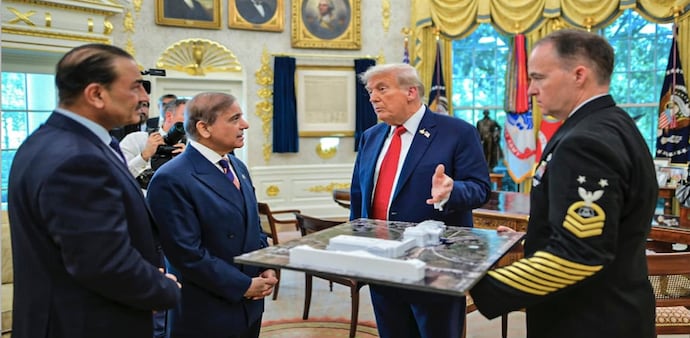
Referring to Asim Munir and Shehbaz Sharif’s meeting with Trump at the Oval Office, Bisaria said there was no media because the Pakistanis do not like to be exposed to the media.
Separately, Pakistani computer scientist, academic and CEO at AISight, Umar Saif, also reflected on the vast change in the attitude towards Islamabad – although he seemed to think that’s because of their “competency”. He said a few years ago Pakistan was ostracised internationally, the US President was not even ready to pick the phone, Saudis were deeply offended by them and China had downgraded it to a deputy mayor. “Fast forward today, and Pakistan is undoubtedly a star of international diplomacy. This is what negotiating from a position of strength looks like ... and what good, competent, consistent diplomacy can deliver. Well done!” he said.
While a few years back, US President Donald Trump accused Pakistan of deceiving Washington that spent $33 billion on the Pakistani army, he now seems to think it is governed by two great leaders, PM Shehbaz Sharif and army chief Asim Munir. That drastic change has much to do with Islamabad’s capability to remain relevant to its “three godfathers” as well as play the game, said Former High Commissioner of India to Pakistan, Poland, Canada and Lithuania, Ajay Bisaria.
Speaking at the session, ‘India, US, and the Geopolitical Shifts’, on Day 2 of India Today Conclave Mumbai, Bisaria said, “Trump 2.0 is a completely different game compared to Trump 1.0. He governs more from the right. He's governed more by the MAGA (Make America Great Again) ideologues and so on. And the Pakistan story is part of it. It's part of transactionalism. Now on Pakistan's part, it's gaming this United States attitude. And for Pakistan, the big picture story is that its foreign policy, apart from having an element of wanting revisionism on Kashmir, is one of trying to remain relevant in different ways to its three godfathers globally, which are the US, China and Saudi Arabia. It does it in different shapes and forms and in varying degrees of success.”
“In the recent past it managed to persuade the United States that the Pakistan army is distinct from the civilians. That Pakistan could be of use. In 2018, on January 1, Trump had tweeted that all he got from Pakistan was lies and deceit after spending $33 billion on the Pakistan army in the previous 15 years,” said Bisaria.
The former diplomat said that Pakistan has been offered a package of transactions by the US, including cryptocurrency, critical minerals, exploration rights on petroleum and also some things relevant to CENTCOM (United States Central Command) for counterterrorism.
“Pakistan in a drip drip drip way keeps handing over some terrorists to the US,” said Bisaria. He added that the US now sees the possibility of basing rights in Pakistan and Bagram air base in Afghanistan. “So all this little package along with the sweetener of a ‘we nominate you for the Nobel Prize’ is what gets Asim Munir an audience,” said the former diplomat.
Referring to Asim Munir and Shehbaz Sharif’s meeting with Trump at the Oval Office, Bisaria said there was no media because the Pakistanis do not like to be exposed to the media.
Separately, Pakistani computer scientist, academic and CEO at AISight, Umar Saif, also reflected on the vast change in the attitude towards Islamabad – although he seemed to think that’s because of their “competency”. He said a few years ago Pakistan was ostracised internationally, the US President was not even ready to pick the phone, Saudis were deeply offended by them and China had downgraded it to a deputy mayor. “Fast forward today, and Pakistan is undoubtedly a star of international diplomacy. This is what negotiating from a position of strength looks like ... and what good, competent, consistent diplomacy can deliver. Well done!” he said.