
PM Modi inaugurates first Hindu stone temple in Abu Dhabi; know all about the grand temple
The Hindu temple, built on a 27-acre site in Abu Mreikhah, has been constructed using ancient architectural methods clubbed with scientific techniques.
- Feb 14, 2024,
- Updated Feb 14, 2024 7:59 PM IST
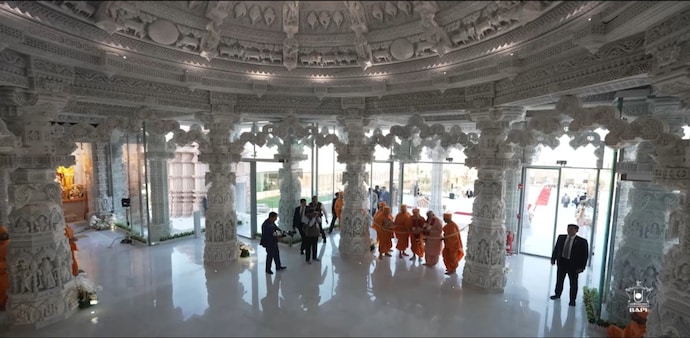
Prime Minister Narendra Modi inaugurated the first Hindu stone temple in Abu Dhabi on Wednesday. After inaugurating the temple, the Prime Minister offered puja and performed Aarti at the BAPS Mandir. The temple, built on a 27-acre site in Abu Mreikhah, has been constructed using ancient architectural methods clubbed with scientific techniques.
- It has been built with over 300 high-tech sensors to measure temperature and monitor seismic activity, no metal has been used in the construction of the temple, and fly ash has been used to fill up the foundation.
- The grand temple has been built by the BAPS Swaminarayan Sanstha at a cost of around Rs 700 crore. The temple has been built as per an ancient style of construction and creation mentioned in the Shilpa and Sthapathya Shastras, Hindu scriptures which describe the art of mandir design and construction.
- The structure has a prayer hall with the capacity to hold 3,000 people; a community centre; an exhibition hall; a library; and a children’s park. The temple stands tall at 108 feet, being crowned with seven shikhars (spires) each representing one of the seven emirates of the UAE.
- The temple, surrounded by meticulously crafted ghats and features of the Ganga and Yamuna rivers, has two central domes -- 'Dome of Harmony' and ‘Dome of Peace'. Its entrance is marked by eight idols, which symbolises the eight values foundational to Sanatana Dharma.
- The main temple is constructed on a raft foundation using UAE's largest single pour of unreinforced fly ash concrete, said construction firm Shapoorji Pallonji. "Instead of iron and steel reinforcements, bamboo sticks and glass fibre were used."
- The temple façade is built on this foundation, using 40,000 cubic meters of marble from Italy and 1,80,000 cubic meters of pink sandstone from Rajasthan. Thousands of artisans and volunteers intricately carved the stones in Rajasthan, for BAPS. These were then put together in Abu Dhabi like a giant jigsaw puzzle.
- "The architectural methods have been clubbed with scientific techniques. Over 300 high-tech sensors have been installed at every level of the temple to measure temperature, pressure, and movement (seismic activity). The sensors will provide live data for research. If there is any earthquake in the region, the temple will detect it, and we will be able to study," Swami Brahmaviharidas, head of international relations for BAPS, told PTI.
- Fly ash has been used to fill up the foundation, replacing 55 per cent of cement in the concrete mix, reducing the carbon footprint of the temple.
- Madhusudan Patel, the temple's construction manager, told the news agency that they have used heat-resistant nano tiles and heavy glass panels, merging both traditional aesthetic stone structures with modern-day functionality. "Considering the extreme temperatures in UAE, the tiles will be comfortable for visitors to walk even in hot weather. Non-ferrous material has also been used in the temple."
- Eighteen lakh bricks, seven lakh man hours and 1.8 lakh cubic metres of sandstone directly from Rajasthan — Abu Dhabi's first Hindu temple has been made in the Nagara style of architecture, just like the recently inaugurated Ram Temple in Ayodhya.
- Umesh Raja, a volunteer at the temple, said 20,000 tonnes of sandstone pieces were carved in Rajasthan and then shipped to Abu Dhabi in 700 containers. "Not just the stone, many labourers who helped construct the temple over five years belong to Gujarat and Rajasthan. Even the marble mined from Italy was first shipped to India for carving and then back to the UAE to be used in the interiors," he said, adding that 18 lakh bricks have been used in the construction of the temple.
- The work for the structure has been going on since 2019. The land for the temple was donated by the UAE government. The UAE has three other Hindu temples that are located in Dubai. The BAPS temple will be the largest of all in the Gulf region.
Also read: Economics of MSP guarantee: Experts say may be difficult given financial implications
(With inputs from agencies)
Prime Minister Narendra Modi inaugurated the first Hindu stone temple in Abu Dhabi on Wednesday. After inaugurating the temple, the Prime Minister offered puja and performed Aarti at the BAPS Mandir. The temple, built on a 27-acre site in Abu Mreikhah, has been constructed using ancient architectural methods clubbed with scientific techniques.
- It has been built with over 300 high-tech sensors to measure temperature and monitor seismic activity, no metal has been used in the construction of the temple, and fly ash has been used to fill up the foundation.
- The grand temple has been built by the BAPS Swaminarayan Sanstha at a cost of around Rs 700 crore. The temple has been built as per an ancient style of construction and creation mentioned in the Shilpa and Sthapathya Shastras, Hindu scriptures which describe the art of mandir design and construction.
- The structure has a prayer hall with the capacity to hold 3,000 people; a community centre; an exhibition hall; a library; and a children’s park. The temple stands tall at 108 feet, being crowned with seven shikhars (spires) each representing one of the seven emirates of the UAE.
- The temple, surrounded by meticulously crafted ghats and features of the Ganga and Yamuna rivers, has two central domes -- 'Dome of Harmony' and ‘Dome of Peace'. Its entrance is marked by eight idols, which symbolises the eight values foundational to Sanatana Dharma.
- The main temple is constructed on a raft foundation using UAE's largest single pour of unreinforced fly ash concrete, said construction firm Shapoorji Pallonji. "Instead of iron and steel reinforcements, bamboo sticks and glass fibre were used."
- The temple façade is built on this foundation, using 40,000 cubic meters of marble from Italy and 1,80,000 cubic meters of pink sandstone from Rajasthan. Thousands of artisans and volunteers intricately carved the stones in Rajasthan, for BAPS. These were then put together in Abu Dhabi like a giant jigsaw puzzle.
- "The architectural methods have been clubbed with scientific techniques. Over 300 high-tech sensors have been installed at every level of the temple to measure temperature, pressure, and movement (seismic activity). The sensors will provide live data for research. If there is any earthquake in the region, the temple will detect it, and we will be able to study," Swami Brahmaviharidas, head of international relations for BAPS, told PTI.
- Fly ash has been used to fill up the foundation, replacing 55 per cent of cement in the concrete mix, reducing the carbon footprint of the temple.
- Madhusudan Patel, the temple's construction manager, told the news agency that they have used heat-resistant nano tiles and heavy glass panels, merging both traditional aesthetic stone structures with modern-day functionality. "Considering the extreme temperatures in UAE, the tiles will be comfortable for visitors to walk even in hot weather. Non-ferrous material has also been used in the temple."
- Eighteen lakh bricks, seven lakh man hours and 1.8 lakh cubic metres of sandstone directly from Rajasthan — Abu Dhabi's first Hindu temple has been made in the Nagara style of architecture, just like the recently inaugurated Ram Temple in Ayodhya.
- Umesh Raja, a volunteer at the temple, said 20,000 tonnes of sandstone pieces were carved in Rajasthan and then shipped to Abu Dhabi in 700 containers. "Not just the stone, many labourers who helped construct the temple over five years belong to Gujarat and Rajasthan. Even the marble mined from Italy was first shipped to India for carving and then back to the UAE to be used in the interiors," he said, adding that 18 lakh bricks have been used in the construction of the temple.
- The work for the structure has been going on since 2019. The land for the temple was donated by the UAE government. The UAE has three other Hindu temples that are located in Dubai. The BAPS temple will be the largest of all in the Gulf region.
Also read: Economics of MSP guarantee: Experts say may be difficult given financial implications
(With inputs from agencies)