
Rahul Gandhi calls ‘Make in India’ a failure, BJP counters with production, export surge data
Rahul Gandi said India is “importing and assembling” instead of manufacturing; BJP’s Amit Malviya counters with growth figures, jobs, and export data under PLI scheme.
- Jun 21, 2025,
- Updated Jun 21, 2025 2:52 PM IST
Congress MP and Leader of the Opposition in the Lok Sabha, Rahul Gandhi, has criticised the Narendra Modi government’s 'Make in India' initiative, calling it a failure that has failed to deliver manufacturing growth or reduce unemployment. Gandhi claimed the programme, launched in 2014, has not created the promised factory boom and has instead benefited countries like China.
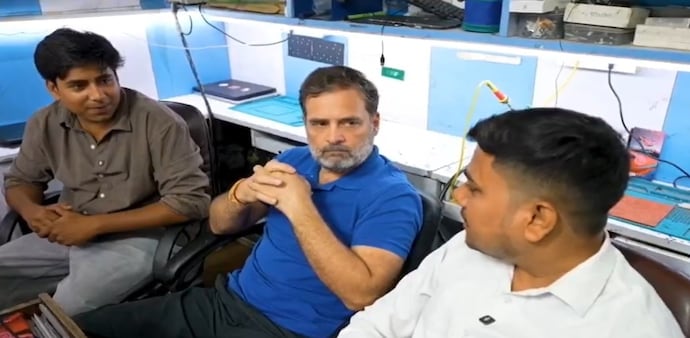
During an interaction with two electronics technicians, Shivam and Saif, at Delhi’s Nehru Place market, Gandhi pointed out that products like mobile phones were being assembled in India with parts imported from abroad. “The truth is stark: we assemble, we import, but we don’t build. China profits,” he said in a video posted on X.
“Make in India promised a factory boom. So why is manufacturing at record lows, youth unemployment at record highs, and why have imports from China more than doubled?” Gandhi asked. He added that manufacturing’s share in the economy had fallen to 14% since 2014, despite repeated slogans and announcements from the government.
He also claimed that the government’s much-publicised Production-Linked Incentive (PLI) schemes were being quietly rolled back. “Modi ji has mastered the art of slogans, not solutions. With no new ideas, Modi ji has surrendered,” the Raebareli MP said.
Gandhi said India needed a fundamental shift in its economic approach — one that empowers small producers through real reforms and financial support. “We must stop being a market for others. If we don’t build here, we’ll keep buying from those who do,” he added.
Responding to Gandhi’s remarks, BJP IT Cell head Amit Malviya said the Congress leader’s claims were misleading and countered them with government data and achievements under the Make in India and PLI initiatives.
“Rahul Gandhi claims that manufacturing is collapsing under Modi’s ‘Make in India’. Let’s bust the myths — with facts,” Malviya posted on X.
According to Malviya:
India is now the world’s second-largest mobile phone producer, up from just two manufacturing units in 2014 to over 300 today.
The PLI scheme has driven cumulative investments of Rs 10,905 crore and production worth Rs 7.15 lakh crore.
Mobile phone exports have surged from Rs 1,566 crore in 2014-15 to Rs 1.2 lakh crore in 2023-24 — a 77-fold jump.
Electronics production value rose from Rs 18,900 crore in FY14 to Rs 4.22 lakh crore in FY24.
Under the PLI scheme for electronics alone, 1,39,670 direct jobs have been created.
99.2% of mobile phones sold in India are now made in India, up from just 26% in 2014-15.
Electronics exports crossed USD 38 billion in FY24-25, a 32% year-on-year increase.
The government has approved semiconductor projects worth Rs 1.52 lakh crore, with a projection of reaching USD 300 billion in electronics production by 2026.
Malviya also highlighted that 1.8 lakh new companies were registered in 2023-24, marking a 16% rise over the previous year — signalling continued industrial and entrepreneurial growth.
Congress MP and Leader of the Opposition in the Lok Sabha, Rahul Gandhi, has criticised the Narendra Modi government’s 'Make in India' initiative, calling it a failure that has failed to deliver manufacturing growth or reduce unemployment. Gandhi claimed the programme, launched in 2014, has not created the promised factory boom and has instead benefited countries like China.
During an interaction with two electronics technicians, Shivam and Saif, at Delhi’s Nehru Place market, Gandhi pointed out that products like mobile phones were being assembled in India with parts imported from abroad. “The truth is stark: we assemble, we import, but we don’t build. China profits,” he said in a video posted on X.
“Make in India promised a factory boom. So why is manufacturing at record lows, youth unemployment at record highs, and why have imports from China more than doubled?” Gandhi asked. He added that manufacturing’s share in the economy had fallen to 14% since 2014, despite repeated slogans and announcements from the government.
He also claimed that the government’s much-publicised Production-Linked Incentive (PLI) schemes were being quietly rolled back. “Modi ji has mastered the art of slogans, not solutions. With no new ideas, Modi ji has surrendered,” the Raebareli MP said.
Gandhi said India needed a fundamental shift in its economic approach — one that empowers small producers through real reforms and financial support. “We must stop being a market for others. If we don’t build here, we’ll keep buying from those who do,” he added.
Responding to Gandhi’s remarks, BJP IT Cell head Amit Malviya said the Congress leader’s claims were misleading and countered them with government data and achievements under the Make in India and PLI initiatives.
“Rahul Gandhi claims that manufacturing is collapsing under Modi’s ‘Make in India’. Let’s bust the myths — with facts,” Malviya posted on X.
According to Malviya:
India is now the world’s second-largest mobile phone producer, up from just two manufacturing units in 2014 to over 300 today.
The PLI scheme has driven cumulative investments of Rs 10,905 crore and production worth Rs 7.15 lakh crore.
Mobile phone exports have surged from Rs 1,566 crore in 2014-15 to Rs 1.2 lakh crore in 2023-24 — a 77-fold jump.
Electronics production value rose from Rs 18,900 crore in FY14 to Rs 4.22 lakh crore in FY24.
Under the PLI scheme for electronics alone, 1,39,670 direct jobs have been created.
99.2% of mobile phones sold in India are now made in India, up from just 26% in 2014-15.
Electronics exports crossed USD 38 billion in FY24-25, a 32% year-on-year increase.
The government has approved semiconductor projects worth Rs 1.52 lakh crore, with a projection of reaching USD 300 billion in electronics production by 2026.
Malviya also highlighted that 1.8 lakh new companies were registered in 2023-24, marking a 16% rise over the previous year — signalling continued industrial and entrepreneurial growth.