
'Redistribution is part of nation-building': Ex-CEA Arvind Subramanian on fiscal tensions with southern India
Subramanian shared the view in a conversation with the Carnegie Endowment alongside Devesh Kapur, his co-author of the new book - A Sixth of Humanity: Independent India’s Development Odyssey
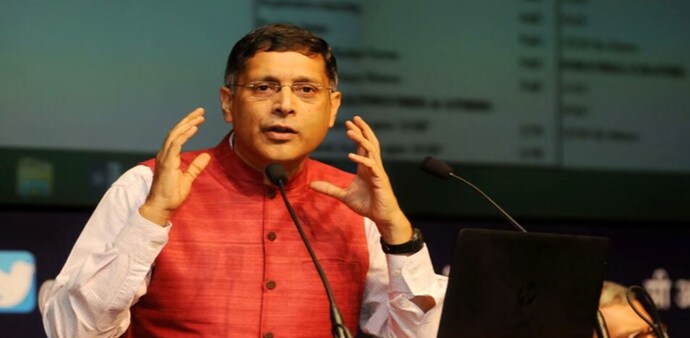
- Oct 26, 2025,
- Updated Oct 26, 2025 9:24 AM IST
Former Chief Economic Adviser Arvind Subramanian has said that some degree of redistribution between richer and poorer states is 'inevitable in any fiscal polity', but warned that the pattern of fiscal transfers must remain politically sustainable as regional imbalances deepen.
Subramanian shared the view in a conversation with the Carnegie Endowment alongside Devesh Kapur, his co-author of the new book - A Sixth of Humanity: Independent India’s Development Odyssey.
The two authors discussed India's evolving fiscal federal framework amid growing resentment among southern states that contribute more to the central tax pool but receive significantly less in return.
"When you have a nation, you want to knit it together, and there are different regions and places, and bring different things to the table," said Subramanian, who previously served as the CEA from 2014 to 2018.
"In response to the incontrovertible thing that we show in the paper - that in terms of fiscal resources, there's more transfer from richer to poorer states - there are other dimensions which we don't go into. For example, Bihar could turn around and say to Tamil Nadu, 'We provide you a cheap labour. Therefore, while you may be transferring fiscal resources, we are transferring human resources.'"
Kapur, who teaches at Johns Hopkins University, added that India's fiscal federalism has always had a political goal in addition to an economic one. "If you take this on per capita terms, it's Jammu and Kashmir and the northeast that get way higher transfers. Now, we know that these are the regions where India's nation-building has had its greatest challenges. There are very good political reasons for that," he said.
Subramanian cautioned against describing India's fiscal framework as an 'internal aid model', a term used by some southern leaders to criticise redistribution. "The biggest 'fiscal donors', as it were, are not the southern states - they're actually the western states and Haryana. Yet, the clamour in India today, at least, is from the southern states, especially Tamil Nadu. So it's clear that the fiscal is only one dimension of the disaffection that's happening," he said.
He argued that while redistribution is necessary, its political sustainability is becoming harder to maintain. "What is becoming more and more problematic in India is that the identity of donors and beneficiaries is kind of fixed, and second, the magnitudes are rising. So, at some point, they become politically unsustainable," he said.
Kapur also recalled how earlier policy choices created regional distortions. "In the early decades, the freight equalisation policy penalised the eastern states - especially Bengal, Bihar, undivided Bihar, and Orissa - and benefited the western and southern states," he said, offering a historical counterpoint to southern India's present-day charge against the Centre.
Southern leaders across party lines have accused the Centre of practising "fiscal discrimination" and undermining the spirit of federalism. Chief ministers from Karnataka, Tamil Nadu, and Kerala argue that despite the South contributing a disproportionately large share of India's taxes, exports, and GDP growth, their states receive a much smaller portion of central funds and infrastructure investments.
Business Standard earlier reported that the five southern states - Tamil Nadu, Kerala, Karnataka, Andhra Pradesh, and Telangana - contribute about 30-35% of the GDP, but receive only around 15% of central tax devolution.
"Fiscal federalism will always have a strong redistributive goal but also a strong political goal, especially for younger and complex federal countries where it is an important instrument of nation-building," Subramanian and Kapur concluded. "The challenge is not to get away from redistribution but to make it more politically sustainable."
Former Chief Economic Adviser Arvind Subramanian has said that some degree of redistribution between richer and poorer states is 'inevitable in any fiscal polity', but warned that the pattern of fiscal transfers must remain politically sustainable as regional imbalances deepen.
Subramanian shared the view in a conversation with the Carnegie Endowment alongside Devesh Kapur, his co-author of the new book - A Sixth of Humanity: Independent India’s Development Odyssey.
The two authors discussed India's evolving fiscal federal framework amid growing resentment among southern states that contribute more to the central tax pool but receive significantly less in return.
"When you have a nation, you want to knit it together, and there are different regions and places, and bring different things to the table," said Subramanian, who previously served as the CEA from 2014 to 2018.
"In response to the incontrovertible thing that we show in the paper - that in terms of fiscal resources, there's more transfer from richer to poorer states - there are other dimensions which we don't go into. For example, Bihar could turn around and say to Tamil Nadu, 'We provide you a cheap labour. Therefore, while you may be transferring fiscal resources, we are transferring human resources.'"
Kapur, who teaches at Johns Hopkins University, added that India's fiscal federalism has always had a political goal in addition to an economic one. "If you take this on per capita terms, it's Jammu and Kashmir and the northeast that get way higher transfers. Now, we know that these are the regions where India's nation-building has had its greatest challenges. There are very good political reasons for that," he said.
Subramanian cautioned against describing India's fiscal framework as an 'internal aid model', a term used by some southern leaders to criticise redistribution. "The biggest 'fiscal donors', as it were, are not the southern states - they're actually the western states and Haryana. Yet, the clamour in India today, at least, is from the southern states, especially Tamil Nadu. So it's clear that the fiscal is only one dimension of the disaffection that's happening," he said.
He argued that while redistribution is necessary, its political sustainability is becoming harder to maintain. "What is becoming more and more problematic in India is that the identity of donors and beneficiaries is kind of fixed, and second, the magnitudes are rising. So, at some point, they become politically unsustainable," he said.
Kapur also recalled how earlier policy choices created regional distortions. "In the early decades, the freight equalisation policy penalised the eastern states - especially Bengal, Bihar, undivided Bihar, and Orissa - and benefited the western and southern states," he said, offering a historical counterpoint to southern India's present-day charge against the Centre.
Southern leaders across party lines have accused the Centre of practising "fiscal discrimination" and undermining the spirit of federalism. Chief ministers from Karnataka, Tamil Nadu, and Kerala argue that despite the South contributing a disproportionately large share of India's taxes, exports, and GDP growth, their states receive a much smaller portion of central funds and infrastructure investments.
Business Standard earlier reported that the five southern states - Tamil Nadu, Kerala, Karnataka, Andhra Pradesh, and Telangana - contribute about 30-35% of the GDP, but receive only around 15% of central tax devolution.
"Fiscal federalism will always have a strong redistributive goal but also a strong political goal, especially for younger and complex federal countries where it is an important instrument of nation-building," Subramanian and Kapur concluded. "The challenge is not to get away from redistribution but to make it more politically sustainable."